Tuesday, March 25, 2014

Anime Boston - Because the Stuff I Wanted to See is Being Trickled Out Slowly

It's been a while since I wrote out a con report.

This is partially because it's not something I've been in the habit of (only really doing two or three any given year), and partially because I just tend to enjoy them on a personal level, rather than an industry level.
Well, with the exception of New York Comic Con in 2012. That was a mix of catching enough generally interesting industry material to report and the fact it felt worth passing along on the long shot anyone might be listening that it was being run with such incredibly poor management as to make the late Joseph Conrad spin in his grave.

To be honest, this one also had a few problems, but was still a very enjoyable con.

So I'll regale you for a bit, but try to keep it brief. One part cause I didn't really get to as many events as I'd been hoping to (for various external reasons, but through no real fault on any part.)

I promise, there will be a review to come in the next couple of days. Won't be a theater run one, but an interesting title nevertheless.

In the meantime, rather than do this one chronologically, let's break this down by the good and bad, shall we?

First, we have the events and panels...

Like I said before, wasn't able to get to too many of these. Largely a consequence of the travel time to and from the con, more focus on catching up with other people and the fact that Saturday was...well...we'll get to that.

Anyway, of the three panels did make it to this year, two of them pretty much had to be at, as I was participating in them. It's not really a shameless plug at this point now that they're over, is it?

First was a discussion on live action anime adaptations that actually aren't bad. Between myself, my girlfriend, and another friend, we put together a pretty solid list of six fairly strong entries that prove the classic perception of all live-action adaptations of Japanese media to be abortions is somewhat exaggerated. The resulting spread was a good mix of comedy, drama, action, and even some fairly creepy thriller elements (watch the 20th Century Boys movies and tell me Friend isn't at least a LITTLE creepy...) Further, thanks to some suggestions from the audience, we got a good spread of titles to consider for if we do this panel again in the future. Cause hey, it's not always gonna be Dragonball: Evolution.

...not that that stopped us from using that as a title image.


Later that day was the one panel I got to just attend as a regular congoer and learn from. The panel was apparently approved at the last minute, which was rather unfortunate, since it was an interesting topic, and from the sound of things drew quite a crowd.
I say 'from the sound of things' because, thanks to the short notice, they got dealt a VERY small room to work with. We were lucky to get seats, but reportedly there was enough of a line outside that con staff had to give the warning that if you got up from your seat to leave, they couldn't guarantee it wouldn't be taken by someone else. Which I can't say I blame them on - with the draw this apparently got and the room they had to work with, they were just doing the best they could with what was available.
The panel itself was initially about the idea of gender identity in anime, which is itself a particularly interesting topic to explore. In particular now as the medium is slowly evolving and (still somewhat slowly) getting better with the handling of transgender (as well as agender and genderfluid) characters. It was quite well-informed and broke down a lot of the depictions in various shows for good and bad, most notably with regards to some of the more awkward stereotypes and misunderstandings the medium has depicted and informed over the years.
From there, the second half of the panel went into how con culture has developed with regards to how it views and treats transgender people. This was equal parts informative and disheartening. For as much as the con culture plays itself up as being inclusive, this is one area where it could stand to do some learning. Fortunately, for what people were able to sit on the panel, the message was largely well received - one rather problematic question asker aside (without going into too much detail, let me just say I found myself muttering the phrase "Dig up" repeatedly. The guy just did NOT realize how much worse he was making his stance by trying to explain it.)
In all, this is a panel I'd like to see developed more for future years. Hopefully in the future the con will be able to give them a bigger room to work with, cause this is a topic that a lot of congoers could benefit from learning more about.

The one photo we were able to get of the panel. Sorry it's not the best quality.


Finally, and a part of Anime Boston that has been a tradition for me for several years now, I took part in the annual panel "All the Mecha You'll Ever Need." As the title suggests, it's our salute to the giant robot genre of anime - with our suggestions for lesser known titles and discussion on topics within ranging from general talking points to recent announcements of new developments, cause this is one type of anime that's pretty regularly rife with new material. It's one of those events I look forward to every year at Anime Boston, and we all have a lot of fun with it each year.

As you can guess at this point, panel photography is also kind of a crapshoot in general.


From here, the next plus in general is the Artist's Alley. These cons are as much about the general social aspect as they are the industry getting to reach out to the fans. In this regard, the Artist's Alley is a big plus here - as it's a chance for a lot of people, some local, some otherwise, to sell their goods and generally converse with other fans. It's also just a very nice area to relax from the crowds in the hallways from time to time. Plus, I will admit this is becoming a part of a tradition for me with regards to one of the booths - Zombie Romance. With each con, artist Kristilyn Stevenson opens up for commissions. Between the two I have done so far, I have the makings of a recurring theme of horror villains slowly growing (I must say, I'm quite impressed with how she handled the rendition of Fluffy, the crate-dwelling monster from George Romero's Creepshow.)
Which leads to the other great thing about the Artist's Alley. It's also a great place to reconnect with people you don't meet up with as often.

Actually, I wound up meeting up with a lot of people this year. Some I was expecting to, others I did not expect. It's probably one of the best parts of the con for me, really. I mean, I go to AB for some of the industry aspects, don't get me wrong. Likewise, some of the guests are pretty awesome (voice actor Richard Epcar is actually a pretty fun guy to talk to with the right topics, though learning how Williams Street treated Lupin III was kind of a shame.) But really, this is one of those cons where, more often than not, I go for the people - for the chance to catch up with people I've not met in a while. It sounds kind of overly sentimental, but Hell with it. It IS a big part of this for me.

The Dealer's Room is another area where that works out for friends as well as purchases. I did catch up with a couple of people there as well, however briefly. I didn't pick up as much this year, admittedly - spent more in the Artists' Alley, though I DID pick up a copy of Vertical's release of Satoshi Kon's manga Tropic of the Sea. Halfway into it right now and I have to say, it's pretty solid so far - though I keep being struck by how much Kon's art reminds me of that of his friend and fellow artist, Katsuhiro Otomo. Still, it serves the story well.
Anyway, I'm getting off topic. Otherwise, it's just fun to sometimes take a spin through there, see some of the stuff, and talk with both friends and just some of the vendors about shared interests (one vendor talked with turned out to be a fan of classic Giant Robo, which was a fun surprise.)
Also, this year I finally confirmed the existence of an item I have been scouring dealer's rooms to find for several cons now: the infamous Kaiyodo Revoltech figure of Woody the cowboy from Toy Story. For those who don't get why this is such an infamous find, the figure was packed with a second face which...well...let's just say if you don't mind losing a bit of sleep, go google the phrase 'Rapeface Woody' to see what the Internet has done with this figure and its gleefully nightmarish rictus grin. I didn't pick it up at this time (cause $50 is a very hard sell for that) but even just seeing it for myself was still pretty well worth it.

This small picture doesn't even begin to do it justice.


Really, for as low-key as this con was for me, there was only one particular downside to it - and to be perfectly fair, that wasn't on the part of the con.

Rather, the security being demonstrated by the Hynes Convention Center and the Prudential Center wound up creating more problems than they solved. Spurred on in particular by problems at last year's con rave, and much more to the point, last year's Boston Marathon, there was a pronounced uptick in security, and especially bag checks this year. This resulted in already long lines becoming even longer - a problem only further aggravated by the decision to hold this year's con in March where other years have held it in late April or May. Given the cold winds this season, most people would stick to the indoor line rather than chance the outdoor entrance, making that interior line that much longer and slower. This got particularly bad on Saturday, where I know at least one person sent a message saying they, and I quote "ragequit the line." On top of that, if that shorter line is any indication, there were the somewhat sporadic metal detector tests. It's the kind of thing where, on the one hand I feel like making everyone take it would have just further slowed the line, but on the other, as it was employed, it really was inconsistent and ultimately kind of pointless.
Along with the logistical problems, it didn't help that the Hynes, despite having hosted this con for over ten years now, wasn't exactly respectful about the whole thing. While my own experience was fairly unremarkable, other congoers reported being openly treated as though they were kids - these being grown adults, mind you - for the fact they were going to this. Now, you don't have to like anime, I can respect that. But really, every other business in the area is good about this - they reach out to the fans in a way that doesn't feel pandering, and they enjoy the extra business the con brings. By comparison, the Hynes and the Sheraton have had some painfully bad promotions and this dismissive attitude by their security staff is surprising. It's not enough to break the con, but for as many years as they've been hosting AB, one would expect a little bit more respect and professionalism by this point.

Ah well...

Next review coming in the next day or two.

Till then!

My girlfriend and I taking a crack at the practice of couples cosplay.
Her part turned out quite well. For myself, I apologize for nothing!

Friday, March 14, 2014

Mobile Suit Gundam III: Encounters In Space - Well THIS is Rare in a Trilogy

It's time for this month's installment for the 35th Anniversary project. I promised the reviews would be back, did I not?

Anyway, after the four month turnaround between movies 1 and 2, the climax of this trilogy would take another six months before hitting Japanese theaters in 1982. This is partially because, of the three movies, this one had the most extra work done on it. And it benefits greatly from the extra work. In fact, this may be one of the rare trilogies I can think of out there where the third part actually winds up being the best.
This is just a minor side note, but it is surprising how most trilogies tend to hit their peak on the first or second part, and how very rarely they save the best for last.

So, much like last time, this movie picks up almost exactly where the second movie left off. As Soldiers of Sorrow left things, the Federation had successfully rolled out their own mobile suit forces and driven Zeon off the Earth. They're now poised for the big win and launching their counterattack to take back space. We start with our protagonists on the White Base, just leaving Earth. With the events of roughly the final twelve episodes to pull from (minus some content the show had given over to one-off Zeonic weapons and characters who mainly arrived to be an enemy of the week) this movie has a pretty straight shot to the finish. Along the way, we also get to see more of the Zeonic higher-ups, who were largely in absentia for the second movie. The de facto leader Gihren in particular comes into his own as the movie's primary antagonistic mover. Char remains the overall big antagonist, but the movie makes it clear that Gihren is the bigger threat here. We also see the much-hinted at Newtype storyline of the first two movies come into its own here, most notably with the arrival of new character Lalah Sune (Keiko Han,) a myserious woman who becomes a sticking point in Amuro and Char's conflict. All this set on the backdrop of the final explosive days of the war.

In the far-flung future, the giant robot version of the old 'banana in the tailpipe' prank elevates the stunt from a cheeky hi-jink to a surprisingly lethal shenanigan.


Okay, so that's kind of a scant description, but considering how much I'll be going into detail from here, summarizing would be redundant.

As I've said before, this is a rare case where this is arguably the best movie in the trilogy and one of the highest points in the franchise. One of the biggest advantages this has over the first two movies is how focused the narrative is (by comparison). From the moment the movie starts, both sides are being steered towards the coming final battle. Even the White Base's stop off at the neutral colony of Side 6, which is not as directly connected, moves things forward by laying groundwork for several characters' actions in the battles to come. In particular, Amuro gets some considerable developments here, from meeting the above-mentioned Lalah, and from from being reunited with his father (Motomu Kiyokawa,) - a reunion that doesn't fare much better than his earlier reunion with his mother.

"Trust me on this, son. You put this baby in the Gundam and you can get all the free cable you want.
Even the dirty channels.
ESPECIALLY the dirty channels!"


This is one of the arcs that I've come to appreciate more in the original Gundam than I had given much credit to on first watching. Amuro's character arc has been a source of a lot of mixed response in the fandom over the years, with people viewing him as everything from an interesting take on the mecha hero archetype, to a neurotic whiner who should have been jettisoned at the first signs of protest. The fact is, like his early parts or not, the coming of age storyline at the heart of the plot is actually rather well-handled. The scenes with his parents serve as vital points of driving home that he's changed (and so have they) and that he can't go back. The arc in this movie is actually one that, while I can admit to having joked about it before, I will also concede is actually kind of dark - after being left for dead in the first movie, Amuro learns his father has effectively gone insane as a result of prolonged time out in space, thanks in part to his own actions. That's a lot to expect a kid to run with, and Tohru Furuya sells the performance well.

Compared to Amuro's arc, many of the other major character plots run the gamut in quality. The next big standout here actually goes to the Zabi family - after having been largely fringe villains, the talking heads to which their soldiers answer to mostly, in the first two movies, this film actually really sees them fleshed out into personalities. These run anywhere from the brash, but surprisingly noble Dozel (formerly played by Daisuke Gouri, played in this version by Tesshô Genda) to the shrewd Kycillia (Mami Koyama) and patriarch Degwin (originally Yuzuru Fujimoto, played here by Hidekatsu Shibata.) Degwin's arc in particular makes for an interesting one. Despite being the leader who started the war in the first place, when we see him he's an ultimately broken man: his power has been supplanted by his eldest son, in whom he sees a growing megalomania, and the war has already cost him his youngest son. By this point, he's a man who's looking at his legacy and asking himself "My God, what have I done?" Though this man's actions have cost billions of lives, one can't help but pity the man as he makes several futile attempts to try and defuse the situation before it gets any worse. To make matters worse, even as he tries to fix this course, his children continue to plot and scheme against one another, arguably proving bigger threats to themselves than their own enemies do.

"...and they called me Space Hitler.
Well who's Hitler no--?
...
...Okay..."


Next after this is the storyline involving Char. This is a point where I should point out for anyone who hasn't been playing at home (and it's only been somewhat addressed in the first two movies, which is why I hadn't really gone into it sooner) that there's a running plot throughout the movies regarding Char's true lineage. In a fashion that will likely phase no one in a generation that's been brought up on Star Wars, Char is actually the son of the deceased leader of Zeon's republic. On top of this-as we learn early on-Sayla is actually his sister.
Yes, it's kind of a cliched plotline, but again, take it with a grain of salt. These movies are over thirty years old by now, it still had a bit more life in it as a plotline back then. With everything building to a climax, both of these storylines are also stepped up. In the case of the storyline with Sayla, it's kind of a relief. As one of the more dated elements of this story, their storyline feels a touch overly melodramatic in a lot of its invocation. It also at points feels like a derailing of Sayla's character as a result of said melodrama. When she's finally confronted about it in this movie, the story actually starts to come more into its own. The melodramatic elements of much of the earlier encounters are stripped away and, able to finally just get it out there, Sayla handles matters with a surprising amount of maturity that makes their later somewhat understated reconciliation feel much more earned.

"We're now two movies on like this, so what say we just get this over with? I take off, you start running after me calling my name all weepy, we meet again in another month and do this again.
Sound good?"


The only storyline in this movie I can really say is particularly problematic is one that's partially a consequence of the series. This concerns new crewmember Sleggar Law (Makio Inoue,) who had previously only appeared briefly at the end of the last film to announce his being assigned to the ship. In both series and movies, Sleggar has the unfortunate case of 'new character syndrome' as the latest add-on into an ensemble that has already gelled into a capable team by the time he arrives. This is magnified by the fact he's a very outgoing, cocky character by design, which makes him a bit tricky to fit into the dynamic without it feeling forced. In this case, the main hook the movies try to work in is an ultimately doomed romance with helmswoman Mirai (Fuyumi Shiraishi.) On paper, it's not a bad idea to try and help generate an emotional investment in the character who we really haven't gotten to know. Yet as it's presented in the movie, it's a very rushed storyline. In the series, while it's still somewhat problematic, it's at least built up more care of Sleggar's generally flirtatious attitude. In the movie, they really only have one major interaction before the romantic storyline is kicked off, and given how that one goes down, the romance carries some rather uncomfortable implications as a result.

Finally, in terms of the overall plotlines, we have the Newtype plotline. This is probably one of the biggest 'love it or hate it' elements of the entire series. I don't know if it's the difference in cultures, the difference in sci-fi, or a consequence of the fact the sidestory OVAs got big here before the main series, but I've seen some pretty insane debates unfold over the Newtype plotlines, and whether or not they're good or not. I've seen arguments ranging anywhere from people criticizing it as a ripoff of The Force from Star Wars (never mind the fact that both are indicative of how 70's sci-fi was quite in love with the idea of psychic abilities) to people arguing it's the one thing that really makes Gundam unique compared to many other robot shows that followed. As far as how this movie handles it, it's very much a product of the times the show and movies were made in. Now that multiple Newtypes are in play in the story, the movie tries to work in the mental element of their encounters, leading to some rather surrealistic imagery being invoked at times (not quite on the level of, say, the spacegate in 2001: A Space Odyssey, but getting there.) Personally, I still think this plot element is handled fairly well for the medium, but it bears warning that it may not be to everyone else's liking.

See? Told you we'd be getting more into the nuts and bolts of the story.

Now for the technical aspects...
To follow up on the narrative focus, this is one of those areas where the movie needing a longer downtime was necessary. Compared to the first two movies, this final installment called for a lot more sequences to be reanimated from the ground up. As a result of this, the movie has a much easier time blending an already focused story arc into a more continuous narrative, and even fleshing it out more along the way. Even at its weakest, the seams don't feel as apparent as they previously did.
As a nice bonus, the newly animated footage is actually quite good. A lot of the new footage stands out because the overall quality has increased substantially, especially where the mobile suit battles are concerned. Both in terms of attention to detail and even some of the combat choreography, the movie does one better over the series on this department.
The cast continues to deliver great work, especially given some of the degree of emotions their characters are put through as the story goes on. Again, it's actually rather impressive to realize this version was recorded years later, but the cast can still slide into roles they had played twenty-one years ago without losing anything in the process. It speaks quite well for the versatility of the cast involved.
Meanwhile, the music also continues to help deliver the emotions here. This is especially necessary given the end of this movie, and the score (some of which was worked on by Joe Hisaishi of Studio Ghibli fame) helps further underscore those emotional beats. One aspect I have to give the rerecord here is in their decision to rework some parts of the music arrangement. I'd need to doublecheck to confirm, but one thing I was struck by looking at the old dub was the fact the movie's two vocal inserts: 'Beginning' and 'Encounter' were swapped. The recent version had switched them around, creating a better fit both in terms of tone and lyrically (which makes it kind of problematic the official releases never subtitled the song lyrics, but I digress.) This is especially true with 'Beginning,' which gets used at a major turning point in the movie and really helps perfectly set the feeling of the scene without it requiring any further explanation.

I'm just going to say this outright. Of the Gundam movies made to date, this is still probably the best. I know this seems like it's gonna be setting the deck against the next nine months, but I'm going to be honest there. Besides, the later movies have their strengths also, just saying, this movie got it closest to perfect.

...this awkwardly translated line aside.


With that, we come to the end of the original series. In all, it was pretty refreshing to sit down and give this a fresh watch from a reviewing standpoint. There's a few weaknesses, but overall, they have held up quite well. Further, keeping their relative perspective in the pop culture in mind helped to further let me appreciate just what made this title a hit on that second run. If you can handle the dated science fiction elements (and let's face it, that's not a problem unique to this series) it's still a rather enjoyable series and film trilogy.

Gonna be interesting to see where this project goes from here. Next month we'll be jumping several years and two series ahead, both in terms of production history and in-universe chronology.

In the meantime, will have other works lined up for you guys as well.

Till then!

Monday, March 10, 2014

Never Compromise. Even in the Face of Good Taste, Never Compromise

First thing's first, I should explain why the Oscars post I had mentioned before hadn't happened.
This came down to two major factors:
First, timing. It just didn't pan out for this year.
The second, and more pressing, was realizing I had not seen several of the prominently nominated films, and couldn't do so in a short period of time. As such, I felt my weighing in on these matters wouldn't be a particularly fair ruling.
That said, the awards themselves I was mostly satisfied with. The ceremony got kind of tedious at points, and there are a couple of wins I found a little iffy, but overall I was pleased - particularly with the Best Picture win.

Now then, on to the main point of this article.

There's been something of a small storm brewing on the internet over the past week. The funny thing is that the storm is over an item that's been out there and easily accessible for years now (the document in question, I first read years ago.)

To roll the timeline back accordingly, this storm started brewing recently care of an interview with producer Joel Silver. In the interview (courtesy of ComingSoon,) Silver discussed several of his projects before they decided to bring up the unfilmed Terry Gilliam adaptation of Watchmen. Silver, when asked, assured he felt it would be a much better movie than the later version helmed by Zack Snyder, who he argued came at it too slavishly (a comment I'll also be discussing here, but one thing at a time.) The full extent of this movie has remained something of a mystery over the years - though Silver points to it using an early draft (which you can find with a Google search fairly easily) by Sam Hamm (perhaps better known to comic fans for his work on Tim Burton's Batman.) The draft in question is... rather problematic. It takes a LOT of liberties with the material, particularly with the ending - which, as its presented, suggests Hamm became bored with the comic mid-way into chapter 11 and decided to turn to LSD for inspiration. It's a rather overtly meta finale, and I don't imagine it would have gone over particularly well.

Despite the fact that Silver concludes by saying he thought Snyder's version was fine, it seems that Snyder was still stung by the comments. Given he sees Watchmen as his best work (and the web suddenly feels even less guilty than it already did about savaging Sucker Punch) he decided to respond in an interview with The Huffington Post. The interview contains comments that are best described on the web as 'shots fired.' Most notably, his assertion that he made Watchmen to, and I quote "save it from the Terry Gilliams of the world."

Zack...Zack, you may want to rethink that statement. You're already on some pretty thin ice in the nerd community for...just about everything you've done so far with Man of Steel 2. Taking on a fan favorite like Terry Gilliam right now is like jumping up and down on said ice in cleats while singing the Heat Miser song (...this last part wouldn't really affect much, but it'd certainly emphasize the 'What in the everloving Hell are you doing?' factor by a considerable margin.)

With the debate having flown through and the dust settling (for now), I inevitably felt the need to get some two cents tossed into the hat.

The weird thing was, as I thought about this more - and slept on this half-completed writeup - the more I found I wasn't that annoyed with Snyder in this equation.

Sure, his interviews give the sense of a man who's fairly full of himself. And to be perfectly frank, I think he never quite got Watchmen as a story (I'll explain below). At the same time, the more I looked at this drama, I found my ire being aimed at a mix of producer Joel Silver and the internet and media for taking the man at his word.

Before I go on, I will ask - does anyone readily have any source that says that Terry Gilliam expressly intended to use the Sam Hamm draft of Watchmen as his shooting script, beyond what Silver said?

Because I've been looking, and what I've seen has so far been to the opposite effect. On a bit more digging, the consensus is that Gilliam was actually NOT happy with Hamm's draft of the movie, and had been working on doing a rewrite to bring it more in line with the original comic when the project fell through. If someone can provide evidence otherwise, then fine, I'll accept it. As it is though, nowhere have I seen any word that Gilliam was okay with this ending beyond the statement of Joel Silver.

Joel, to be perfectly and completely honest with you. I have a hard time accepting your word on this. Ironically, because the last time you said anything about an Alan Moore production, it turned out to be a, if I may be so blunt, steaming load (as evidenced here.) In fact, memory serves, THAT little distortion of the truth turned into the final straw that lead to Moore finally just completely washing his hands of all adaptations of his work and even going so far as to tell them to give what would have been his cut of the movie to the artist he worked on the comic with instead.
So you see where I'm coming from here, Joel? You have a history of having put words in other people's mouths before. So seeing Snyder now taking shots at Gilliam because of a seemingly less than accurate thing you said REALLY doesn't look good for you here.

Further, both the media and the web are really letting me down here. For every person I've found who has pointed out that the story actually seems to have been contrary to what Silver is claiming (some even offering sources, including one citation from the book The Greatest Sci-Fi Movies Never Made that included information on the adaptation) there has been no fewer than five taking the man at his word. Which shouldn't bug me as much as it does, because sadly we live in an age where this is all too common (as anyone with any experience using social media can attest to) but one would think at least one of the news sites would do the research to clarify the statement. The clarification has instead come from commenters after the fact.

Not one news site has tried to check into this, simply taking this man - who I must again point out has outright lied to the press before - at face value.

I could probably go on about the overall sloppiness of this in length, but that feels like it's better kept as a write-up for another time.

So for now, I'll just leave this point at this - Joel, you've pissed off one creator, and indirectly kicked off a beef with another. In the future, it's probably best if you don't speak for other people's intentions unless you're willing to back them with some source.

Now as for Snyder...oooooh boy...
Well, I have a couple of points to say with regards to Snyder's part in all of this.

The first is with regards to the arguments, by both Snyder and Silver, that Snyder's version of Watchmen is overly faithful to the book. This...is not a statement I'm sure I can entirely agree with. It certainly puts itself through a number of hoops to capture the visual style, and I will at least give it points for that.

Likewise, the story matches many of the beats in the book, even taking some of its soundtrack cues from the references in the comics (though inexplicably trading out 'You're My Thrill' for Leonard Cohen's 'Hallelujah', and giving us one of the most inadvertently comical sex scenes this side of Caligula.) The problem is, the faithfulness is really only in the superficial sense - which is particularly problematic given the book in question. When you look at the reasons that Watchmen was and is still considered the iconic story it is, the visual style, while on the list, is a relatively low component. Instead, it's the story's 'shades of grey' exploration of the true nature of the comic book superhero and its almost 'designed by a mad man' level of arrangement and layout (the chapter 'Fearful Symmetry' remains one of the prime examples of this attention to detail.) It's a very dense, very detailed, and very well designed story that lead many to believe the work unfilmable for years.

Snyder, for his part, makes a decent go of it, and he recaptures the visuals perfectly, but he ultimately seems to miss out on a lot of the heart of the story. It's not just the ending (though I do have to say, if you think the ending debate is just a matter of squid vs Dr. Manhattan, you've missed the point) it's that the whole movie loses a LOT of the careful details and layout that made the story so unique. Rereading it last year, I was actually struck by the fact that several sequences in it would translate quite well to film (scenes like the detectives examining Blake's apartment, with cuts to the fight as they examine the room, or Dan and Laurie's getting into a street fight intercut with Dr. Manhattan's press conference are the kind of moments that could be an editor's wet dream.) Many of those scenes in Snyder's movie lose the impact they had in print - ironically, if he had been as 'slavishly faithful' as Silver asserts and Snyder stands by, these scenes would carry much more memorably, since they'd keep the, if you'll excuse the phrasing, 'like clockwork' editing that hits each beat with a surprising sense of timing. As it is, his version plays the scenes in summary, but doesn't really seem to get the feeling behind them.

Of course, more damning than composition, he seems to miss the point of the story when it comes to how he handles Moore and Gibbons's free-wheeling moral compass.
Yes, he TECHNICALLY keeps the moral dilemma in the movie, but the movie still takes a side.

Things like how Ozymandias is depicted: his uniform and Karnak are dark and cold, and Matthew Goode plays him with a downright frosty detachment that flies pretty far past the good-natured condescension that he views his colleagues with in the original material. For a character who is supposed to be seen as an extreme criticism of the superhero way of handling things, he's turned into more of a straight-up villain. On the other side of the coin, we have how the film depicts Rorschach (who, I have to admit, I think Jackie Earl Haley does a pretty good job with.) Where Veidt comes across as more openly evil, which is something no one is really supposed to give off in this narrative except MAYBE The Comedian, Rorschach has several of his harder edges softened -with much of his reputation for torture and murder left on the cutting room floor. In particular, the kidnapping story, an event which is supposed to symbolize the character's complete crossing to the point of no return is severely muted, going from a protracted torture and murder to a simple act of angry homicide, complete with a faux-Batman one liner that was never in the original text. It actually feels a bit harder to believe Rorschach's psychiatrist in the movie could be as disturbed as he is in the original (for those who haven't read the book, here's a hint: watch the ending of the original Mad Max.)

And, since I already touched on it, let's discuss that ending. Now, again, when people discuss the ending, the discussion usually becomes 'squid vs Manhattan.' While this is a factor, the problem is, that's not the big issue with the ending. The big thing about how Watchmen ends is less how Veidt succeeds, but that he succeeds. More important is how everyone responds to it, including Veidt himself. Remember, the big theme of the story, and where its title comes from, is the idea of who patrols superheroes and keeps them in line. In the end, there is no answer, as the two genuine superhumans in the story are both proven to be above the justice or morality of the average human (e.g. Dan, Laurie, and Rorschach.) One of these applies the classic 'superhero' logic on a global scale, essentially using his abilities to force the world to play nice. The other realizes the squabblings of normal humans no longer apply to him and leaves on his own. Of the three 'normal' people, two accept that they never really did accomplish much in costumes and return to the private sector, while Rorschach, unable to reconcile his own black and white morality with the actual way of the world, chooses death. When his time comes to die, the scene in question is meant to seem like the last act of a genuinely broken person who can no longer function in the world, and in the end, he dies alone and forgotten - a mere steaming smear on the snow. The movie then undermines this in Dreiburg's reaction: turning one man's tragic inability to function in the world into an act with a source of blame. The death galvanizes Dreiburg into lashing out at Veidt, and giving him a set of parting words that seem to be more for the benefit of the audience than any actual effect in the movie - even in the film to this point, Veidt views Dreiburg as little more than an angry child, so there really doesn't feel any point to rewriting for Dreiburg to have this tirade. By comparison, the conversation Veidt has with Dr. Manhattan, a scene the movie cuts, had considerably more weight - thanks in no small part to the fact it was coming from someone that Veidt considered an equal, who could further instill that sense of doubt in him. Further, this scene helps dispel a bit of the ability to see Veidt as a villain. In the movie, he views his act of mass murder with an almost clinical detachment. He says he weeps for everyone, but the way Goode plays it, it feels like lip service from a sociopath. In the comic, we see his genuine regret as well as his lingering doubts that further cast doubt on the ideas of who's right and wrong in the finale.

This is only a brief note and I could keep going. Really, the big problem with the ending is that, like it or not, it essentially tells you there IS still a right side in the matter, even if it's ultimately powerless - a notion that seems to run counter to the entire spirit of the book.

Those are just some examples, and I could keep going. Point is, yes, the movie is faithful in some regards, but it's nowhere near as slavish as it seems to be.
In general, I find myself classifying the Watchmen movie along the same lines as Tom Hooper's Les Miserables adaptation. It has some things it does well, but at its core, it's hindered by an ultimately limited director who doesn't really do the material in question the justice that its reputation deserves.
Which brings me to my final point, regarding Snyder's implications about Gilliam.

Here's the thing - Gilliam is a man who's paid his dues. Over the years, he's developed a very distinct cinematic voice and put his name to any number of movies, both critically acclaimed and fan loved. The man helped helm the Monty Python films to great success, he gave us one of the best pieces of dystopian cinema to date in Brazil, a movie he had to fight the studios tooth and nail to make, and he currently is one of the only directors who can be said to have helmed a successful Hunter S. Thompson movie.

By comparison, Snyder's career has been rather rocky. He started out strong with a well received remake of Dawn of the Dead, and kept up the hype with 300. After that, however, Watchmen only performed decently - especially given the profits had to be split due to the rights conflict that preceded its release - and Sucker Punch flat out bombed. Even with his comeback on Man of Steel, he's being met with a lot of mixed reception, and his movie making several 'worst of 2013' lists.

Snyder, there's no nice way to say it. By comparison, you're still just getting started. You haven't really played the game enough to be able to fling dirt and Gilliam and have it actually stick. I'm not gonna say you never will be (Editor's note: He won't), but you've got a LOT of growth as a filmmaker to do before you can call a man with his voice and drive out.

Also, with regards to one other comments in the interview, I don't think time would have helped Watchmen. Snyder asserts that 2009 was, in his words, "sort of the height of the snarky Internet fanboy - like, when he had his biggest strength." He figures THIS is the reason Watchmen never became a comic movie watershed on the order of Marvel's The Avengers or The Dark Knight. If anything, coming out post-Avengers might have actually hurt it, given how Marvel has caused everyone to step up their game in terms of comic book movies. It certainly seems like his own efforts are being prodded by DC's desperate drive to match the Marvel money train.
Further, I don't see how he figures the field really changed from before and after the Avengers. He argues comic culture is more established, but at the time Watchmen came out, the world had already seen the successes of Sam Raimi's Spider-man trilogy, Iron Man, and the first two Nolan Batman movies. I hate to break it to ya, Zack, but the culture was already there. Also, suggesting the 'snark' has gone down any only tells me you don't check the web that often. If anything, the internet has savaged your later movies far more than it did Watchmen.

...I'm gonna stop myself before I dissect the whole interview, cause like his movie, it has a lot that could be dug into and explored.
In conclusion, the two things I've taken from this incident:
1) Zack Snyder may want to dial back his ego a bit.
2) Joel Silver REALLY needs to stop speaking for other people. It doesn't go well.
Okay. Sorry about that guys. We'll be back to the reviews next time.

Thursday, February 27, 2014

The Monuments Men - Soldiers of Considerably Less Sorrow

The Monuments Men is one of those movies I had to take a bit of time to sort out my thoughts on. If nothing else, the one definite thing I will give this movie is that it's a great example of how release context can impact how a movie is received. I say this remembering how trailers had initially lined this movie up for a release initially during the holiday season - AKA, the prime awards time. This, in turn, had lead to some mixed impressions of the movie as being something of an Oscar bait movie- which admittedly, I could see the case for: a director with some good stand in the Academy, a strong cast, and World War II, which, horrible as it is to say, is kind of catnip for the Academy. Still, the concept was interesting enough that I was game to give it a chance regardless. Then, as things grew closer, the movie saw a shift in its release, being moved from a prime spot in the holiday season to the post-Awards hangover of January/February: a time of year somewhat notorious for being where studios dump their shelfwarmers they were ashamed to bring out before. This lead people to wonder, and grow a bit concerned.

This was partially explained when the movie opened to decidedly mixed reviews - not awful, but nothing particularly glowing.

To bring this point around, I honestly feel like the decision to withhold this movie till January/February was a smart move from a distribution standpoint. On having seen the movie, I was struck by the fact that, had I seen it amid the peak of what's meant to be the studio's best and brightest, I'd feel inclined to come down a LOT harder on it. Seen amid the frozen wastes of the year's starting line, I find myself considerably more lenient towards it.

Of course, that still doesn't completely tip the scales one way or the other, so let's get going, shall we?

The story is based in part on an actual operation during World War II- seeking to preserve much of the art and architecture of the countries in which the war was being waged. To guard from Hitler's cultural cleanse and the general destructive nature of combat, the US army assembled a special team of architects, artists and historians to go over and act as consultants in what buildings to avoid blowing up and to try and track down the art the Nazis confiscated. In the true style of old Hollywood, director George Clooney (who also appears as team member Frank Stokes) assembles an all-star cast to undertake this mission, including Matt Damon, John Goodman, Jean DuJardin, Bill Murray, and Bob Balaban.

"...OK, John. You caught me. I lied about this being a Coen Brothers reunion.
But you've gotta admit, that WOULD be pretty cool."

You can kind of see where the concerns of awards-bait might have come from at first.

This is the part where I feel a bit bad for the "but..." factor on this movie. I mean, the movie has a pretty fascinating premise, Clooney's certainly a solid director, and he's put together a great cast here. The problem is, the overall movie isn't the sum of its parts. Despite its interesting jumping off point, the movie suffers from a problem with staying focused. For as much as the title suggests the protection of old buildings, paired with the fact Bill Murray's character is chosen because he's an architect, the actual protection of buildings is almost an afterthought in this movie. Instead, the film concerns itself more with the art side of the mission, with two particular items as the objects sought out: Michaelangelo's Madonna and an altarpiece that maintains the closest thing to a continuous thread in the movie. Of course, that focus is, as the last part suggests, still somewhat tenuous. Despite the all-star cast put together for this team, they actually spend the bulk of the movie split up into teams investigating several leads across Europe. This then splits the movie into several mini-stories of varying quality (much as I enjoyed seeing Murray and Balaban play off of each other, their story is largely inconsequential but for one somewhat amusing moment where they get a lead entirely by chance.) Even what's supposed to be one of the main plotlines, involving Damon's character and a French collaborator played by an interesting but ultimately wasted Cate Blanchett, doesn't really add a whole lot to things. I was actually REALLY surprised this one didn't pan out to much, since it has a lot of potential - and to their credit, Damon and Blanchett have some interesting chemistry at first when he's still trying to convince her that America isn't planning to just steal the art back for their own collections. Like so many of the other stories in this, it's a lot of time spent for a minor clue that feels like it probably could have been tightened up or done away with - in this particular case, there's a pseudo-romance scene between the two that feels like it was never really earned, or that the film isn't even particularly invested in it. It's frustrating that there's some threads of a solid movie in here, but so much of it gets buried in a lot of fluff. The fluff isn't necessarily bad, but it's also somewhat disappointing.

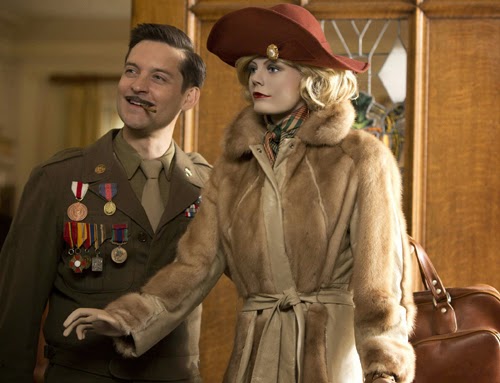
It almost looks like something from a 50's sitcom.
...until you remember that they're looking at Nazi confiscation documents.

In the director's chair, Clooney's always been one for harkening back to the older style of Hollywood, and it has served him well before. In this case, however, that old time sensibility feels a bit out of place for the subject matter. Trying to do an old-style of World War II movie in a post-Saving Private Ryan age is a REALLY tricky act to pull without making your view of war seem idealistic or sanitized. George tries here, and I will give him that, but it really doesn't work too well for him on this outing. Even the moments that are supposed to strike an emotional chord with us - such as when the team loses a comrade, or when we see the Nazis torching artwork to keep it from falling into enemy hands often feel somewhat arbitrary in spite of themselves. A similar problem occurs with regards to maintaining an air of suspense in this movie: alongside the Nazis, one of the big looming threats this movie's trying to push is the invading Soviet army - where the Nazis seek to burn the art, the Soviets want to plunder it. It's not a bad idea narrative-wise, but the fact is, as far as the movie's concerned, it becomes more a matter of tell than show, and the most the Soviets do is drive up, look intimidating, and move on, lather, rinse, repeat. Even the Nazis themselves are, with two exceptions, almost a non-threat to this movie.

On top of all this, and most damning, is the fact that the movie's message is also infected by this lack of agency. The entire reason for the Monuments Men as a team is a good one - and the idea that art is an extension of a culture's voice and history is a great idea to explore, but this film never really touches on it that much, save for a speech by Clooney that pays the idea a bit of lip service. Otherwise, the movie's big concern is just 'get it before the Nazis do' and any greater statement is left for a later that never comes.

Probably the biggest surprise of this movie for me is the realization that Bob Balaban is actually surprisingly tiny.
...that's not just riffing on this picture. I mean in general, I had never really noticed just how short he is.
Bringing things back to the earlier point of the merits in holding this movie off, I do admit - had I seen this during the peak season, I'd probably be judging this one much harsher than I am now. Right now, its release during a lackluster time of year release-wise makes its failings less damning and more disappointing.

Of course, even outside of this time of year, disappointment is probably the best word for this movie. It was made with some very good components - a very promising story, a director with a solid track record, and a great cast. Unfortunately, at the center of it is a script that overextends itself without having enough cohesion to justify all those threads being thrown out. Rather than feeling like a full movie, it feels like it's flipping between vignettes from multiple other movies that sort of all blend together in the last act. Clooney makes the most of the script, but even his direction isn't at its best on this one either. It's the kind of movie I almost feel bad coming down on, since it had a lot of potential to be good, but it's weak enough in a critical area to really stop me from being able to say it works.

About the best I can do for it - to crib from another, better, WWII-related movie - is to drop the figurative hat on George's head and remind him: "you lost today, kid. That doesn't mean you have to like it."

(...yeah, I know. He's older than me. Humor me, the quote feels odd if I adjust it for proper ages.)

Anyway, going to be trying to weigh in on the Oscars for this year, though I admit, I'm still doing some extra research for that, so mileage will vary.

Till then, you've been warned!

Friday, February 21, 2014

Mobile Suit Gundam II: Soldiers of Sorrow - We Noticed You're Still Alive

We'll have to fix that.

...oh, dammit! I was kidding!


Well, it's been a few days. After some considerable drinking, I've recovered from...that.

Sorry in the highly unlikely event anyone who's reading this liked that movie, but that has just gone on the list of the worst of all time. Not sure if it's #1, but damned if it isn't making a game effort for it.

Anyway, I have two others lined up for the next few days. Initially, this was going to be the later of the two reviews posted, but I needed something I knew I'd be happy with to wash that film out of my mouth. While the other film isn't awful, it wasn't going to be strong enough for this one.

With that, we now start entry #2 in the 35th Gundam anniversary writeups for this year. Within four months of the release of the first movie (there's a release turnaround you almost never see these days) Sunrise released the middle piece of their compilation trilogy for the original Mobile Suit Gundam. Like any good trilogy, this learns from some of the mistakes of its earlier film, and does try to build on them more. It still has a ways to go, but we're getting there.

That said, let's dive in.

Events-wise, this movie kicks off right where the first left off. We're given a brief montage complete with narration to bring everyone up to speed on the events before we start setting the scene for this movie This includes getting a more formal introduction to some of the antagonists, most notably Ramba Ral (Masashi Hirose) - the enemy ace who served Amuro a tasty curb sandwich at the end of the first movie, and M'Quve (originally voiced by the late Kaneto Shiozawa, and for the re-record played by Masahiko Tanaka.) From there, we jump back to the White Base where we last left them: knee-deep in enemy territory and trying to make their way to their own headquarters. It's a journey that makes up the bulk of this movie, and it's not an easy one for them: loyalties will be tested, friends will be made and lost, and the high cost of war will take its toll all around.
...you know, your classic Part 2 narrative escalation.

Yeah, it's a highly illegal move, but you've gotta admit, this would make fencing a LOT more interesting.


Like I said above, this film seems to have learned from some of the problems of the first movie in terms of pacing and time. There are still some stops and starts - for example, despite receiving a formal introduction, M'Quve really doesn't amount to much in this film. Given the movies skirt around a major battle that was included in the TV series( here only addressed in passing) where M'Quve was supposed to be the big antagonist, his role in this movie really only amounts to some passing 'this is what's going on in the rest of the world' narrative, and to serve to screw over Ramba Ral. This last part becomes the one real bit of character development he gets in these movies. His role is still a valid one in the overall story - highlighting the internal conflicts and self-serving officers in higher positions are eroding Zeon from within even as their enemies get stronger - but for his part, the movie renders him less a character and more a plot device. By comparison, Ramba Ral gets the bulk of the first chunk of the movie to highlighting him as a threat. Which makes sense - not only is he a fan favorite character, he's also the first time the crew really gets to see the face of the enemy in this version (the show has several one-off episodes that highlight this point, but they were all cut down in the interests of time.) In this regard, the film actually does a good job keeping a lot of his character intact. Further, this continuous plot arc holds together better than some of the more clear-cut transitions in the first movie. It's still not a perfect job, as there are still a few scenes where you can see the narrative stitch where an episode cut out. The section where a disillusioned Amuro deserts the ship and takes the Gundam with him is one of the biggest examples of this. They try to play it off better, but you can still imagine the 'cut to credits' moment, as the bridge  between the scenes doesn't quite take.

Well...screwing Ramba Ral over and a legacy of flamboyance in the eyes of the fanbase.


To be honest, I have a bit of a harder time holding the awkward bridges against this movie compared to the first film, thanks in large part due to the fact that  the span of story this movie is trying to cover is almost literally all over the place. While the first movie covers a large chunk of narrative ground, it's still a pretty contained chunk of story (making up roughly the first 12 episodes of the series, and even then cutting roughly 4 or 5 episodes worth of that out in the process.) It feels fairly contained location wise, too- first they escape from the colony, make a quick sidestop at Luna II, then it's off to Earth where the rest of the film plays out in the NA area. It feels a bit more cohesive as a three-act structure, even with the episodic start and stop. By comparison, this movie spans a good chunk of the globe more notably, going across Europe before its finale in South America. The changes in locale feel much more pronounced in this film, which further adds to the feeling of breaks in the plot.

It also helps that, even with the awkward breaks, the stories in this part are upping the ante to make up for it. As is often the case with second parts of a trilogy, this is the movie which aims to go darker, and it manages to do so in several places, sometimes better than the events within the series. In particular, there are two arcs that translate well for this - the first is involving secondary pilot Kai (Toshio Furukawa) who goes from being just a sarcastic support character in the first movie to actually getting his own arc here, which also serves to hit home just how this war is affecting civilians as well. While part of the climax of the arc can feel a little over the top by today's standards, the emotional payoff still hits surprisingly well, in no small part thanks to Furukawa's handling of the role. The other turn here is one of those elements where I actually feel the movies did one better over the TV series: without giving too much away, as mentioned above, the crew do experience some losses of their own. One of these is an arc that, within the TV series, makes for a REALLY awkward scene. While it makes sense to show just how much the crew member meant to everyone, the show's depiction of their reactions is almost comically over the top: EVERYONE breaks down bawling at the character's death, and I mean full on fall-to-your-hands-and-knees-crying-your-eyes-out grade bawling. It's well-intentioned, but laid on WAY too thick to really take seriously, and I think Tomino realized it, since the scene in the movies is a lot more reserved. Everyone is still clearly saddened and shaken up by it, but there's also still more of a sense of shock with it that resonates better. In general, the film has more emotional beats to work with, and mostly hits them accurately.

Even with some of the 70s narrative styles, that Kai subplot is still pretty damn depressing.


This movie also further highlights one other area the movies have an edge over the series by comparison in that there are certain elements of the story that get better addressed within this version of the story than they do in the series. In particular, the concept of Newtypes - a sort of psychic phenomenon that becomes particularly prominent near the end of the series, are introduced earlier here and more gradually developed than in the series, likely thanks to the fact they had the story already all laid out and could structure it in more easily. It's actually first introduced within the first movie in a conversation, but this is the movie where that concept really starts getting set up more, in particular in the suggestions that Amuro may be developing those abilities as he makes his way through the war. It's still relatively minor in this particular film, but given it's a major element of the third movie, it helps to have them setting the foundation for it up now.

Additionally, this marks the most prominent moments where the movies break away from the series - this is thanks to the fact that, rather than story being edited by virtue of omission, this movie marks where newly animated sequences were worked in in order to bring the story more in line with what Tomino originally had in mind. One of the most overt examples of this being rolled in mid-movie, when the original unit for Sayla (You Inoue) is changed from the more openly gimmicky and toyetic G-Armor of the TV series for the more plausible, and functional looking Core Booster (see below for comparison on both.) It's primarily an appearances case here, but it does also serve as the biggest tell that the movie is reworking parts of the series.

Before

After


As I said at the start, as a sequel, this movie shows it has learned from the shortcomings of its predecessor. It still has some problems, in this case partially a consequence of the sheer range of narrative they're covering, and the episodic format still betrays the movie, but, as with last time, they're at least trying to cover up the seams as much as they can. In this case, while some are still apparent, they've patched many others over fairly well, and this is in part thanks to the fact that the series was gaining more of an over-arching story by this point. By the time the crew reaches headquarters in Jaburo, the movie hits a pretty continuous stride that it maintains all the way to its finale - a somewhat more optimistic, but still memorable scene of the White Base returning to space set to Daisuke Inoue's 'Ai Senshi' (an incredibly catchy song whose translated lyrics are surprisingly dark considering the upbeat tune they're played to.) It doesn't have quite the same impact as the first movie's finale does, but after the rough ride the crew go through in this film, it's a refreshing note to close things on - the end may be in sight, and even though it's not going to be at all easy, they're at least on their way.


...you know, given how wrong this looks out of context, and how much the fandom has already joked about it, riffing this almost feels redundant.


So yeah, there are still a few fumbles, but it's still an overall better movie in terms of composition.

Next month it all pays off with the end of the original trilogy, Encounters in Space.

Of course, I've got a lot of other material lined up for you guys before that point in general reviews. So, once again, keep an eye out.


Till next time!

Saturday, February 15, 2014

Tyler Perry and Jack Chick Present 'Temptation'

Boy, did I miss an opportunity here. When I was choosing the punishment movie of 2013, I had this movie on the docket- It was even one of the finalists. Instead, I opted for Movie 43 - a film that, to my surprise, Just bored me rather than angering me.

So I decided to tag Temptation for this year's unofficial wildly inappropriate Valentine's movie (after Fireproof (2012) and I Spit On Your Grave (2013), it's becoming a theme, alright?)

Had I known then what I know now, I would have given this one the punishment slot.

Now then...where to begin, where to begin...?

One of the biggest problems I'm having in this writeup is: what can I say about this movie that hasn't already been said? This has a LOT wrong with it - both technically and in terms of a message. In fact, I'd be willing to bet money some of you are reading this because you already know how downright horrible this movie is, but you still want to see me take a baseball bat to it.

In the event my suspicion is correct, I shall do my best not to disappoint.

Now then, in getting started on this, I will ask you indulge me on a bit of a digression. On his album My Weakness is Strong, standup comedian Patton Oswalt talks about his anxieties as an upcoming father - most notably his decision to scale back his use of certain substances. One of these he brings up is LSD - his concern is not that he'll physically harm the child, but rather that in an LSD-induced state, he'll cause the kid's first memories of him to be him rambling like a complete idiot. To underscore this point, he acts out an entire mock-rambling in which he explains to his hypothetical child about the secret conspiracy behind Lucky Charms cereal. The message the cereal is sending, he argues, in its symbols hidden in the wheat pieces and the marshmellows, is that the path to Christianity "which is no fucking fun," but is full of grain and will keep you healthy and regular and the path of paganism, which is bright and colorful, will rot your teeth and make you fat.

Why do I bring this up? Because the entire time I was watching this movie, I imagined this rambling. Except unlike Patton, who is using it as an example of him making an ass of himself in front of his child, this movie totally believes the message, without any drug assistance behind it.

Actually, I take it back - that would actually be MORE pleasant than the bill of goods this movie's trying to sell.

Temptation - Confessions of a Marriage Counselor, is the latest effort (as mentioned in the title) by writer-director-producer-sometimes actor Tyler Perry. Now, I'll admit, this is actually my first time taking on one of his films. He's a presence I've been aware of for a while - most notably for the fact that there is a considerable school of criticism about the fact his films tend to send some incredibly mixed messages regarding race and morality. In fact, it was hearing how badly this handled the latter that had me going "now THIS I've gotta see."


"Look on the bright side - sure, you're gonna make a load of crappy decisions over the course of this movie that will leave you alone and miserable, but when the credits roll, I'M gonna be the one the audience wants to see die screaming."


The movie is mostly told in flashback, recounting for us the story of Judith (Jurnee Smollett-Bell) - an ambitious woman working for a high-profile matchmaking service. She's also happily married to her childhood sweetheart Brice (Lance Goss,) who works as the owner of a local pharmacy (his childhood dream, as the movie's intro tells us - so you know this guy's gotta be a nice guy.) One day, Judith's boss (Vanessa Williams, as one of the few people who seems to be trying to act in this - albeit with a bit of an odd accent) brings in a new client, a wealthy, charismatic (in theory), and somewhat short-fused client named Harley (Robbie Jones) who is apparently one of the top richest tech gurus out there. Judith gets assigned to work with him on the possibility of his investing in the company. He immediately takes a shine to her - and by shine, I mean he's rather overtly flirting pretty early on before it starts sliding into sexual harassment territory. Judith is at first shocked, but also intrigued - to this point, all her carnal knowledge has been limited to her husband (and watching HBO, as she assures us - buckle your seatbelt, the writing doesn't get any better form here.) Eventually, she caves and begins an affair with this smooth-talking playboy, who her mother (Ella Joyce) immediately pins down as the Devil himself. In true morality play fashion, Judith's life hits the skids so hard and so fast as to make the cast of Reefer Madness wonder what the Hell just blew past them.

Before I get into the problems with the story - which we could be at a while - there are two points in particular I'm gonna need to address about this movie, because I'm not gonna be able to look the other way on them otherwise.

First off, we have the acting in this. I feel kind of bad for hitting on this point. As many issues as he has, Perry IS one of the few directors out there who's getting black acting talent out there on the big screens to the extent that he is. On the other hand, I'm sure Perry could respect the idea that the road to Hell is paved with good intentions - and for however much good that casting does, the fact is, most of the cast in this movie are genuinely hard to commend in their roles. About the only people I can really say are doing much in the way of actual performing are Vanessa Williams, even if her character is mostly just an exposition device, Ella Joyce, who, to her credit, is trying to actually make the most of a character that the movie can't seem to really decide how it wants us to view her, and to an extent, Brandy Norwood as a new hire at Brice's pharmacy who provides the final clues to set up the film's climax. In Norwood's case, it's a bit of a split - she manages to handle some scenes fairly well, while underselling the urgency in others. The rest of the cast, meanwhile, are just underselling all around.

I suppose, if one REALLY wanted to, they could pitch this as the incredibly dark sequel to Moesha...but why would you want to give this thing a further reason to exist?


Well, OK, that's not fair to all of the cast - there are a few who are actually doing even worse. In particular, I'd just like to say I'm really pulling for Kim Kardashian to take this year's Razzie for Worst Supporting Actress for her work on this movie. She's pulled off something I didn't think was possible - I genuinely loathed her character within the first minute she was on-screen. About the only other person that really stands out worth much of anything in this ensemble is Renee Taylor as the movie's token white at Brice's pharmacy - a role that mostly amounts to some misfired comic relief that leads me to wonder if Perry had initially written this role for his Madea character, then decided it would be for the better to leave her out of a work he was clearly trying to sell as a serious drama. ...Not that this stops him from still leaving in an iteration of the comic relief old woman anyway.

Of course, I do have to cut the cast some slack here. Most of them, anyway - Kardashian's still just awful all around on this one - it doesn't help that her character is basically just a shallow enabler who goads on most of Judith's bad decisions, but the fact is, one could still at least get a passable performance with that if they actually tried. The fact is, they're all trying to make do with a cast of characters that, at best are boring or confused, at worst, outright horrible. Before we even get into the nature of the characters, I should probably start by saying this has some of the worst dialogue I've seen in a movie since - appropriately enough - Smiley. Alongside the above-referenced nugget about HBO, this movie is riddled with some incredibly painful dialogue that feels like it was written by someone who doesn't understand how people interact. Besides the fact that there are many scenes where dialogue is essentially bound to the purpose of being an information dump - either dumping out characters' backstories, or putting their emotions front and center cause emoting is hard- some of these conversations are just mind-boggling in their implication that people genuinely converse about these things. Even if Kardashian's role were being played by someone else, her scenes would likely still be pretty insufferable simply by virtue of the fact that, again, her character's sole purpose in life is to be an incredibly shallow version of a Magic 8-Ball that gives you crappy life advice. If I actually tried to put together a reel of some of the more standout bad dialogue this movie has to offer, I'd probably get in legal trouble, since it would likely amount to just uploading the bulk of the movie as is.

Maybe that's a bit harsh - but seriously, I kind of want to give these actors a medal for being able to get some of these lines out with a straight face.

Now's probably the best time to finally take the plunge into the biggest stumbling block of this movie - it's incredibly muddled and altogether problematic message.

One of the biggest problems this movie has is that what it's saying with its moral, and what the movie itself is saying in its depiction come across as two ultimately different things. For starters, let's take a look at the characters the movie wants us to view as good: Brice means well enough as a character, and to his credit, Goss does try to make what moments he has as a good guy work - but the fact is, the movie also tries to make him fit the boring side in order to justify Judith's being lured by forbidden fruit. As a result, Brice comes across less as a well-intentioned guy who came up short, and more like the black Ned Flanders. He's depicted as such an upright citizen it's almost maddening - no matter what he's going through, be it heartbreak, rage, or disbelief, he just trucks along with a weird sort of stoicism that would make Job look and go "Come on, dude. REALLY?" Even when he DOES finally give in to his anger in the film's climax, it's such an uninspired moment that it's hard NOT to get mad at him for only being as peeved as he is. Meanwhile, as the closest thing this movie has to a moral compass, Joyce's Miss Sarah is depicted as dancing the borderline between a voice of reason and a religious zealot. She's technically right in that she's the only one who seems to realize Harley is an absolute jackass - but it's delivered through a filter that reads as a dialed down version of Mrs. White from Carrie. Therefore we have a harder time being able to take her warnings as actually credible- which, in some ways, highlights one of the bigger problems with this movie.

I actually might find him a bit more tolerable if he DID also end all of his sentences in '-iddely'. Not much more, but it WOULD help.


Meanwhile, as the protagonist of this movie, Judith is in a particularly uncomfortable spot as far as the overall movie is concerned. I've tried to give Perry the benefit of the doubt and looked at this first part from a few angles, and every time, I keep coming back to the same uncomfortable conclusion that this movie seems to want to hit home: the biggest crime that Judith is guilty of is being a woman who isn't satisifed. That's really all she's done wrong here. The sad part is, based on how Brice is written and portrayed, I can kind of see why she is. The fact is, he's a very stagnant character in a lot of ways - he got his dream, and as far he's concerned, that's enough for the both of them. That Judith should have any sort of interest in pursuing her own goals is seen as unusual, and the big reason why Harley is able to get his proverbial claws into her. Even Brice's attempts to make things better don't exactly help matters - yeah, he's a nice guy, but the film never really seems to make him actually attempt to understand her. Again, his logic seems to be "I got mine, what's your problem?" Further adding to this incredibly problematic depiction is how Perry chooses to actually have Judith and Harley's relationship start. There's really no way to sugar coat this point - he effectively rapes her.
That's right.
It's out in the open now.
AND SHE STILL GOES BACK TO HIM.
I'd be lying if I said I didn't fight the urge to punch my laptop screen when THAT came about. Making it even better/worse is the fact that nothing's ever said of it after. Sure, we make much of the fact Harley's a drug user and quite abusive all-around, but the fact that he rapes Judith is really just like the, to make a reference to the movie Heavy Metal, moving violation at the end of his criminal charges. Further adding to the frustration is the fact that Judith never really seems to feel any conflict about matters. Even when Harley calls her for what's really a straight-up booty call while she's at home with her husband and mother, she gets talked into leaving with almost no effort. She commits herself alarmingly fully to a man who, despite her repeated attempts to rebuke, winds up raping her. There is no way you can NOT make this a problematic message. If anything, I'm actually surprised this film didn't get met with MORE controversy on its release. Particularly for one other point I'll be getting to in a spoiler cut at the end - one which I'm willing to bet most of you can already guess.

The notion of 'personal space' is apparently a myth in this movie. Or at least a convenience, since they really don't seem to pay this scene too much mind after it's over.


Really, this is just a very special breed of bad movie. Yes, it has many general classic hallmarks of bad cinema in general - the dialogue is awkward and almost laughable at points, the acting is confused and listless or outright annoying, depending on the actor, and the direction, while not bad, is pretty unambitious. Instead, the movie's faults lie in its very skewed moral views, which seem to class 'goodness' as factors of gender and social standing (while perhaps not as overt, there IS a bit of a 'rich people are evil' subtext to this that feels rather clunky in how cliche it is, though that's still a distant second to the movie's pretty unsettling message about women.) Probably the biggest problem here is, the movie is asking its protagonist to choose between two options that, as the movie presents them, are both pretty horrible: Brice is well-meaning enough, but he's made so morally spotless as to be bland. Even Judith's attempts to revitalize their marriage are pretty readily shot down by him. It's hard NOT to blame her for feeling bored. At the same time, the only other option the movie gives her is a short-tempered sociopath, and she gets hints of this pretty early on. The entire time, the movie never seems to entertain the notion that neither of these two may actually be good for her, and instead treats her eventually winding up alone as losing it all. I realize Perry is very informed by a Christian background in his films, but in this case, the message he's sending is rather alarming - and I'd be lying if I said I didn't find it a bit of a relief that people didn't buy into it.

Huh...this wasn't quite as venomous as I expected the write-up would be. Cause I'll be honest, this movie really is just...exasperating in how utterly repulsive the message it sends is.

Now then, before we get to the last REALLY problematic point in the spoiler guard, I'll say unto those who wish to avoid the spoilers: keep an eye out. Got two more reviews lined up for this week.

Till then!

Monday, February 10, 2014

The Spoils of Babylon - Because Sometimes I Watch Things Outside of Film

As the title suggests in part, this is born out of one of those times where I decide to take on something from the world of television (not a first for me as last year's Christmas special writeup showed. Plus that made for TV movie version of Les Miserables back during Summer Reading if you want to count it.)

In this particular case, I had promised to give this one a writeup after it completed its short run.

That said, as I sit down to compose my thoughts on this show, I'm struck by a discussion that occurred within the last year or so. Comedian/critic Doug Walker had done a video, and subsequently some convention panels/discussions on the notion of parody as a viable means of entertainment. One of the big talking points was whether or not the rather crassly commercial wave of '* Movie' films, designed to stripmine pop culture on the cheap to drum up just enough interest to cash in on their opening weekend, were a sign that parody was becoming a dying form of humor. There was a lot of discussion from all camps, with people bringing up everything from the Three Flavours Cornetto trilogy to the numerous 'Abridged' joke series going on the web. The consensus seemed to be mixed overall, but largely deciding that, while the age of the head-on style genre roast a la Airplane! or Blazing Saddles may be in a lull, parody in general is still quite alive and kicking in other forms.

Which brings us to Eric Jonrosh's The Spoils of Babylon: a six-episode series made as a co-op between Funny or Die and IFC. When this was first advertised, I really wasn't sure what to make of it. It seemed like a comedy, but it was still delivering itself with enough of a straight face to make one question it at first. It wasn't until the show got closer to release and more information came out that I became interested in giving it a look. In no small part because the premise reminded me of the earlier British series Garth Marenghi's Darkplace (which, in its own right, is a wonderfully bizarre riff on 80s British television, horror shows, and the laughably egomaniacal author at the center of it all.)
In this case, rather than riffing on low-budget British horror television, IFC aimed its guns both higher and (relatively) more obscure: firing a warning shot across the bow of the old big-budget all-star miniseries that reigned supreme in the 70s and 80s (Think The Thorn Birds or North and South). Like Darkplace, Spoils of Babylon starts and ends each episode with an appearance by fictional author Eric Jonrosh: Will Ferrell does a scenery gnawing impression of the later years of the life of Orson Welles, a persona that's entertaining enough in his own right. The story Jonrosh puts together is a mishmash of melodrama archetypes. What results could almost be summed up as "What would happen if we sat Douglas Sirk down with a crack pipe and a copy of The Thorn Birds?" Family legacies, forbidden love, changing eras, drug abuse, and children born out of wedlock fly fast and loose over the show's six episode span (trimmed down from what Jonrosh claims to be his original 22 hour cut.)

Somehow, this image just on its own perfectly sums up the fake feeling they're trying to evoke.


As is often the case in parodies, while the script in itself can be funny, this is another example where the bulk of the humor lies in its execution. First and foremost is in the cast on this . They, within the show's wonderfully skewed directorial style - which we'll be getting to next - all play their roles in such a way that they can enjoy playing up the overacting, but also still keep within the framework of the project. Despite how over the top the production gets, and he has his share of moments, Tobey Maguire actually tends to become the comic straight man in many scenes. To his credit, he can deliver the laughs when needed, and to be able to keep to the straight man role in a show like this is an accomplishment in and of itself. Next to him, much of the rest of the cast get to have a bit more freedom to make with the insanity - none more than Kristen Wiig as his adopted sister/lover/rival (...it gets complicated.) Wiig starts the show at a bit of a restrained pace, but come the end of the first episode, she cuts the brake cables and handles the rest of the series playing up the over-the-top craziness with a manic energy that no one else quite manages to match, despite some VERY game attempts. Next to Wiig, the two biggest standouts here are, appropriately, also the other two major members of the story's main family. As the patriarch in the first few episodes, Tim Robbins, like Maguire, tends to be in the straight man role more than the comedic role. But he still sneaks some great laughs in with the more understated reactions to the craziness around him. Also, I have to give him some extra points for keeping to one joke introduced on the sly in the first episode and staying with it for the entirety of his run (when introducing the cast, as different actors, Jonrosh assures us that despite Robbins's character being played by a British actor, he does a very convincing American accent - which then leads to Robbins slipping into British during random scenes.) The other standout, rounding out the clan, is Haley Joel Osment as Maguire and Wiig's bastard offspring (like I said, complicated.) Osment's Winston definitely takes after his mother, playing up the gleeful crazy. In particular, his fight with Wiig in episode 5 is one of the best continuous laughs of the show's run. After having been out of the limelight for a while, it's safe to say that, while Osment's days as the lead may have passed, he's actually shaping up to have a fairly promising career in comedy if he plays his cards right.

...okay, so there's also Maguire's British wife played by a voiced-over mannequin.
...and yes, they DO have a love scene together. It's very likely as crazy on screen as it may be in your heads right now.


Alongside the cast, the other area where this show really sticks to its story is in the direction. As we're first lead into this opus, Jonrosh assures us that it's a high profile project that he pulled out all the stops on. In turn, Matt Piedmont's actual direction runs on the idea that Jonrosh was full of crap. The show is laced with all sorts of examples of carefully orchestrated directorial ineptitude that lead to some great laughs. A strong example of this is in the second episode, where a frustrated Robbins starts repeatedly slapping a hysterical Wiig. Piedmont turns the scene into a continuity nightmare, with the two cast members changing shots and positions with each slap, before concluding it on a hilariously understated tap. Further, the sheer number of different directorial tricks the show plays with, often deliberately failing at them (a fake use of classic 3-D in the third episode is another prize winner here) lends more to the sense that Piedmont knows exactly what he's doing and has done it VERY well.

I just want to state for the record, I didn't alter this image in any way beyond resizing it for the blog. Time has NOT been kind to Mr. Osment.
Still, like I said above, he's got a sense of humor at least.


It's actually a bit odd for me to be praising some of this, since as a general rule, I've usually been of the mind that you can't force bad. I've seen many other productions try to do so bad it's good and just fall on their faces. I think the difference here is, this isn't so much a pure 'so bad it's good' but rather the crappy elements further adding to the joke at the center of all of this that is Eric Jonrosh. All the time, Ferrell plays him as a man who believes himself to be a misunderstood genius and-even after we find out his miniseries is (by design, and yet not) overacted, shoddily directed, and riddled with (most damning for him) some of the most laughably bad prose this side of Battlefield: Earth- he still continues to buy into his own perceived greatness. It's like an insane and slightly drunk variant of a Matroska doll. Rather than just being a straight-up 'look at this deliberately bad production we made' project, The Spoils of Babylon makes it slightly more ambitious, making the ineptitude part of a larger mechanism - rather than being the entire joke, the failure is also a reflection on the wine-soaked ego of its fictional author.

and now, as Jonrosh would himself say it best "when the wine is gone, it's time to leave."

I'll likely be attempting a bit more work along this line in the future. For now, don't worry, next will be a straight-up film writeup again.


Till then.