Wednesday, July 23, 2014

Snowpiercer: Ax Murder on the Terry Gilliam Express

I'm gonna say this now: this has been a mixed summer for me film-wise. It hasn't been completely awful, but outside of a couple of standouts, there haven't been a lot of entries that made me go 'THIS was worth it!' Nothing really made me think 'This was a great summer movie' like previous years have. Which makes it an odd mix of funny and a bit sad that the summer release that does it for me the most is one that was half-buried on arrival.

For months, Snowpiercer was the movie that was mainly known for the feud between director Bong Joon-Ho and the Weinstein brothers over distribution. For those who don't know the story, word is the Weinsteins wanted to cut twenty minutes of the film- a move Joon-Ho balked at and challenged. He eventually got his cut through, but the major release was scaled back to a limited one. For a time, people were concerned this meant the movie would be doomed in the 'New York and Los Angeles only' loop. A fear that was thankfully misplaced.

Upon finally seeing it this week, I can honestly say it's been well worth the wait.

For those not familiar with the film- and sadly, thanks to the PR game, this might be a lot of people- the story (adapted from the French comic Le Transperceneige) takes place in a different style of dystopian future. As global warming spirals out of control, humanity attempts to solve the problem with an quick-fix experimental chemical known as CW-7 (Editor's note: Because OF COURSE WE WOULD). It works WAY too well- temperatures drop too far, too fast, and the world is plummeted into another ice age. All that remains of humanity is living aboard a specially powered, self-sustaining train designed by the mysterious industrialist Wilford. No, it's not a scientifically sound setting. No, you won't get a gold star on the internet for talking about how the setting doesn't make sense. It's not trying to be 2001: A Space Odyssey in terms of scientific accuracy. For the sake of the story the movie's trying to tell, it's consistent with its own rules. Just take that as it is now and you'll find this ride a LOT easier to take and enjoy.

and if that's still not enough for you, consider this - Wilford gave this train an aquarium car.
If that doesn't render your argument irrelevant, I don't know what to tell you.


When the movie begins proper, the train has been running for seventeen years. Society has stratified in a big way. Picture Metropolis by way of Brazil-  those in the front cars live a life of insane levels of opulence, while those in the back are herded like cattle around a mobile ghetto and fed on a diet of processed protein bars. Quite literally, they live to serve the needs of those in the front of the train.

The conditions in the storyboard department are particularly awful as a consequence of this


Among those in the back, a rebellion is brewing. Guided by the aged Gilliam (John Hurt) and rallied by the angry Curtis (Chris Evans) the people in the tail of the train make plans for an uprising. Unlike those before them, they are determined to fight their way to the front of the train to confront Wilford himself- or die trying.

This is one of those films that works by taking a familiar framework and making it succeed through execution. Science fiction is full of stories of dystopian uprisings, and this film isn't trying to reinvent the wheel,  rather it's determined to make one VERY exciting wheel in the process. Alongside the rebellion aspect, the movie also has a good streak of just straight up adventure in its proceedings. Each new cart of the train they manage to fight their way onto offers new sights and new dangers. The more they press on, the group finds the stakes going up as their numbers shrink - without giving anything further away, it's worth noting that one of the main themes throughout the movie is the idea of sacrifice of the individual for the greater good.
The only aid they find outside their own ranks comes from a former security specialist and his daughter (Song Kang-ho and Go Ah-sung, respectively) and a hostage turned unwilling guide (Tilda Swinton in an entertaining mix of smug and self-serving, as the situation dictates.)

In the troubled times of a dystopian future, it's worth remembering your next of kin can readily double as a club if you're desperate.


Alongside these outsiders, the team the movie has put together are an interesting crew. As our protagonist with both a figurative and literal ax to grind, Evans's Curtis is a VERY different role from his more famous turn as Captain America. Where his other role is a man with a clearly defined sense of right and wrong, Curtis is a man who's seen and done some horrible things in the interest of staying alive, and he won't let himself forget that. As the one person he pins his trusts on, Hurt provides the kind edge to the harsh world at the back of the train. Like Curtis, he's been living this Hell since the beginning, but he's also recognized the value of empathy within it. Alongside these two the team also includes Octavia Spencer as a woman determined to get her son back from the front of the train, Jamie Bell as Curtis's surrogate little brother and biggest supporter, and Ewen Bremner as another parent whose lost much to the front and is itching for some payback.

I realize it's his vision and I respect that - but I think Abrams is making a mistake by not making this the team for the new Star Wars movies.


It's tricky actually praising individual performances in this, since there so many talented actors at work. Alongside the team mentioned above, Kang-ho and Ah-sung provide interesting performances, first appearing as little more than a pair of burned-out junkies before slowly revealing they know more than they're letting on. Likewise, as mentioned above, Swinton's turn as Wilford's zealot/mouthpiece Mason is a bizarrely memorable turn for the actress. For a role that was written with another person and gender in mind, she still manages to take it and make the character distinctly her own, resulting in a character you can be entertained by while also wanting to smack her for her proselytizing. Speaking of the devil, Ed Harris makes an brief but memorable appearance in the final act as the elusive Wilford. He plays the man with an odd mix of almost paternal warmth and ruthless pragmatism. His ability to calmly and casually explain all the necessary evils of his society is almost admirable, even with the knowledge we have of the horrifying actions he's had carried out to keep the train running. It's not a performance that immediately goes head and shoulders above the others, but it's a wonderfully understated turn that really helps drive home the final act.

The stories of just how it was that John Hurt escaped the set of Indiana Jones and the Kingdom of the Crystal Skull remain a mystery. Those that saw him in the weeks immediately after, however, are all in agreement he did NOT get away easily.


Besides the cast, Joon-Ho's direction is a big factor in what keeps this movie running. The action sequences he's put together on this film are some of the best I've seen in recent years. One particular highlight being an extended fight between Curtis's army of determined revolutionaries and the ax-toting enforcers Mason has deployed to defend the train's water purification cart. The sequence moves in starts and stops, its lulls accented by some great 'stare down' moments to build the tension before resuming the carnage and keep up the energy. It's a great multi-stage sequence and one of the most memorable in the film. After that fight, the direction changes up styles. Each new car in the front of the train is almost like its own little world, evoking feelings ranging from unusual calm (an aquarium car that provides first class passengers with fish) to the comic/disturbing (a visit to a classroom is the pinnacle of black humor in this film.) Joon-Ho handles the transitions between each room and style well, especially factoring in the characters this movie is focused on: this is an alien experience for many of them who've been living in squalor for ages, and the film nails that almost otherworldly feeling.

In the initially proposed recuts, this scene was going to be set to the song Love Train.
Test audiences liked it - just for all the wrong reasons.


This is one of those reviews I've had to write and rewrite several times in order to come to a point I'm satisfied with.

It's a movie that, to talk about, is incredibly easy to lapse into just talking out the whole story. Which, of course, I don't want to do to you guys - especially because this is a movie that's really worth seeing if you can find a theater playing it. It's certainly not a bold new revolution in filmmaking, but it's a strong offering from an already pretty established director and a great first foray into the English language film market. On top of which, I'm really not exaggerating when I say this is easily one of the best movies I've seen this year and certainly this summer. I tried my best not to go into hyperbole, but it's not exaggerating to say that here.

Really, if you know of any place showing this, it's well worth the two hours to go see. I won't say it's the cinematic second coming, but you can expect a well-written, high energy action film that is INCREDIBLY satisfying for this summer movie season.

So maybe I caved to hyping it a little. It is worth it though, and hopefully this sold some of you on seeing it.

Keep an eye out, got another review lined up in the next couple of days. It's a bit of an older title, but one that's recently seen a fresh take.

Till then.

Monday, July 21, 2014

The Strain – S01, E02 – 'The Box'

For as much as people joke about teenage sex and the basement as leading causes of horror death, there's something to be said for the body counts racked up by ignoring the lone field expert's warnings.

The final shots of this episode serve as a great example. Following up on last week's closing shots of bereaved father Gary Arnot (Steven McCarthy) being reunited with his mobile - but still quite dead daughter Emma (Isabelle Nélisse.) This week, we close out as he attempts to resume life as it once was. When young Emma mentions she's hungry, still completely unaware of what for - he offers to feed her. This oddly tender scene then meets its quick, blunt, and rather brutal payoff: without a shred of recognition, Emma latches onto her father's throat. The man doesn't even have the time to fully register this as his face, locked in dead surprise splashes into the bath, bleeding out. It's a well-executed, well shot sequence that- like last week- closes out on a rather chilling single shot: a heads-up shot of Emma in the bath, a faint trail of her father's blood leading to her mouth.

Cue credits, aaaaaaaand good night, kids!


A fitting ending, as much of the episode focuses on Eph’s desperate attempts to maintain quarantine- efforts are undermined by forces human and otherwise- and the consequences of last week’s events are felt . The airplane's dead have now taken to the streets (Following their entree of coroner),  Setrakian is confronted by a ghost from his past, and the mysterious Master is finally face to face with those who secured his passage.
As the stories come together, the blood starts to flow.

"Boop!"


Everyone gets a bit of attention this week, both for good and ill. Though he only has one scene, Abraham is once again the high point of this episode. Still in jail, he has a visit from the Stoneheart Group's Eichorst (a coldblooded Richard Sammel.) For being a scene of just two people talking, this has enough of an air of dread about it to easily the episode's best scene and further build tension for things to come. The Stoneheart Group actually provided for some of the better scenes this week, after a vague introduction last week. Though Johnathan Hyde's Eldritch Palmer is sometimes written as an almost Monty Burns-style evil old rich man (his first scene in this episode has an aide discussing harvesting organs from someone to sustain him if his current gambit fails,) it makes up for it in acting and payoff. While Hyde wasn't exactly how I first pictured of Palmer reading the books, he has carried the role off in such a way as to counterbalance some of the more cartoonish aspects of his villainy. His follow-up scene, where we finally meet the Master (Robert Maillet) properly, is another standout scene in the episode. As much as last week gave us that good shock when the Master made short work of a victim, it's his appearance this week that I find more unsettling. All he has to do here is unveil himself and speak (voice by Robin Atkin Downes) and the presence the character has, even when only seen from the back, is appropriately unnerving.

"He got my letter!
HE GOT MY LETTER!
THANK YOU, SANTA!
THIS IS THE BEST CHRISTMAS EVER!"


Unfortunately, the storyline of the Master's bloodthirsty progeny is something of a series of ups and downs. In the first look at the living survivors, I just want to eschew professionalism for a moment to say – my God, those four get annoying. Granted, this is intended – we're meant to share in Eph's frustration at the fact his investigation is being undermined at every turn. Still, it's hard not to yell at the screen 'WHAT PART OF CDC QUARANTINE ISN'T SINKING IN?' I'll concede this is partially thanks to the Stoneheart Group's poisoning the news with cover stories, but even then, these guys just act like a group of miserable ingrates. I honestly have a hard time feeling any sort of pity for what they have coming to them.  Pushing their release in the first place, Leslie Hope's Joan Luss is trying to stay on top of the situation legally, but mostly just comes across as obnoxious (again, somewhat on purpose, but doesn't mean I have to like it.) After her, Johnathan Potts as Captain Redfern is probably the one sympathetic member of the survivors, stewing in guilt knowing his airline is streamlining the process to avoid a scandal. It's a storyline that one can tell isn't likely to be around long, but it's a nice touch and Potts plays it well. Most prominent is Jack Kesey as goth rocker Gabriel Bolivar. He's still obnoxious (as he's supposed to be) but by having him more entrenched with other people, it's less of an annoyance this week. The fact his time this week ends with him starting to develop a taste for human blood means his storyline is going to get interesting from here.

The CDC end of the narration is off to a bit of a slow start for the first half. Like Eph, it's hard not to be frustrated at seeing the number of ways people and money are used to undermine attempts to stop a burgeoning epidemic. My only real issue with this story right now – remember that coroner who died horribly last week (in probably one of the best scenes of the pilot?) We're three-quarters of the way into this episode before anyone thinks to check up on him. I realize there's a lot going on, but it does seem weird from a viewer's perspective to leave that hanging as long as they do. Fortunately, they make up for it in the aftermath as Eph and Nora (Mía Maestro) rush to try and find their runaway corpses before a bad situation becomes even worse. I still can't really feel much investment in Eph's personal life, but his professional life is at least providing some entertainment this week.

Unfortunately, we see further into the personal lives of Eph and Gus. I hate to say it, but once again, these are the weakest storylines of the episode. It's a mix of a couple of factors here, really – first is the fact that we have a series where a vampiric outbreak stands poised to turn New York into a feeding frenzy. In a setting like that, things like Eph's divorce and Gus's concerns over his mother and brother really feel like small potatoes. Making matters worse, the show never really tries to make an effort to get us to care about them despite that. It's mostly just two very cliche storylines that are so poorly integrated and developed, they may as well be in a whole other series.

The old 'Dead Rat' gamble. For when you just don't want to wait 30 minutes for a table.


On a plus side, however, this episode does also introduce us to the character Vasiliy Fet. As of now, his storyline is more of a side note in the story, but it makes sense to establish him early. After his intro, writers David Weddle and Bradley Thompson weave his plot through scenes of the airline survivors, which makes for a decent segue as his investigation ties into a restaraunt where survivors Luss and Bolivar discuss suing the airline (and have to backburner the plan when Fet shuts the place down.) For what little he's got so far, I have to admit he's off to a good start. He doesn't get much here, but he's entertaining enough to make his time worth bearing with for now. It's worth noting that del Toro has admitted, in the original writing, the character was first envisioned with Ron Perlman as an inspiration. Durand channels this inspiration in his performance well. This is particularly evident in his later scenes of the episode, when he confronts a restaurant about a rat infestation. Durand's imitating Perlman, but he has a similar air in how he conducts himself  that fits the part well. I look forward to seeing how he handles future events when his plot becomes more closely tied to the coming storm.

As a follow-up, The Box is showing some signs of improvement on Night Zero. The dialogue's not perfect, but there are less clunky moments. The cliche elements, the family drama aside, are all at least given more effort in their execution. Durand's a welcome new addition to the cast, and while he's not poised to oust Bradley as the cast's MVP, he's already got me looking forward to more from him in the future. Like last week, this week's episode finds its best strength in its direction. Stepping in in place of del Toro this week, David Semmel shows a good sense for the horror moments – which are fast poised to be the show's weekly highlights. In particular, he has a knack for the slow burn style. His direction during Abraham's conversation with Eichorst - the camera work slowly becoming tighter with each new cut as their conversation builds - as well as the build up in the final scenes with Emma both carry a strong sense of impending doom.
Once again, that ominous final shot is a great note to close things on. Following up last week's end with a sign of greater danger still ahead.

So the escalation has begun. The show feels like it's finding its footing, which is always a good sign. Even disregarding book knowledge, this episode just gives a better sense of direction compared to the pilot. A bit less ambitious, but it makes up for it in focus.

With that, two film reviews will be coming in the next few days. Also, keep an eye out on next Monday for the write-up on the next episode – Gone Smooth.

Till then.

Saturday, July 19, 2014

Summer Reading: Great Expectations (1998) – Due to Name Change, This Week's Pun Is Cancelled

Did I not promise Summer Reading was back?

With that said, this was one of the adaptations that was already locked for this year's project, and probably one of the stranger entries as an adaptation.

Updating a classic story for a modern setting is always an interesting prospect, even before you factor in who's behind it. Adaptation in and of itself is already an interesting challenge as you transfer mediums anyway, so when you want to transfer a narrative to another time and place, it also means re-evaluating certain choices made within the original story to reflect on changes in culture and history.

Given how much of Great Expectations is focused on matters of class and upward momentum, I was  not sure what to expect from this particular rendition- Even the cast had me a bit uncertain.
Still, it's Alfonso Cuarón directing, so I was ready to give this one a fair chance.

I should say now – as I alluded to before, this is an adaptation that does a space-time shift of the narrative. Further, to fit the new setting, several names have been made considerably less British/Dickensian.

So I'll run through the changed names now just to save us some call backs later:

Dickens – Cuarón

Pip – Finnegan Bell ('Finn')
Miss Havisham – Nora Dinsmoor (the Havisham surname is now bestowed on Estella)
Magwitch – Arthur Lustig
Jaggers – Ragno
Bentley Drummle – Walter Plane

This about covers the main players for this one.

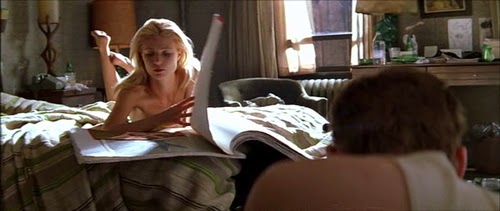
"Draw me like one of your British girls."


In looking at this one, I should note that my feelings of this as a film and my feelings of this as an adaptation run on two different tracks. In the interest of giving this one its due on its own merits first, let's start with just how this stands as a movie.

Just taken as its own movie, Cuarón's Great Expectations is kind of a split film. There's some elements of it that are actually quite good. Unfortunately, the areas it misses are such that it's hard to look the other way.

To start off on the good foot, let me say this: for a man who doesn't direct. that often, Cuarón does good work when he is in the director's chair. Even on this film- which isn't his strongest (that prize may continue to go to Children of Men)- he still manages to make it look very good. Between the camera work in several scenes and the cinematography by Emmanuel Lubezki, the film has a rich visual palette going for it, and is arguably its strongest point. In fact, the only part where I really had any issues with the direction on this movie was during one fateful scene, as Finn and Estella (Ethan Hawke and Gwyneth Paltrow) are having an intimate moment early in the film. The sequence has a dutch angle that makes sense at first for conveying perspective of Estella from where Pip is sitting – it does help establish their dynamic in the scene, and it's a well set up look. The problem is, a similar angle is then used on Pip, which doesn't really do much to convey his role in this dynamic. Instead, it makes the angles in the scene appear to be less thought out for characterization and more style for style's sake. Which is a shame since, this scene aside, the movie makes the most of its visual style.

Beating Battlefield: Earth to the inappropriate use of Dutch angles by a good two years.
Suck it, Travolta!


Besides the camera work, many of the supporting cast members are well chosen. In particular, I have to give shout outs here to Chris Cooper and Anne Bancroft. In the case of the latter, while I had some issues with how Bancroft's character was rewritten, I definitely can't fault her for her part in this – for the part she's given, she plays the role quite well. The result is a good level of eccentric without going completely overboard. It's not the bitter vengeful recluse that her character started life as, and the film wants us to believe is still in there, but for playing a strange loner, Bancroft gives her a sort of weird energy that keeps her from feeling like just a caricature. Cooper, meanwhile, offers a bit of a more grounded variant on Joe for the updated setting. Where the original Joe is a simple-minded blacksmith, with a speaking style that wouldn't really hold up well here, Cooper's Joe is a fisherman and a blue collar worker – a role he plays with a very easy-going air. It's a shame his arc is so pared down in this version, because Cooper really does a good job with capturing why Joe is considered one of the few genuinely good people in Pip/Finn's life. The rest of the supporting cast also help carry the movie, including Hank Azaria in a very buttoned-down turn and Robert DeNiro, from when he was still actually acting instead of just embracing an archetype.

"Okay, kid. Unless it's Scorsese, do NOT let anyone know you saw me!
Got it?"


Finally, I have to admit – the soundtrack to this movie is actually pretty solid for the era it was made. It's not one that will go down with the all time greats, but it still keeps the film moving along pretty well for the most part, in particular with contributions by artists such as Iggy Pop and Tori Amos.

Okay, that covers the pros- now on come the cons.

Remember how I discussed how the supporting cast in this are among the movie's stronger parts? Sadly, this isn't the case with the leads. I'm still not sure what it is about Ethan Hawke that either motivates or demotivates him in his acting. I know he can work well with certain films, as proven by his collaborations with Richard Linklater and the movie Gattaca. In this, however, he's rather flat. I could partially understand this by nature of the fact that the character he's being written from is very introspective. Most of what we know of Pip in the book is not from what he does, but what he intimates to us through his recollections. Unfortunately, even the attempts to flesh out Finn through voice-over narrations (ghost written by David Mamet) don't feel like they fully connect. They make for some nice prose, but they seem to be running on a different track from what we see on screen. Meanwhile, as the cold, but beautiful pedestal constantly out of Finn's reach, Paltrow's Estella alternates between being a good idea and a bad idea. At the start when she's supposed to be completely detached from Finn, Paltrow fits fairly well. The problem comes when she's supposed to start warming up to him and eventually play on his emotions – a plot this version never really seems all that committed to. For as much as this movie is interested in making a deal of Finn and Estella's romance, there really isn't much chemistry between them.
This is where I'm gonna have to also touch on the film as an adaptation, because it does partially tie into my issues with this film's writing. I do have to give Cuarón and Mitch Glazer some serious points for ambition, because this is an interesting idea. The problem is, a lot of the time it feels more like the story is a jumping off point for their own entirely different story, one where Pip/Finn is a talented artist who just needs a lucky break and a greater emphasis is made on romance. Now, this wouldn't be a bad idea  if it was well-written in its own regard. The problem is, it rushes so quickly through its own story that many characters are essentially fast-tracked through their developments. Most egregiously in this regard is when Bancroft's Ms. Dinsmoor finally realizes just how badly she's ruined Finn's life. In the original story, we see this played out in a few visits as Pip realizes how Estella has now turned against her benefactor, leaving the old woman alone again. In this case, she turns up in the city, Finn confronts her and lets her know how Estella broke his heart, and she caves in like the proverbial house of cards. Bancroft makes a game effort to sell the regret, but it doesn't change the fact the road to that reveal is so rushed it feels arbitrary.

I know sequels are all about pushing the envelope, but I am REALLY not getting a good feeling about this sequel to The Graduate.


As a movie, I find it an interesting, albeit flawed attempt. As an adaptation, the film is a big disappointment. Like I said at the start of this project, there's a lot of little events one can play with in looking at Great Expectations, but as an adaptation, it is first and foremost on Pip. It's his growth, both into class and into an adult and more rounded person. His feelings for Estella are certainly a part of that, but ultimately he still has a life beyond just her. In this film, that is the only real relationship he seems to have. Sure, there's still Joe at the beginning and end, but without characters like Herbert Pocket or Wemmick on board, this means Pip in this case spends the bulk of his time fixated on his relationship with Estella. Even more perplexing since it was never reciprocated in the original book – Pip falls hard for her, but Estella always keeps him at an arm's distance. Seeing her not only reciprocate here, but actually initiate sex on one occasion just feels VERY out of place.

Also, I'm not sure why the drinking fountain was deemed the best place to initiate not one but two French kisses, but this film apparently was pretty sold on the idea.


The sad part being, again, I could live with this much of a departure from the source if it was done well. Unfortunately, a rushed script and weak leads leave the whole thing hollow at the center. Which is a shame since, as I said, there are some elements of this movie I actually really appreciated.

In all, it's an interesting experiment, and I will continue to give Cuarón and Glazer points for making the attempt. As it is though, its weakness is in a crucial place, and the strengths of some good acting and some great directing can only undo just so much of the damage.

However, for an adaptation I approached with skepticism, this was better than I expected. Still not great, but it at least had more to offer for it than I initially expected. If nothing else, this DID further convince me I need to look into more of Cuarón's filmography, because even back then, the man knew his way around a camera.

That's two in. The next entry is in two weeks. In the meantime, keep an eye out – episode two of The Strain and another film writeup to follow in the next few days.

Till then!

Friday, July 18, 2014

Mobile Suit Z Gundam: A New Translation I- In Which Giant Robots Ride on Dewbacks

Okay, I did shorten it. The longer title of the movie would make this title bar even worse.

Now then, as the timeline goes, I should clarify something now before going any further. This wasn't the next immediate movie after the last entry in this project. In fact, there were a handful of others between that, for a couple of reasons, I omitted from this project. The first reason being- of course- only twelve entries for the year.
The others, let's tick down the list:
-Gundam Wing: Endless Waltz-Special Edition: Really not much to add for this as a movie goes. It's essentially the three episode straight to video sequel all cut together, with a couple of new scenes and a change in vocal song. Nothing was cut for time.
-08th MS Team: Miller's Report: Similar problem. The movie is essentially just a longer version of two episodes of the show stapled together. It makes for an interesting companion piece for the series itself, but not really offering a lot on a movie level.
-The Turn A Gundam compilation movies: These almost made the cut, actually. I had a change of heart for two reasons; first, to fit new titles coming out within this past year and (more damningly) the fact these movies have no translations beyond some Hong Kong bootleg subtitles. Having seen the first, I can honestly say their erratic pace and editing make things confusing enough without having to contend with machine-grade translations to boot.

Which brings us up the timeline (and past a few 'Special Edition' speed reads of some series) to 2004. Around this time, Bandai had its first big movie announcement in a long while: to commemorate its 20th anniversary, Mobile Suit Z Gundam, the popular sequel to the original series, was getting its own compilation movie trilogy. To further sweeten the pot, the project was to be helmed by series creator Tomino himself, with promises of a more upbeat ending.

What followed? We'll get to that.

To bring up to speed for those just tuning in, the story of Z Gundam takes place roughly 7-8 years after the end of the original series. After the devastation of the One Year War, the Federation created a security branch called the Titans to maintain order at any cost. This went about as horribly as could be expected and lead to a rogue faction within the Federation determined to oppose the Titans. In the middle of this brewing civil war is hot-headed teenager Kamille Bidan (voiced in both the series and movies by Nobuo Tobita) whose political views and temper soon get him pulled into the conflict as well.
As the first series after the original, this helped solidify the fanbase of the original Gundam and turn the brand into a powerhouse. Further, the decision to move the stage to a new group of characters with much of the returning cast in supporting roles helped give the brand some extra longevity at a time when they could afford to keep milking the same names and faces.

"Yeah, you're not really in this one much, but look at the bright side, Amuro:
You're still getting a spot in the opening credits over people with a lot more screentime than you!"


Anyway, that's a quick overview.

So how did these movies fare?

On its own,  I find myself really torn by this first movie. I will admit to some bias, both for and against it as a fan of the show, so let me just get that out of my system now. With that acknowledged, I'd just like to start this off saying these movies are kind of a problematic set-up right out of the gate.

What do I mean by this? Let's compare them with Sunrise's earlier, and more well-known compilation trilogy for the original series. The first movie trilogy took forty-three episodes worth of material, with a fair handful removed pretty seamlessly as one-off storylines and was able to pare the whole thing down to three movies over two hours each. Even with that run-time and as much cut as they have, the movies still feel jam-packed, especially in the first two cases.
By comparison, A New Translation takes a fifty episode series, one with considerably less 'disposable' events and cuts it down to a trilogy of movies where each clocks in about ninety minutes. So we're taking a long series with more content and trying to cram it into a space roughly ninety minutes shorter than the previous trilogy.

As you can imagine, a LOT is getting cut here.

In the case of the first movie Heirs to the Stars the cutting is actually not that badly done. Events-wise, the movie covers a span of roughly the first fourteen episodes. Given a lot of the more self-contained character development events in this section of the series, it actually compacts down a bit easier than later parts will. In fact, much as I feel odd admitting it, some of the decisions made here are pretty good. In several cases Tomino opts to streamline the narrative by folding certain events into one another It suits the first half of the movie well, creating a tight narrative without feeling like the fast forward button got broken. Once they come to a break in the action that momentum stalls a bit, but it does make up for it again after a middle slump.

Take THAT, physics!


In fact, while I have issues with the later two movies (we'll get to those in time) I do have to concede the first part of this trilogy, for what it's covering, isn't that bad for the most part in terms of time management. Really, there's only three areas I'd say its structure suffers. First of these is with regards to the very beginning: the incident that really gets Kamille sucked into the main story is when he picks a fight with a Titans officer and later rival, Jerid (Kazuhiko Inoue.) In the series, you see the fight as it happens, which makes sense. The movie starts off with a decent idea, bringing us in after Kamille's been placed under arrest and he's getting grilled by an MP. This would be a great point to discuss the fight, and possibly flashback to it. We get a flashback- but it's not for another half hour of film and then it's by Jerid in a rather out of left field sequence. It's a sequence that starts off setting itself up pretty well before making a really baffling call on a choice that should have been easy. From there, the other areas that suffer are the above-mentioned momentum break (I can understand why they want to keep the developments of the sequence, but the movie really does just seem to flounder at that point) and another case of a character taking that previously mentioned mysterious bus to Mexico. The latter isn't as much of an issue in this particular installment, since their death would have been near to the end of the movie enough to save discussing it for next time, but they're never mentioned again, so on the bus they go!

Sorry guys, but in the future, teen melodrama DOES still get some priority.


Alongside the storyline issues, there is one other big problem this movie suffers from. In comparing this to the previous compilations, it's worth noting how much time there was between series and movie. Mobile Suit Gundam was only about a year after the series ended. 0083 made its movie before the last episode of the series even hit shelves. Turn A's films were within the year of the show's end, and so on. You can likely see where I'm going with this: these were made shortly thereafter so the new material could still blend in with the existing footage pretty seamlessly.
Then we come to Zeta. I want to reiterate - these movies were being made as Zeta's 20th anniversary celebration. There is a good twenty years between when the show went off the air and these films were made. The transition goes about as well as…let's just say the Star Wars Special Edition joke in the title is there for a reason. Now, to their credit, the new animation is actually quite good. The problem is, it clashes badly with the original footage. This is a problem that time can't really help. The overall quality of productions has changed too much since the old days to properly replicate the footage of yesteryear. So the optimal approach for these films would have been to either use only prior footage or reanimate the whole thing from scratch. Instead, they tried to meet this halfway, and the results aren't great.
I might not dislike this part as much as I would were there at least some consistency in what got reanimated. The new sequences of mobile suit combat, for example, all look great. They offer some nice detail and fluid fight choreography the likes of which the show's older budget was somewhat limited on. On the other side of the coin, there are random parts of newly animated character scenes that seem to be chosen entirely at random. As a result, there are sequences in the film where the footage will be largely old before randomly cutting to one new sequence for a character reaction. If these movies were made in the 80s, this wouldn't be a problem. Given their current age though, the new scenes stick out like a sore thumb.

Here we have before
and then after, when Kamille punches modern production values and flashback lines into the scene a mere second later.


Aside from the problems with story and animation, this movie's otherwise pretty solid. Like I said, the new animation, though it clashes badly, is good on its own. The voice cast are a satisfactory spread of old and new, with the returning voice actors (including the late Hirotaka Suzuoki in his final role) all fitting their original roles quite well, even after all these years. This is especially surprising in the case of Tobita, who can still slip into the role of teenage Kamille pretty easily here. Likewise, the soundtrack is a great mix of old and new: Shigeaki Saegusa's soundtrack to the original series is back here in great form, and it's nice to hear it's held up quite well. Alongside this, the movie also provides two new inserts by Gackt - who provides songs for the whole trilogy - singing the movie's opening and closing themes. For the purposes of this movie, the two pieces really fit the film quite well.

All in all, this isn't too bad as far as Gundam compilations are concerned. It's certainly not flawless by any stretch, mind you. Its age betrays its attempts to modernize, and its brisk runtime, while occasionally helping propel the film, also leads to a couple of confusing creative calls. While the earlier Mobile Suit Gundam films can still be taken on their own, these are movies that are much more clearly intended as a bonus for people already familiar with the series. If you're already a fan, this movie's actually something of a nice refresher. It's certainly no substitute for the series, but as a means of seeing a fresh take on certain highlights, it's an entertaining hour and a half.
 Well, this one fared better than I remembered.

Of course, I recall more of my issues being with the later two movies anyway. So, we'll see how those hold in the months that come.

In the meantime, Summer Reading's back!

Till then!

Monday, July 14, 2014

The Strain – S01, E01 – 'Night Zero'

We're off and running with the premiere edition of weekly TV reviews.

I'd be lying if I said I haven't found the reactions so far on the web interesting. There's a fair amount of good buzz, but also a lot of people who are less than enthusiastic. It's interesting to see this much of a divide, really. Not uncommon, but still interesting. For my own thoughts, feel free to read on.

As of the first episode, we're introduced to the early phases of del Toro and Hogan's trilogy: a Boeing 777 from Germany makes an unexpected landing in New York. Unexpected because, save a few, everyone on board is dead under mysterious circumstances. As a team from the CDC, led by divorced father and misfortunately named scientist Ephraim Goodweather tries to discover what happened, old antiques dealer Abraham Setrakian sees in the incident a ghost from his past, and the shadowy Stoneheart Group prepares to make its move.

Also vampires.

Hey I'm trying not to give too much away here.

For starters, I want to go on record as saying I'm glad that it looks like Guillermo del Toro doesn't plan to just guide this one from the producer's seat. Not just because of the uneven quality of the works where he's acted as a producer, but it also means he's directing several episodes this season. Having him helm this first episode is actually one of its best strengths overall. The story itself can be occasionally cliched and silly- and we'll be getting back to that- but the man knows how to make it look good. The moment that really sells it – and this seems to be the scene that's netting a lot of the praise for the show's first episode – is a moment when a luckless coroner winds up finding out all too late the horrible truth about the passengers from the dead airplane that starts this series off. It's a well done bit of creepy escalation that adds to the long list of setting a scene to seemingly inappropriate music and having it stick. I'm not sure this will supplant the Red Sox fans' claim on Neil Diamond's 'Sweet Caroline', but it makes a damn good bid for it all the same.

Even in New York, the strains of Neil Diamond can reach out to Red Sox fans...
Just make sure they don't notice the Yankees t-shirt you have on under your work gear.


Direction aside, the episode is hit or miss based on what plotline or aspect you choose to focus on. I suppose it bears repeating from last time – for being the designated hero of this story, Ephraim Goodweather (played by Corey Stoll) is the weak link of the series, both as far as the books at large, and in this particular episode are concerned. Now, I'll grant that this isn't a cast that's exactly designed to be all that groundbreaking or original, but the other characters del Toro and Hogan introduce over the course of the series, for all their well worn tricks, are at least interesting enough to keep me intrigued. By comparison, Goodweather feels less like a character and more like a laundry list of characteristics of everyman heroes: he's passionate about his work, often at the expense of his family (which has lead to his divorce, though he is still seen as quite amicable to his wife and very loving to his son,) he's treated as the best at what he does, though he still butts heads with authority figures, and his coworkers all defer to him. It's a shame that, for being the weak core of this, his plotline in this episode is actually still the strongest, and Stoll makes a decent effort at playing the role. However, I have to admit, he does feel a bit too- and I hate to use this phrase but not really sure if there's a better fit - 'television pretty'.

His involvement aside, the CDC story is actually plot that's the most well-handled, and that's for good reason. Of the three prominent stories, it's the one that can afford to tip its hand the most. We see enough to introduce us to other characters in this series, such as aged vampire hunter Abraham Setrakian or the shady (and also somewhat misfortunately named) Stoneheart Group, but their plotlines are still shrouded in mystery by comparison. Their roles here are more to introduce the players while the script is more focused on the mystery of what happened on the fateful Boeing flight featured in the show's cold open.

As far as how those other plots go, it has its ups and downs. As of this first episode, David Bradley is shaping up to be the cast MVP as the aged Setrakian. For a man who most American audiences more likely recognize from background roles like the cantankerous Argus Filch or the now VERY despised Walder Frey, Setrakian is going to seem like a change of pace for him. He's a more active character, a sort of modern day Van Helsing. He makes a strong first impression, playing both sides as the feigned harmless old man before showing the iron hidden underneath it waiting for a moment to strike.

"Okay, maybe it's time I finally flush the sea monkeys."


The third plot, involving the secretive Stoneheart Group, is probably the weakest right now from a writing perspective. The show does make it clear they had a hand in bringing vampires into Manhattan, but it's keeping the full nature of their plans under wraps. On the one hand, this makes a lot of sense, so as to not reveal too much too soon. On the other hand, it also means the involvement here is vague at several points. Partially suffering as a result of is Miguel Gomez as local gang member Gus, whose attempts to make some money to support his mother get him involved in the greater mystery. Gomez, like Bradley, is an almost pitch perfect match for the character. Unfortunately, he really doesn't have much to do here, so he comes across as a pretty broad stereotype. We get hints of things to come, but that's about it.

Having read the trilogy, it's a bit of a challenge for me to try and review this from a completely detached perspective, especially in a case like this where knowing what's coming really does help inform how some of the elements of this episode get taken. Just taken on its own, I do see the case of a lot of frustrated reviewers with regards to how flat some parts of this seem right now. I happen to know where they're going with it, but just on its own, it's not really giving the audience much to work with yet. Even more frustrating (and even with the book knowledge, I can admit this much) is the fact that what knowledge this does give is often  overtly spelled out, rather than subtly delivered. The prize winner being the decision as to how to allude to Setrakian's past as a Holocaust survivor. Again, I'll grant that on its own is already kind of a cliché, but having it get revealed by having someone ask about his tattoo isn't helping.

Despite these faults, I'll admit that I feel I got my figurative money's worth out of this episode. The writing and characterization aren't particularly noteworthy just yet ( and to be fair, most shows take a bit to really get the ball rolling) but at the same time, when it worked, it worked well. The horror aspects in particular are already delivering some great moments. Besides the above-mentioned 'Sweet Caroline' scene, the episode's cold open and ending make for some great moments of build-up, as does our first look at the infamous Master, a hint of more del Toro creatures to come. This won't be sweeping up Emmys hand over fist, but at the same time, it doesn't really feel like that's what the show wants. For the story it has to work with and the elements they're emphasizing in the marketing, they've delivered nicely. If they can bolster up the acting and writing, that'll make for some very nice icing on this cake. Additionally, I'm really hoping del Toro continues to stick around as part of the show's circle of directors – because there's some moments in the later books I would really love to see from his perspective.

As our first introduction to the world of The Strain, 'Night Zero' is about what I was expecting from a pilot episode. It's got a number of rough patches to smooth out, but it also has signs of enough promise to build from. Between del Toro's direction and some good casting in the supporting roles so far – again, shout out to Bradley – this has the potential to make for a good adaptation, and possibly even surpass its source material.
Essentially, not bad for a first episode. Not jaw-dropping, but still a decent proof of concept. Join us again next Monday for the next episode, 'The Box.'

"Astin, for the last time, they've been talking about that Goonies sequel for years. It is NOT gonna happen, man! Let it die!"


Be sure to keep an eye out for other general entries here as well, including the second of this year's Summer Reading picks.

Till then!

Sunday, July 6, 2014

A Less Academic Summer Reading Project: The Strain

A Less Academic Summer Reading Project: The Strain

In a year where I'm already doing three other theme projects (cause yes, Halloween is a go once again), I am still trying something new for regular material.

This was an idea my editor had suggested and one that I can get behind. Initially, I hadn't given much thought reviewing a series as it aired, but after the monster that my end of the season write-up for Game of Thrones turned into, this approach made a lot more sense. It meant no longer having to go back and go over a whole season/series worth of events to discuss why a certain issue irked me. Plus, it's also easier for you to read my discussing one hour of footage a week instead of ten in two articles.

The film projects will also be continuing, naturally (especially now that I know theaters near me are playing Snowpiercer) but this also gives me something else to work with for a while during those times when I'm looking for good material in films or news to discuss.

So why The Strain? Well, we're going to get into some reviewing of the books, so this isn't entirely just announcement.
As I've said many times before, adaptation fascinates me as a process.  Translating works to the screen can be VERY hit or miss, and they can run anywhere from almost blow for blow faithful to different but still faithful to the theme of the work to different entirely but still good on their own merits to missing the point to- you get the idea.

In the case of The Strain, it's a book series that I've been curious to see an adaptation of for a while. Because the books have some interesting ideas to them, and even some of the generic elements they manage to spin in good directions. Yet when all is said and done, it feels like this is a story that really wasn't cut out for the printed page.

The trilogy (The Strain, The Fall, and The Night Eternal) is the brainchild of filmmaker Guillermo del Toro and crime writer Chuck Hogan. The story-as best I can sum up without spoiling too much- starts off concerning an airlplane that touched down on in New York with all but a few of its crew and passengers dead. As a CDC research team (lead by the somewhat awkwardly named Ephraim Goodweather) tries to investigate what happened, other strange events begin to unfold. Ultimately, the story offers up an appropriately del Toro style retooling of vampire mythology.

The different take on the mythology is arguably one of the strongest elements the story has going for it. Within this setting, rather than being polished aristocrats or brooding on their immortality, vampires are effectively a plague- beyond those absolutely desperate for immortality, this life offers no appeal. Some have compared the vampires of the books (often referred to as strigoi) as being little more than zombies, though their behavior is a bit more organized and animalistic by comparison. There is intelligence within them, particularly in the older earlier members of the race, and a sense of hierarchy that defuses the zombie comparisons. Interestingly, the creature they compare to the most are del Toro's own earlier incarnation of vampires, the mutated Reapers from his Blade 2. In fact, a lot of the ideas within this narrative are a chance for del Toro to revisit and flesh out more of the ideas he had on that movie as well as on his work before being turned down for Blade 3.

"Form an orderly line, ladies.
There's plenty of vampire to go around!"


That element aside, the story is hit or miss in its execution. The books actually start fairly strong, with much of the first book building up the mystery of what happened on the airline and what threat is slowly looming in the shadows.

Probably the biggest problem is in the characterization. Now, many of the characters in this aren't bad. In fact, several of them, while kind of cliched archetypes (an example being Abraham Setrakian, an old man who has been hunting the strigoi in secret for much of his life, dreading the day they made their move) are at least fairly likable in their depictions. Otherwise the only characters where I'd really say the books drop the ball are the head of the CDC (a character who plays out as too much of an archetype to take seriously-the fact it appears he's been completely rewritten for the series is a big plus to me) and the Goodweather family at the center of the story. Where many of the other characters in this are at least entertaining to watch play out their archetypes, Ephraim, his son, and his ex-wife all stick a little too close to type to really give us much reason to care about them as characters. By the time one gets to The Night Eternal, where we're supposed to see Ephraim's character pushed to his limits, rather than feel sympathy, we wind up relating more to his peers who are frustrated by his absolutely inert state. Even the attempts to build his son's character, while conceptually interesting, never really go much of anywhere. Meanwhile, the ex-wife never quite emerges past the cliché of the shrewish ex. The book at least acknowledges she's not entirely wrong for divorcing Ephraim, but it's hard to deny it's pretty firmly on his side in the matter regardless. In the end, the conflict that's supposed to be the heart of this story becomes its weakest plot, and makes much of the third book a slog.

With grievances like that, I suppose some of you are wondering "then why the Hell are you going to be watching the series?" Well, there's a couple of reasons for that. For starters, the promotions so far have been looking promising. If nothing else, they look to be capturing the suspense of the first half of the first book quite well, so I'm looking forward to that. For another, the cast are looking fairly promising as well. In particular, I'm pleasantly surprised by the casting of David Bradley as the aged Setrakian. When it was first announced John Hurt was stepping down from the role, I was disappointed, but it didn't take long for Bradley to convince me he could pull it off. For the number of places he's been turning up in those (for lack of a better term) 'hey, it's that guy!' roles, it's gonna be nice to see him promoted to a main role.

Finally, like I said before, one of the biggest stumbling blocks of this story is in its medium. Yes, the characterization is pretty iffy in some regards, but alongside that, its other big failing is in the writing. I want to clarify that the writing isn't awful. I mean, there are some works out there where the writing alone is legitimately painful. In this case, the writing even starts out pretty well. As a crime writer, Hogan is a good fit for the first section of the books, and when he's playing in the slow burn, he's right in his element. It's when the characters are coming together and the mythology starts getting laid out on the table that his writing starts to hurt. It's still alright, but it doesn't seem to really channel del Toro's zeal for the otherworldly that the more mythos-heavy sections of the story need. As they are, the concepts are interesting, but the delivery is dry.

Knowing this story was first conceived to be a television series, I have a good feeling it will translate better. In particular, the two big stumbling blocks mentioned above have good odds of being avoided. A good director can help build up those elements of mythos more beyond the very matter-of-fact presentation Hogan gives them, helping bring more of the del Toro elements back. Likewise, between different writing and the cast in question, I have hopes the series will be able to improve the characters more, and I might finally find Ephraim a character worth really caring about for a change.

I am also curious to see how a series will handle the events of The Fall and The Night Eternal. For one, the books tend to run a bit fast, so they might try and let those breath a little more. For another, they are very much a game changer (and that's all I'll say) in terms of story which could make an interesting challenge for the show runners.

Suffice it to say, I'm pretty interested in seeing where this goes. The original source has potential, though its execution falls short at times. With a different creative team and different restrictions in terms of time and delivery, this could potentially surpass the original material...I said potentially. Don't go holding that against me if the show doesn't work out. Just calling it as I see it now.

So, alongside the other articles being covered, keep an eye out for these as well. First entry will be going up next week following the airing of the first episode.

In the meantime, got more lined up for the next few days.

Until then

Also, the second book features an ex-luchadore fighting vampires.
I couldn't work this as readily into the review, but it IS a nice selling point.

Thursday, July 3, 2014

Summer Reading: Great Expectations (1946) – Big Pippin'

Yes, I know. I'm an awful human being. I apologize for nothing.

Well, as I said in introducing this year, the film that started it all for me was David Lean's 1946 adaptation of Great Expectations. Let no one say I went back on that deal.

"Just great...unless we can figure out how to get this door open, we're going to be late for the Lucky Charms auditions!"


This is a curious case of an adaptation since it's one Lean went into without having read the book. While this would ordinarily would bode ominously for an adaptation (for two infamous examples, see David Lynch's version of Dune or Paul Verhoeven's Starship Troopers-which isn't bad, but REALLY clashes with the source material) it actually works out pretty well here. It helps that Lean initially hadn't intended to take on the project but was sold on it after seeing a staged production featuring a young Alec Guinness (who would go on to make his first major film debut in this.) The resulting film, taking many of its cues from that other adaptation, makes for a pretty enjoyable, albeit brisk, run through the original novel.

I'm going to stress the briskness here. Where Dickens' 400+ page novel paces itself over a lot of smaller events and introspection, this movie clocks it all in at just shy of two hours. Like with last year's choice, the nature of this book means sacrifices will be inevitable, with each new adaptation picking and choosing what to focus on. In this case, the focus is all on Pip (played as a youth by Tony Wager and then as an adult by John Mills.) Which is perfectly understandable, but I do admit to feeling a bit surprised on the rewatch at how sparse some of the other characters are by comparison in this version. I'm not gonna raise Hell over less of someone like, say, Pumblechook (who I can see the purpose behind, but the fact is, he's a character who's meant to be something of a pompous blowhard, so it's hard to say I'd miss him here), but I was a little disappointed to remember just how little we see of Wemmick and his double life. Again, I can understand why, but as one of the more likable side characters in the book, I do feel a little sad seeing him get really only one major moment (though Ivor Barnard does make the most of trying to show both the 'work' and 'home' sides of the character.) Even then, those two still make in to the final cut. By comparison, characters like Startop and Orlick are completely excised. Granted, Startop, admittedly, is pretty easy to drop without much noise, but Orlick takes a few plotlines to the cutting room floor with him.

From The Big Book of Cruel Games:
Telephone With The Elderly - For Those Who Like To Play With an Extra Level of Difficulty


To be honest, I think the only area where I'd say the story trimming is actually of a detriment is with regards to how it relates to Estella (played by Jean Simmons and later Valerie Hobson.) I can understand the reason why the movie cuts out the secrets of her parentage and her drifting from Miss Havisham, but at the same time, that's really a big aspect of her character. Without that, she really feels one dimensional. I could argue that is partially on Dickens, who had issues with his female characters, but the adaptation had the chance to work on that. Admittedly, I could keep going on the things that got cut, but that would just be petty after a while. The point is, this is a pretty slim adaptation overall. While I do miss a lot of the omissions, the movie still holds up what it has left pretty well, paring down of Estella's character aside.

On its own, this is a pretty nice look at a side of Lean that people can forget. On the one hand, the man was responsible for some of the great 'epic' films of cinema – films like Lawrence of Arabia, Doctor Zhivago, and The Bridge on the River Kwai are some of the titles that really helped secure his place among the greats. By comparison, his version of Great Expectations is a lighter, more personal, and at a few points, show a playful side of Lean. On the rewatch, I was actually surprised at a number of the littler touches in direction I had forgotten about that really help the movie at points. The opening scenes in Pip's childhood, for example, uses several interesting little tricks to help emphasize young Pip's mindset, with forced perspective to place us on his level, and one particularly standout moment during his act of theft where his nagging conscience takes the form of many unseen voices calling out and accusing him. It's one of those bits of the book that one wouldn't expect a film version to include, given it's an internalized element, but Lean's showing us these scenes at Pip's level allows for greater understanding and characterization. Another great standout- both for direction and time management- comes in the middle of the movie as Pip undergoes his tutelage to become a gentleman. This is a sequence that takes up a large chunk of the book, and admittedly could become tedious on screen. Fortunately, Lean manages to streamline a lot of it into a pretty breezy montage, helped along by performances by Mills and an endearingly energetic Guinness.

"No one gets away from the student loan companies!
NO ONE!"


Alongside the general direction, another area where this film version really proves itself as an adaptation is in regards to its cinematography and art direction. Wilfred Shingleton and Guy Green (art director and cinematographer, respectively) combine their abilities to help bring many of the locals of Dicken's novel to life. For a movie that turns sixty-eight this year, they still look quite good. Highlights like the opening sequence on the marshes and the numerous scenes in Miss Havisham's run-down estate still do justice to their source material.

Finally, as strengths go-and this is often the case with a Lean film- I'd be doing a big disservice to not discuss the actors. Doubly so for an adaptation given they're the ones bringing these characters to life. In this case, I do have to give many of the cast credit for making the most of the fact that many of their characters are presented in somewhat diminished roles. As the main focus, John Mills carries himself well as Pip, though it's a bit strange realizing he was almost forty while playing Pip's teenage years. Though this works to his advantage in some parts, particularly in the voice-over narratives as an older Pip recounts his life. In these parts, Mills does give him a bit more of an 'older, wiser' sound compared to his younger years, where he has a more hopeful, but somewhat reserved manner. Even during the moments where Pip's emotions do come up, Mills does a good job with conveying it in Pip's restraint. It's an interesting take, but one that also fits the British approach to life. As Estella, Hobson is a choice people have criticized over the years. Personally, I don't think she's that bad (though I must admit, I think Simmons nailed the character a bit better in the younger years) but I do have to admit, she did almost feel like she should have been a bit more emotionally cut off, given the nature of her upbringing. She has a decent chemistry with Mills, but it feels odd for the dynamic Estella and Pip are supposed to have. The supporting cast has a lot to offer, and appropriately, the two biggest standouts here were the two who were also involved in the stage version that sold Lean on this project in the first place: Alec Guinness as Herbert Pocket and Martita Hunt as Miss Havisham. Guinness, as I said before, plays Pocket with a sort of energetic and easy going air that is actually a charming touch for him. Compared to many of the roles he's known for in his later years, it really helps speak to the range the man had in life. As the reclusive Havisham, I found Hunt an interesting pick – at first she wasn't entirely what I'd pictured of the character, but she found her own sort of rhythm for the role, playing it with a sort of detached weariness later tinged with regret that I found grew on me. It did make me a little sad we never got to see more of her split from Estella, cause I would have been interested to see how Hunt would approach the material.

"The Force? Never heard of the stuff..."


One last note I have to give this from an adaptation standpoint, partially because it's one that has come up quite a bit as a meta note on the film, is with regards to its changed ending. This source makes the idea of an altered ending a bit surprising already, given it's known Dickens himself changed the book's ending after hearing that people found the original finale to be too dark. Along these lines, Lean actually managed to do Dickens a bit of one better, in a way. Admittedly, it's an ending that nowadays would be criticized (some would argue rightly so) as the somewhat cliched 'feel good' Hollywood ending. Taken in its context, however, this ending makes a pretty strong case for itself. As a movie made in Britain in the early years of the post-war, the country was in a pretty bleak spot. Yes, the war was over and won, but that also came at the cost of a LOT of lives. In a way, Lean's redone ending seems appropriate for the situation: an older Pip returns to Havisham's house to find Estella, alone again, on the path to becoming another Havisham. Rather than see the cycle of misery repeated, he entreats her step out into the sunlight again and live, opening the windows and bringing light back into Satis House for the first time in years. Yeah, nowadays it seems a little contrived, but for the time period the movie was made in, I can honestly say I see the logic in Lean's choice here. It's sending a message of optimism that was really needed at the time. In a case like that, I think literary fidelity would be understanding enough to sit this one out.

In all, Lean's Great Expectations is a pretty solid jumping off point for this year's project. It's not a 1:1 recreation (with this book, it's highly unlikely to get that detailed easily,) but the fact is, for the elements it is working with, it does them well. Not necessarily the alpha and omega of adaptation, but a very good bid to tell the story in a brief window.

Well, this was actually kind of a nice revisit for me.

We've got more projects coming up soon, and the next Summer Reading in about two weeks.

Bear with me and keep an eye out!