Wednesday, October 26, 2022

Hellraiser: Bloodline - This Is the Way the Theatrical Run Ends, Not With a Bang, But a Cutting Room Slaughter

Welcome back to the Third Row, as we continue our Halloween journey into the weird, winding, and from here on out, incredibly messy Hellraiser series.

To recap - we’ve been introduced to the world of Hellraiser, we’ve gone to its version of Hell, and we’ve even brought that Hell back to the world of man. Despite the complications behind the scenes, the films still do well at the box office, with Hell on Earth becoming one of their most successful to this day.

With that momentum, Clive Barker wanted to do something new for the next entry. Collaborating with Peter Atkins (who had written the scripts for II and III), he began to envision a generation-spanning story about the origins of the puzzle box that started it all. After the fairly safe way Hell on Earth was made (safe for this series, anyway) it had to be a surprise that the studio green lit the ambitious idea without even an outline.

They set to work, developing the story of Hellraiser: Bloodline around the Le Marchand (later Merchant) family that first designed the infamous Lament Configuration, starting at its conception and following the family over the ages as it seeks to contain the dark forces it has unleashed.


A note before I continue - recently, Peter Atkins got to publish his original screenplay for th movie. It’s easy enough to find and can be gotten for a very reasonable price, so if you’re curious, it’s out there and it’s an interesting read.

Why did I bring that up here? Because as you likely guessed, what they envisioned is NOT what we got.

For as troubled as the road to Hell on Earth was, the movie’s actual production went fairly smoothly, if not perfectly. By comparison, Bloodline is the movie Doug Bradley described as ‘the shoot from Hell.’ In a sick sort of course correction from their earlier sight unseen approval, the studio suddenly had a LOT of notes once filming was underway, to the detriment of the production.

What was originally envisioned and filmed as an almost two hour movie was recut, retooled, and whittled down to under 90 minutes, with a skeleton of the original script, numerous characters completely cut and/or folded together, and set pieces either pared down to save money or just completely absent.

To add insult to injury, many of these weren’t dropped at the script level. There are behind the scenes stills you can find to this day involving characters and effects that were made for the movie and then ultimately discarded.

Probably the most famous example of this -
A group of Angelique's victims effectively serving as proto-Cenobites

The one thing the studios seemed reluctant to cut, of course, was Pinhead. While Bradley himself liked the fact this movie was focused on other characters, the studio wanted more of their big money maker. So much so that they did away with the original script’s linear, anthology style and turned its final section into a wraparound as a way to bring the character in sooner. That the movie begins with a quick flash of the iconic Cenobite even before the box summons him almost feels like a defiant jab by the editors at the studio's bidding.

While there’s a lot of changes and cuts I could point out in general, the one I really want to call out, as it relates to the threads I've been following, is with regards to how the studio wanted the role of Pinhead elevated, and how that impacted the character of Angelique.

Because this movie was focused on the history of the box, an object already established as having existed before the franchise's most famous figure, the original script keeps him absent for quite a while before bringing him back in a way that picks up the end of Hell on Earth. This meant the first arc of the movie instead is focused on the demon Angelique. In Atkins’s original vision, she is presented as a similar sort of corrupter as Julia - ostensibly bound to the Satanist who summons her, but playing on his desires to get him to do what she wishes. This gives the added element to the box’s creation that it was made to Hell's instructions, even if it needed human hands to come to pass. The finished film downplays that manipulation and leaves her a begrudging servant for the humans, implying her human master is more in control in commissioning the box - a rare time where I feel like emphasizing the human evil over demons was a misstep. By the time Pinhead arrives in the second act, the script (and the movie to a lesser extent) frames him as at odds with Angelique in terms of ideals and methods - an old guard vs new approach to Hell. It even gets to a point in the script where Atkins has a scene of Angelique actively trying to betray and destroy Pinhead, to her defeat and subjugation.


Unrelated, but one thing I will never not point out about this movie -

You have decent odds of winning a few bar bets on this film thanks

to the appearance by a young Adam Scott in the France storyline.

It’s an idea that feels like it wants to call back to what Barker and Atkins started in Hellbound, exploring the larger world of Hell (and Hellraiser) beyond a single character. Unfortunately, the studio wanted more of said character and were firm on that point. So once again, a movie that was envisioned as continuing the initial theme of focusing on the humans who dabble in Hell's power and what befalls them becomes a personal vendetta, with the family’s desire to undo what their ancestor unwittingly did focused instead on Pinhead specifically targeting them.

The more I’ve read up on this movie, the more I want to give it credit for what it was trying, even if it didn’t come to pass. The most charitable thing I think I can say to describe it is that it’s an interesting failure. Taken on its own, the film is straining to keep its cut and stapled story and budget together, but the flashes of what it once was still shine through at points. These aren't enough for me to try and argue the film is good - watchable, maybe, but that's not the same as good. Even then, it's at its best taken with its troubled production history as part of the package.

Which is my way of saying, if you really want to go this route, I will double down on my earlier recommendation - don’t just watch the film, track down that original script. Per Atkins’s own foreword, the production was so plagued with cuts and reshoots that there’s never going to be a director’s cut. Further, original director Kevin Yagher was so dissatisfied with the movie that he was able to get an Alan Smithee credit. It won’t make the movie itself better, but the perspective does at least lend a method to the madness.

One other thing I have to give the script -
The Siamese Twin cenobites pictured above are

more effectively creepy as Atkins first envisions them

without a backstory and with a description of their method of

killing that the movie's budget never had a chance to do well.

Okay, everyone. Collect your discarded popcorn bags and empty sodas, cause we’re leaving the movie theater behind from here, and heading the infernal pits of straight to video.

I’ll say this much now - for as many missteps as Bloodline takes, I feel a lot more forgiving of it knowing what lies ahead.


Till then.

Tuesday, October 25, 2022

Hellraiser III: Hell on Earth (And In the Studio)

Hello and welcome back to the Third Row. Where the journey into Hellraiser continues on as we ask the awkward question - when your second movie takes you to the bowels of Hell, where do you go next?

After the better part of three years and extensive money troubles, the answer, apparently, was a nightclub.

Hellraiser III: Hell on Earth marks a major turning point in the series based on the aspects I’ve been focusing on. Most notably, the two men at the center of it - original creator Clive Barker and the Cenobite affectionately known as Pinhead.

As Hellbound was under production, the question of where the series would go was already being explored. Contrary to what many would expect, Barker didn’t see the future riding on Doug Bradley’s butcher’s apron clad shoulders. Rather, his plan was to keep the focus on Julia as the main antagonist. This makes sense given how she’s framed in the first half of Hellbound - after being Frank’s mildly reluctant accomplice in the first film, the second sees her elevated to an agent of Leviathan and potentially outranking the Cenobites.

There were just two problems with that - the first was that Claire Higgins had declined to stay on, resulting in her character being written out at the end of the second movie. The second being that most ominous and powerful force in cinema known as marketing. Despite his supporting role in the first two films, Pinhead was (and is) synonymous with the Hellraiser name. With Higgins not coming back, that meant the most logical decision was to bring Bradley to center stage.

Once they got past the part where Pinhead and his associates were killed at the end of the second movie, that is.


"Ah, I'll be fine. It's Hell, I've been through worse!"

Of course, a dead antagonist wasn’t the only problem the series had at this point. Despite ambitions to keep the movies going, distributor New World Pictures was in dire financial straits all around. Eventually, the studio went into bankruptcy and one of their executives started a new studio that picked up the Hellraiser rights, though part of the tradeoff now was that the new rule for the next movie was ‘cheap and nasty’.

This approach caused friction between the rights holders and Barker, who objected to the lower budget the studio wanted the next movie made on. It didn’t help that Barker was coming into this fresh from being jerked around by Fox on his movie Nightbreed, so he was less likely to want to compromise and be left holding the bag a second time. He would eventually be persuaded to come back as an executive producer, but by that time, the movie was in post-production, so the story was made without any contribution from him.

Instead, the new course was plotted by Tony Randel and new director Anthony Hickox (a choice Barker was less than thrilled with due to feeling his sensibilities weren’t right for the series.) The pitch they went with, per the studio’s interests, was smaller scale (despite its title) than the previous entry’s journey into Hell itself and made Doug Bradley’s demonic priest central to the story.

In trying to solve the question of their main villain’s death, they took a cue from the previous movie’s final scene - beginning with a demonic pillar bearing Pinhead’s likeness on it (among others.) While this movie is ultimately divorced from much of the earlier story of the ill-fated Cotton family, this still takes some inspiration from those earlier movies. Pinhead spends the first act of the movie in a position similar to Frank, if less taxing from an effects standpoint - his death rendering him without a body and a need to feed on others to restore himself. Not a bad idea on its face, but one hindered by the fact that, instead of Frank’s half-formed appearance, Pinhead is just a talking face in a pillar. Unable to do much beyond talk and use hooks on anyone who gets too close, the result feels like a mesh of Freddie Krueger and Hannibal Lecter - a talkative monster that seems like he’s trying to verbally dissect his prey to get them to do what he wants.


I have to give them some credit. It's hard to make a talking pillar menacing.

It's an idea that’s not devoid of potential, but it also requires more time and patience than this movie is willing to offer. The idea of leaning hard on temptation, and by extension corruption, could make an interesting thematic continuation of the series, but here it feels more like a means to an end than a major idea to explore. Once Pinhead is out of the pillar, the earlier idea of letting people doom themselves is forgotten and it’s time to make with the slaughter.

And oh, what slaughter do we get. This marks another area where you can tell marketing had a say - with his old team dead, Pinhead was going to need new Cenobites. In an unexplained shift from the previous movie, there is no need to send people to Hell or have them use the box themselves. In fact, this time out, Pinhead just creates new Cenobites seemingly at a whim. The result feels less horrifying than the earlier Barker designs and, at times, flat-out silly (though I suppose that IS part of why the CD Cenobite is so well remembered.)

Oh, I can't stay mad at you.

For what it’s worth, I’m not going to say this movie is a complete write-off. It’s a weird shift in themes and ideas from the earlier movies, but for what they have to work with, Randel and Hickox are making a game attempt at trying to keep some of the old flavor going. It doesn’t really land well, and it really calls attention to the absence of Barker for most of the story process, but their hearts were in the right place, even if the end result feels far more like a traditional horror sequel that marketing had a finger on the pulse for.

Besides that, the movie isn’t without its charms. It’s definitely a far cry from the dark fantasy of the first two movies, but it’s still a fairly brisk movie that has a certain silly appeal for how hard it goes for that ‘Hell on Earth’ title (on a budget, of course.)

I will also concede, by this point, I have made my way through the entire viewing block, so that may be helping my positive take on this one. In any case, what it lacks in the mystery or thematic weight of the first movies, it makes up for just in its enthusiasm to be the Hellraiser movie that the advertisers had been trying to sell since 1987.

It certainly did well enough to get them one more bite at the cinematic apple, in any event.

But that’s a tale for next time.

See you again soon as we make one last trip to the theater for the highly ambitious (and even more plagued) Hellraiser: Bloodline.


Till then.


Thursday, October 20, 2022

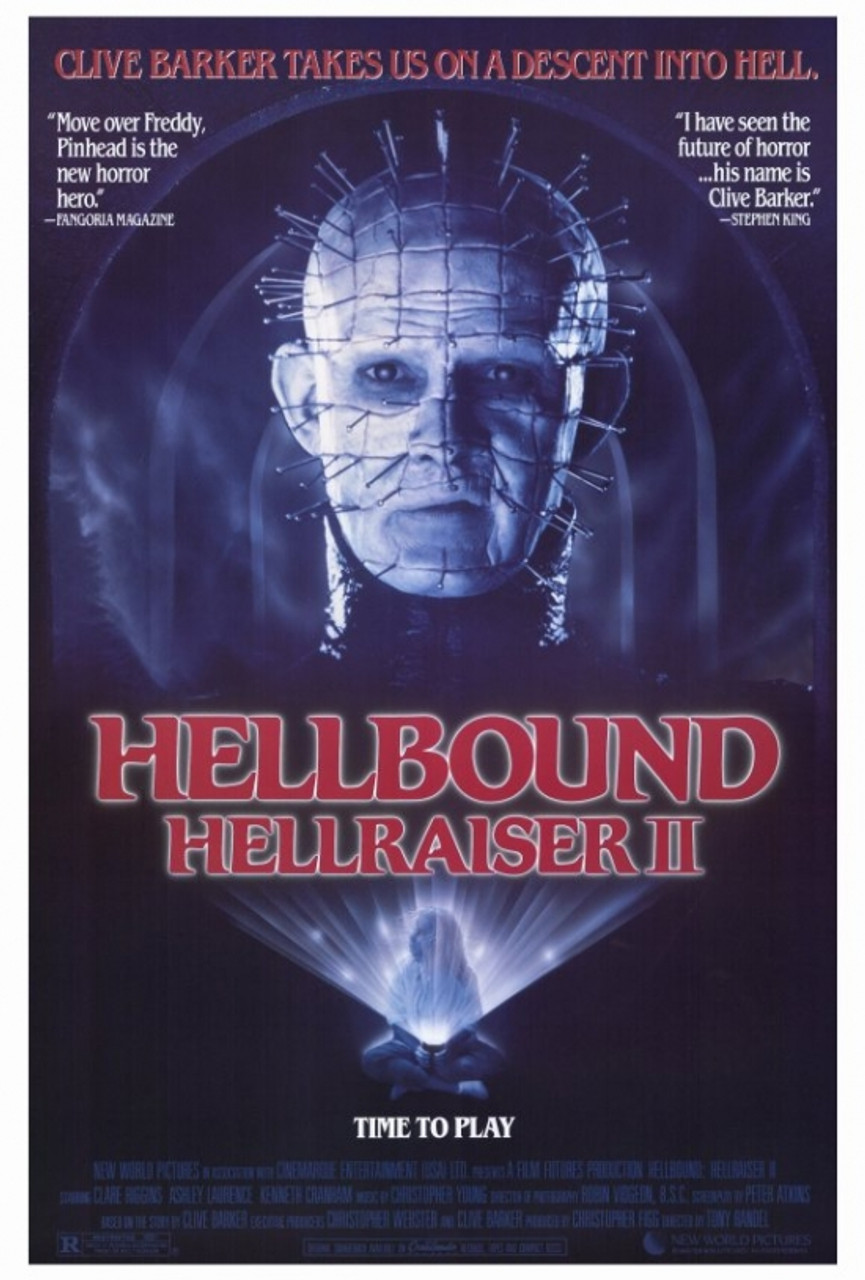
Hellbound: Hellraiser II - The Franchise Goes to Hell (and That's a Good Thing)

Hello and welcome back to the Third Row as we continue this October’s franchise dive into the weird, winding world of Clive Barker’s Hellraiser.

At this point, I have to give a proviso - in the past, I’ve tried to do the write ups with each viewing to take them on their own terms. For the amount of material for this, I’m now into the back half of the films viewing-wise. Expect the writing to step up from here.

That wasn’t why I brought this up. The reason I brought that up here is because this month is the first time it ever really hit me just how quickly this property got up and running as a franchise.

To put this on a timeline: The Hellbound Heart was published in November of 1986. The adaptation went into production by the end of the year, being released in September of 1987. The film went on to box office success and a sequel was soon underway, seeing its way to wide release in December of 1988.

Pretty surprising how quickly a story this heavily leaning into S&M and the occult took off.


As it's another aspect I will be tracking this month, I have to note Clive Barker did not return to the director's chair for this movie, passing the reins to first time director Tony Randel. Barker is still actively involved, however, helping develop the story with Peter Atkins (who becomes another recurring influence on this series.)


That Barker still has as much of a hand in this entry as he does is reflected in how it fits the larger arc of these movies. As with the first film, the Cenobites are prominently marketed, but they aren't meant to be the movie's primary antagonists.


Once again, the driving force at the heart of this movie is more human monsters. In this case, Claire Higgins returns as Julia, though this time she is now the corrupter instead of the corrupted. Her counterpart, in turn, is the movie’s new antagonist, Dr. Channard (Kenneth Cranham.)


The dynamic between Julia and Channard is an interesting counterpart to the first movie, offering parallels without feeling like rote repetition. Julia isn’t an escapee from Hell - she is acting as an agent of Leviathan, leading Channard into Hell rather than away from it. Channard, meanwhile, seeks out Hell not for pleasure as Frank did, but out of a desire for knowledge. Where Frank was a jaded hedonist, Channard is more of a Faustian antagonist, spurred into the Labyrinth by his desire to learn more of life beyond death.


Look, it's not ALL skin-ripping and endless suffering.
That's a lot of it, but it's not all of it!

By comparison, the Cenobites are not the main threat of the movie. In the larger story of the film, they actually matter very little this time. They largely exist to serve as part of Kirsty’s connection to the story. For his part, Pinhead gets a backstory, and it’s nice to see Doug Bradley instill humanity into his iconic character, but it’s secondary to the larger story.


Where the Cenobites and humans collide is where I found myself torn on this watch. On one side, I find the ideas it presents - Leviathan upsetting the order of Hell through Channard and coming against the old guard of the Cenobites - is an interesting idea. I like that, once again, it frames the Cenobites not as heroes or villains, but more the enforcers of a darker cosmic order. At the same time, I find the idea the movie posits about the origin of Cenobites - humans who, for reasons that are never explained, are chosen to serve as Hell’s priests rather than simply be vivisected for all eternity, adds a concept that over-complicates the larger story. Especially since it’s something that is never explained in this or other entries in terms of why someone is made a Cenobite while someone else is simply tortured.


Even with that muddying of the waters, however, I still enjoy Hellbound as a sequel. It takes some interesting swings - going from the fairly low key, low stakes setting of the first and expanding it to the level of a literal descent into Hell itself - and even if it raises some questions that are never answered, it's still a satisfying ride from start to finish.


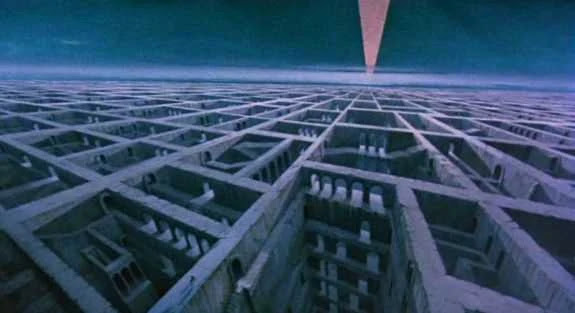
Speaking of which, the movie’s depiction of Hell is practically a character unto itself - between the expansive tableau of the Labyrinth (and some good use of matte paintings), the very stylized visions of each person’s individual damnation, and the cosmic horror aspects of Leviathan, a being represented in vague concepts - Barker and Randel make a fascinating break from the traditional fire and brimstone vision of Hell that adds a level of engagement to the movie.


It's only tangential, but I do want to give a shout-out to
Christopher Young for his score on the first two movies.
His music really adds to the dark, fantastical element of these
films that subsequent films never quite manage to capture again.

 
Part of me would have loved to see this as the path the series would go down - continuing to explore the strange mythology of this Hell that the Cenobites represented just a small part of (and, for his part, Barker had his own vision we’ll touch on next time.)

Unfortunately, these visions didn’t come to pass. Where this movie went big, the next movie dials things back.

That said, this still doesn’t rob from the fact that this makes for a fascinating, if sometimes muddled, expansion on the original movie. As the next step on the road to a larger franchise, Hellbound is an ambitious movie that broadens the scope of the first and leaves a taste for that larger cosmology that, I’ll just say now, will go unfulfilled in later movies.

But, that is a discussion for later.

Keep an eye out as we return to the series soon, and to much lower stakes, with Hellraiser III: Hell on Earth.

Till then.

Thursday, October 6, 2022

Hellraiser and The Hellbound Heart – A Boy, a Girl, and a Box

Hello and welcome back to another October here at the Third Row.

As I said last time, this month I’m diving into the surprisingly deep back catalog of the Hellraiser franchise.

This first step was, for me, a mix of old and new. The 1987 film is one I will admit up front to having a fondness for. At the same time, I confess to being a newcomer to Clive Barker's written works, finally reading The Books of Blood back in 2019. As a result, this marked my first time reading The Hellbound Heart, the original novel that Barker adapted the movie from.

Taking in both versions close to one another, to my pleasant surprise, served to enhance rather than detract. As the man behind both versions, Barker presents a largely faithful adaptation of his book. What changes he makes reflect the difference in mediums and benefits both.


I'm not putting these together just to play compare and contrast, however. In fact, the aspect I really wanted to focus on is one that plays the same in both versions. It’s also a topic that will be a major part of this month.

With that said, let's get into Pinhead, shall we?

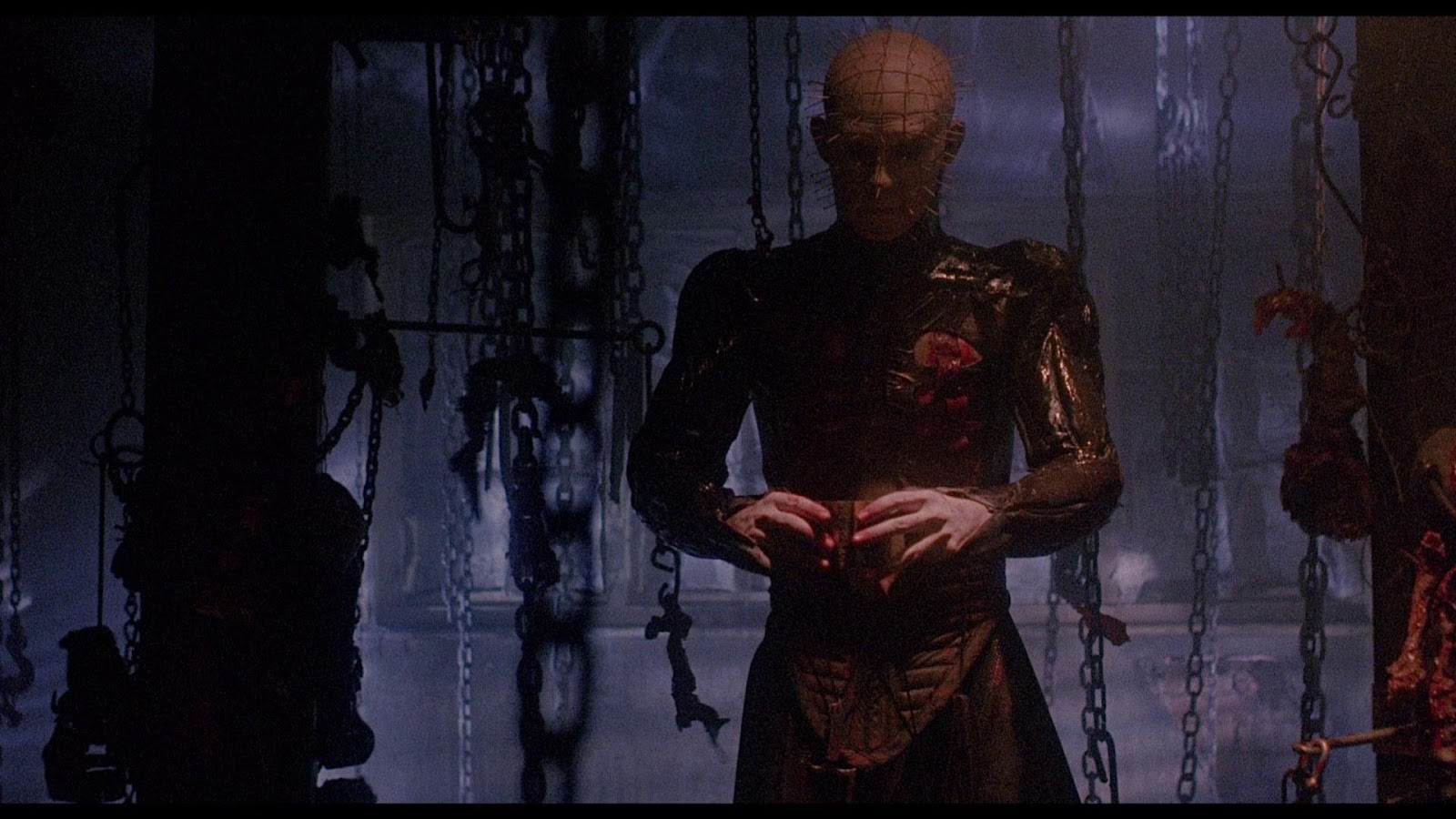
More than anything, to invoke the title Hellraiser calls to mind Douglas Bradley’s grid-faced priest of Hell. He is a horror icon on the level of Jason Voorhees, Michael Meyers, and Freddie Krueger.

Which makes it interesting that, in the beginning, this wasn't his story. In fact, the earliest form of the character is barely there.

If you were to have someone with no knowledge of the series read The Hellbound Heart in a vacuum and ask them where they would see a larger series coming from, they might correctly guess the Cenobites as a group, but still be hard-pressed to recognize the one member who would come to represent the series.

In fact, within the confines of the original novel, the character isn't even named as such (Pinhead was a behind the scenes nickname on the movie that fans adopted, becoming official in the sequels.) The Cenobite that matches the appearance is a supporting character who has maybe ten lines in the whole book, as a generous estimate.

Not a bad promotion, all things considered.

"Clean-up duty now. Straight to video sequels later!"

Of course, that’s for later entries, though they do factor into my thoughts here.

Hellraiser is one of those movies I remember liking as a teen for the shock value. The movie’s blood-soaked finale, in particular, where fugitive damned soul Frank Cotton is reclaimed by Hell in a display involving hooks and chains that is still an impressive, if graphic sight nowadays.

As an adult nearing 40, I still appreciate that. For one thing, it’s a great, grisly visual and kicks off the movie’s delightfully chaotic finale. Plus they have spent so much time setting up Frank as an utter bastard that it’s hard not to enjoy seeing him reap his karmic reward. With age, however, I’ve also come to appreciate just how the reduced rule of the Cenobites plays in the larger film, especially with regards to Frank’s aforementioned awfulness.

Contrary to the marketing, Pinhead and his cadre of torture priests aren’t the main villains of the movie. They aren’t summoned to do wrong or inflict torment on the innocent, they’re summoned in response to a misdeed. Instead, the core horror of the movie is focused on the dark, savage, and all too human love affair between Frank and Julia.

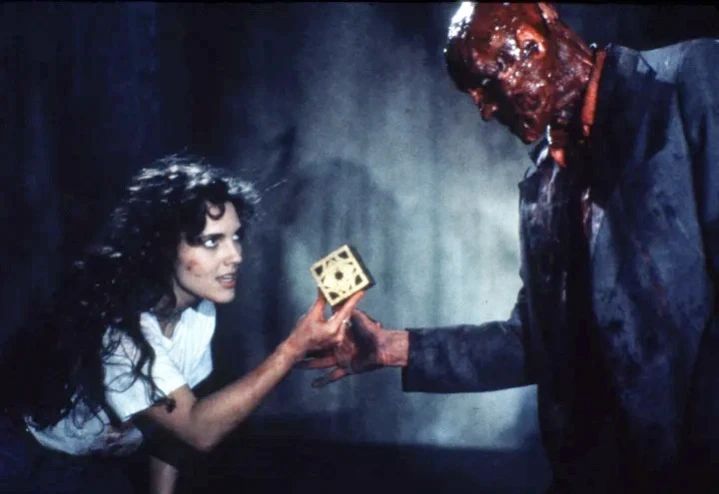
That human factor is part of what makes the story so interesting to me. Yes, for large parts of the film, Frank certainly doesn’t look the part (physically, he is a ghoul, made to feed on the blood of others in order to slowly restore himself) but his arc is still familiar, if amplified for horror. Frank is presented from the jump as a man in pursuit of pleasure - it’s his prime reason for seeking the puzzle box in the first place. He gets far more than he had bargained for, however, and instead spends most of the movie trying to find a way to cheat the consequences of what he agreed to. Julia is in similar straits - bored by her marriage to Frank’s brother, Larry, she has been harboring desires for the man she had an affair with years earlier. When Frank returns, however half-formed and appeals to her, she doesn’t have to be asked twice.

One particular change in adaptation I have to give Barker points for -
The decision to change Kirsty from just a friend to Larry's daughter.
It's an extra detail that adds to Frank's creepiness by giving his 
advances an overtly incestuous overtone 
(no doubt intentional given how Sean Chapman
leans into the delivery on "Come to Daddy.")


Over the course of the film, these are the two we see as monsters - Julia picking up random men she can then kill and feed to Frank (though many are seen as alive when Frank starts to feed, adding to the brutality as they plead for mercy.) All are seen as expendable in their pursuit of pleasures, culminating in their decision to murder Larry - ending in a final ‘insult to injury’ as Frank wears his skin as a disguise to fool Larry’s daughter, Kirsty.

By comparison, the Cenobites are, despite their ethos of pain mixed with pleasure, strictly business - they come when the box summons them. They bring whoever summons them to Hell to be subjected to torments for all eternity. They are beings that could be described as horrifically principled. The only time we see them even slightly waver on their rules is a result of Kirsty accidentally summoning them, then bartering to avoid damnation. Even that flex is, ultimately, still within their jurisdiction - the box summons them and they can’t return empty handed. In order to give them someone in her place, Kirsty offers them a more tempting target - one who has broken their rules and that they would, otherwise, be unable to deal with unless he summoned them himself.

It goes back to an aspect of horror that I’ve resonated with more and more over the years - so many of the monsters mankind has dreamed are presented as beings with set rules. There are ways to deal with them, ways to avoid them, ways to summon them, and in some cases ways to defeat them. It’s not universal, of course, but often there is a sense of guidelines that are seen as irrefutable, or if refuted, the storyteller is called to task on.

As a result, they are often presented as more principled, reasonable, and, for lack of a better term, honor bound than human beings. Just as often as horror presents creatures with set rules of engagement, it presents stories about how the most disturbing aspects of human beings is how they will frequently skirt the bounds of what is acceptable or the social contract in pursuit of their own personal drives.

Love is...
Helping your skinless partner by bringing home people
he can drain the life force from.


In this case, that means the beings who live and thrive in an alternate world where pain and pleasure are horrifically intertwined, despite a lifestyle built around sensation, are still framed to us as the creatures of (for lack of a better term) law and order, compared to the movie’s fugitive couple. Despite their menacing appearances and brutal means of dealing with those who are damned, they are ultimately seen as fair against the self-serving, ruthless counter of Frank and Julia, whose love is even secondary to self preservation.

While I don’t imagine marketing did it this way on purpose, the misdirect makes the movie into a great inversion of expectations that allows it to stand the test of time arguably far better than many of the movies that came after where our leather-bound sadomasochists take the center stage.

That, however, is a topic for later this month. For now, the time comes to put the box back on the shelf.

It won’t have long to gather dust, however. Keep an eye out, for soon we’ll be back here to discuss the fascinating, fantastical sequel that literally takes us to Hell in Hellbound: Hellraiser II.

Till then.

Saturday, October 1, 2022

This October – The Third Row Goes to Hell

Summer has ended. The days are getting cooler. The nights are coming sooner.

Fall is here.

More to the point, October is here.

I had debated whether or not to do the franchise run again this year. Life's been all over the place, and part of me was still irked that last year didn't quite go to plan. For what it's worth, the Godzilla run DID lead to a video presentation for those who are interested in seeing it.

In truth, I only really started really feeling the itch to make another run this year in early September.

So, after weighing options, and putting it to a poll, here I stand poised for a fairly busy October. Because like I said up top – we're going to Hell this month. Repeatedly.


That's right – starting now till the 31st, we're diving in the labyrinth of skin ripping and BDSM puzzle enthusiasts that make up Clive Barker's* Hellraiser series.

*Okay, PARTIALLY Clive Barker's. We'll get into that later in the month.

And oh, what a month it shall be. Ten films, the novel that started it all, the upcoming Hulu reboot, and Barker's (at the time) final word on the property.

I've had the better part of a year to rest up for this one and I intend to make up for the lost time in a big way.

So put down some newspaper and limber up your fingers. The first spin at the puzzle box will be coming real soon.


Till then.

Wednesday, October 27, 2021

Godzilla Raids Again (1955)

Welcome back to the Criterion Challenge/October Franchise Run/Godzilla Deep Dive (it's a little of all three for now.)

We're a bit late into the month, but still determined to keep moving. Over the next few days, we'll be covering the first 'arc' of Godzilla - from atomic menace to what I'd like to call 'friend to all children', but that's Gamera's beat.

Anyway, that's getting ahead of ourselves.

Flashback to 1954 - in the wake of Honda's original Godzilla becoming a success, Toho producer, Iwao Mori, already had the word 'sequel' on his lips.

An ambitious idea, to be sure. Save for the fact that the titular monster was dead.


Not that that's ever stopped a sequel before, of course.

Taking inspiration from a line from Professor Yamane (Shimura Takashi, briefly reprising his role in this) the movie found its hook - when your first radioactive dinosaur dies, get yourself another one. Or two, as the case may be here.

Going in this, and the subsequent entries, I am coming at this with a particular primary focus - tracking the franchise as a whole, and how each property evolves that from its beginnings to what is considered the 'traditional' Godzilla film.

The decision to have multiple kaiju is where Godzilla Raids Again distinguishes itself in that line. Godzilla is back, but audiences are also introduced to the second of what would become Toho's extensive bestiary - the giant ankylosaurus, Anguirus.

Okay, one new observation here - this is the first time it really hit me how at first they tried to keep to dinosaurs as far as expanding the roster went.

At first, anyway, but we'll come back to that.

Besides the another kaiju, the most marked change this movie has over its predecessor is that it is considerably less grim. This doesn't make it a light-hearted movie, of course, but it also avoids anything on the level of the destructive horror of the previous movie's Tokyo attack and its somber aftermath.

There is still a fair amount of destruction to go around (including a subplot involving one of cinema's more unlucky jail breaks) but it also spends much of its time looking at the impact of these giant monsters from a trade and supply line perspective. Which is an interesting take, don't get me wrong, but it also causes this to lose out on the horror of the previous movie.

Despite that, it does keep with its predecessor in its view of its titular monster - yes, Godzilla is fighting another kaiju in this, but that doesn't mean he's our hero. In fact, neither Godzilla nor Anguirus really pays any mind to what the humans around them are doing. They're just destroying whatever gets in their path - including each other - and the humans are left to determine how to handle the winner.


How those humans handle that marks the last major difference between this and the original - there is no oxygen destroyer and no troubled scientist to really drive the nuclear comparison this time. Which isn't a bad thing - as much as I love that aspect of the original, it's not an element you can expect to keep repeating to the same returns. In that case, I'd prefer they give it one good go rather than keep repeating it till the tank runs out of gas.

In turn, this version emphasizes the human effort in terms of trying to trap the surviving monster (including two pilots, one of whom is played by Kurosawa alum Minoru Chiaki.) There isn't a superweapon to save the day - just risky planning and a willingness to put one's life on the line to try and stop another catastrophe in the form of a radioactive dinosaur.

Godzilla Raids Again is an interesting part of the larger lore for me. On the one hand, it lacks the punch of its predecessor. On the other, it still makes a good effort to stand on its own, and marks the first expansion of the kaiju roster. It's a generally well made, eminently watchable Godzilla movie, especially if you're looking for titles from the era when the character was still seen as, literally, a walking disaster.

This also marks the last of the black and white era for Godzilla. Next time we step into the world of color, and Godzilla's first warm-blooded opponent, with the vaunted (and rumored) throwdown King Kong vs Godzilla.

Till then.

Thursday, October 7, 2021

Godzilla (1954)

Well, I warned you all it was coming. If you didn't heed me before, now is the time to report to your nearest shelter.

Because October has come to the Criterion Challenge, and kaiju are coming with it!

As promised last time, from here till the end of the year, it's a deep dive into the complete Showa Era of Japan's most successful giant lizard himself - Godzilla.

So, let's begin --

This isn't my first time writing about Ishiro Honda's 1954 classic for this blog. It's not even my first time doing for October. Despite that, I'm not terribly worried about repeating myself, though I will be hitting a few familiar points in more detail.


The original Godzilla has an interesting place in my heart and in my life. It's one of those certain things - we all have them - that I come back to over the years and my experience with it is different every time.

There are two things I will say this movie has stayed consistent on for me. The first is that it has been a genuinely well made movie that still holds up for me. The other is that, for a film in which a giant lizard rampages through a city, it finds ways to genuinely unsettle me.

To give this some context - Godzilla, as a character, has been a part of my life since I was a little kid. To the point where what memories I have of my grandfather on my mother's side (who died when I was young) were watching some of the Godzilla vs movies with him. The big lizard has been a nerd gateway drug for me in a lot of ways.

I say this to make clear - I first knew the version of Godzilla that was akin to The Incredible Hulk: he's big, he's destructive, but at the end of the day, he's still on humanity's side.

So, as a kid, my first time watching this movie (in its Americanized King of the Monsters cut) was like watching Superman toss a little old lady into traffic.


I had gone in not knowing this started as a very direct take on the impact of the atomic bomb on Japan, so I was shaken by seeing this character I had come to love as a horrific force. I still liked the movie, but seeing the very human toll of destruction was genuinely upsetting to me at the time.

I would come back to the movie over the years, first through that redone version and later when the original Japanese finally became more readily available, and over time, I've been pleasantly surprised to realize it still shakes me, but for different reasons.

A big part of that comes down to how I've looked at the movie over time. As a kid, I came to the movie for Godzilla, so my attention was largely there for Godzilla (and credit where it's due, for pushing 70, the effects work still looks good in this movie.) As I've gotten older, the human face of the movie becomes more prominent.

Which is part of what makes it fascinating to watch in the larger arc of the property. A lot of the later installments in the series we'll get to are over the top, silly, and yeah, I'll say - fun.

By comparison, the first movie in this series, true to its origins as a movie made in response to the horrors of the atomic bomb, is a very somber, human story. Even the movie's main set piece - in which Godzilla rampages through Tokyo - takes a lot of time to focus on the people on the ground caught up in the destruction. As a result, moments like the news crew reporting on the rampage to their bitter end, or a terrified mother trying to reassure her children as death bears down on them give the scene more heft than it would have as just an actor in a suit tearing up a cardboard city.

That the movie commits as much to showing the destruction and aftermath on that level is part of what makes it work so well. It takes itself seriously enough that it's hard not to engage with it on its own terms, rather than just a kaiju rampage.


Alongside the destruction, there is one other part of the movie's human side I have to acknowledge my increased appreciation for. That is the depiction of the brooding, troubled Dr. Serizawa.

For much of the first two acts, the man is framed as a cypher - his major role being as the fiancé to Emiko that complicates her relationship to Ogata. His work is secretive, he is aloof, and even his appearance, complete with eyepatch, suggests a mystery. It's only in the wake of Godzilla's destruction that his secret comes - not even from himself, but from Emiko recognizing his research could be vital.

With the reveal, in which we learn of his work developing the device known as the Oxygen Destroyer, our perspective on the character changes. If Godzilla is the atomic bomb, Serizawa is the movie's answer to Oppenheimer - he didn't have a hand in the lizard's creation or rampage, but in turn, his research has birthed the one destructive force that could match or surpass him. Like his real life analogue, he's not proud of what he's created - the reason he is secretive is because he's horrified with the potential for what he's created. Even when Ogata and Emiko come to him to ask him help stop Godzilla, he is justifiably reluctant - he recognizes the good, but is also all too aware of the evil that his research could do in the wrong hands. When he ultimately does agree, he does so with the assertion that this will be the only time his device is used - a vow he guarantees in his decision to die with Godzilla.

That the movie presents Serizawa in as nuanced a light as it does is a pleasant surprise. Given how fairly fresh the memory of the atomic bombs was at that point, one could see a lesser version of this where a character in this role would be as a monster in his own right. Instead, the movie frames him much as history would come to remember him - someone who didn't set out to unleash this sort of power, and who genuinely regretted it on seeing what it could do.

It's also part of why the ending has come to resonate more for me over time. Those final scenes draw a  comparison, even a kind of kinship between Serizawa and Godzilla. Ultimately, neither set out intending to be destructive (while a stand-in for the bomb, the movie also frames Godzilla's dinosaur origin as tragic - potentially the last of his kind, out of his own time) but the fact remains, their paths have both led them to that outcome. More simply put, wo beings who, like it or not, are too dangerous to live in the world as we know it. I realize that makes it sound edgy put into text, but it's a tragic beat within the film, and the fact the movie commits to it as seriously as it does helps offset any underlying silliness the premise could otherwise have.


In a few years, this movie will turn 70 years old. It speaks to the dedication of the people involved that, even after all this time, there is a power to how it commits to its themes. This isn't to say it's all silliness from here on out, but that this can still resonate this much after all this time is something to commend this movie for.

Yeah. What can I say? I have a lot of feelings on this one.

As we're at the end of the movie with that point, it seems as fitting a place as any to wrap up the writeup. Keep an eye out, we'll be back soon with the still serious, if less grim follow up to this in Godzilla Raids Again.

Till next time.