Showing posts with label 1987. Show all posts

Thursday, October 6, 2022

Hellraiser and The Hellbound Heart – A Boy, a Girl, and a Box

Hello and welcome back to another October here at the Third Row.

As I said last time, this month I’m diving into the surprisingly deep back catalog of the Hellraiser franchise.

This first step was, for me, a mix of old and new. The 1987 film is one I will admit up front to having a fondness for. At the same time, I confess to being a newcomer to Clive Barker's written works, finally reading The Books of Blood back in 2019. As a result, this marked my first time reading The Hellbound Heart, the original novel that Barker adapted the movie from.

Taking in both versions close to one another, to my pleasant surprise, served to enhance rather than detract. As the man behind both versions, Barker presents a largely faithful adaptation of his book. What changes he makes reflect the difference in mediums and benefits both.


I'm not putting these together just to play compare and contrast, however. In fact, the aspect I really wanted to focus on is one that plays the same in both versions. It’s also a topic that will be a major part of this month.

With that said, let's get into Pinhead, shall we?

More than anything, to invoke the title Hellraiser calls to mind Douglas Bradley’s grid-faced priest of Hell. He is a horror icon on the level of Jason Voorhees, Michael Meyers, and Freddie Krueger.

Which makes it interesting that, in the beginning, this wasn't his story. In fact, the earliest form of the character is barely there.

If you were to have someone with no knowledge of the series read The Hellbound Heart in a vacuum and ask them where they would see a larger series coming from, they might correctly guess the Cenobites as a group, but still be hard-pressed to recognize the one member who would come to represent the series.

In fact, within the confines of the original novel, the character isn't even named as such (Pinhead was a behind the scenes nickname on the movie that fans adopted, becoming official in the sequels.) The Cenobite that matches the appearance is a supporting character who has maybe ten lines in the whole book, as a generous estimate.

Not a bad promotion, all things considered.
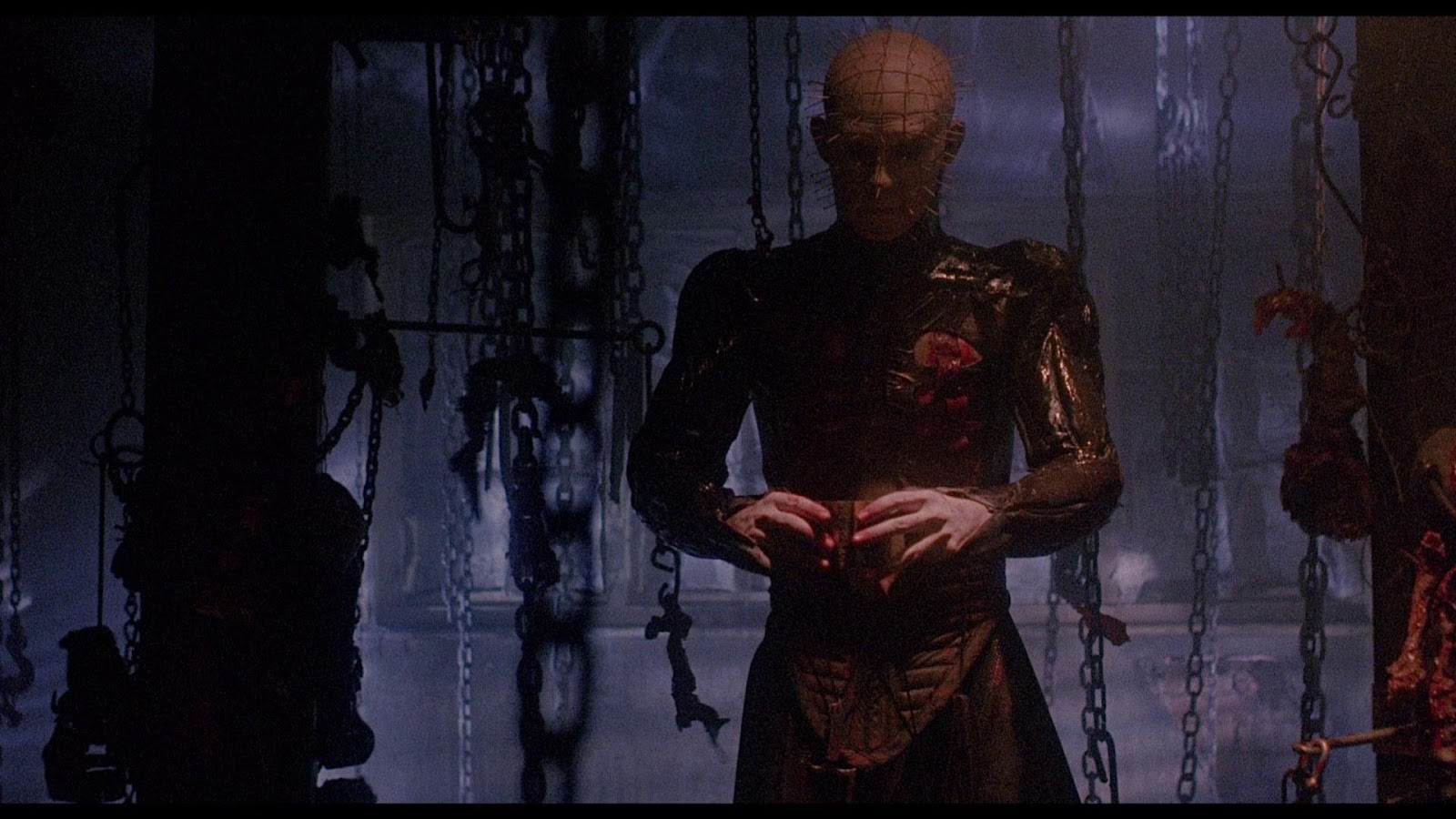
"Clean-up duty now. Straight to video sequels later!"

Of course, that’s for later entries, though they do factor into my thoughts here.

Hellraiser is one of those movies I remember liking as a teen for the shock value. The movie’s blood-soaked finale, in particular, where fugitive damned soul Frank Cotton is reclaimed by Hell in a display involving hooks and chains that is still an impressive, if graphic sight nowadays.

As an adult nearing 40, I still appreciate that. For one thing, it’s a great, grisly visual and kicks off the movie’s delightfully chaotic finale. Plus they have spent so much time setting up Frank as an utter bastard that it’s hard not to enjoy seeing him reap his karmic reward. With age, however, I’ve also come to appreciate just how the reduced rule of the Cenobites plays in the larger film, especially with regards to Frank’s aforementioned awfulness.

Contrary to the marketing, Pinhead and his cadre of torture priests aren’t the main villains of the movie. They aren’t summoned to do wrong or inflict torment on the innocent, they’re summoned in response to a misdeed. Instead, the core horror of the movie is focused on the dark, savage, and all too human love affair between Frank and Julia.

That human factor is part of what makes the story so interesting to me. Yes, for large parts of the film, Frank certainly doesn’t look the part (physically, he is a ghoul, made to feed on the blood of others in order to slowly restore himself) but his arc is still familiar, if amplified for horror. Frank is presented from the jump as a man in pursuit of pleasure - it’s his prime reason for seeking the puzzle box in the first place. He gets far more than he had bargained for, however, and instead spends most of the movie trying to find a way to cheat the consequences of what he agreed to. Julia is in similar straits - bored by her marriage to Frank’s brother, Larry, she has been harboring desires for the man she had an affair with years earlier. When Frank returns, however half-formed and appeals to her, she doesn’t have to be asked twice.
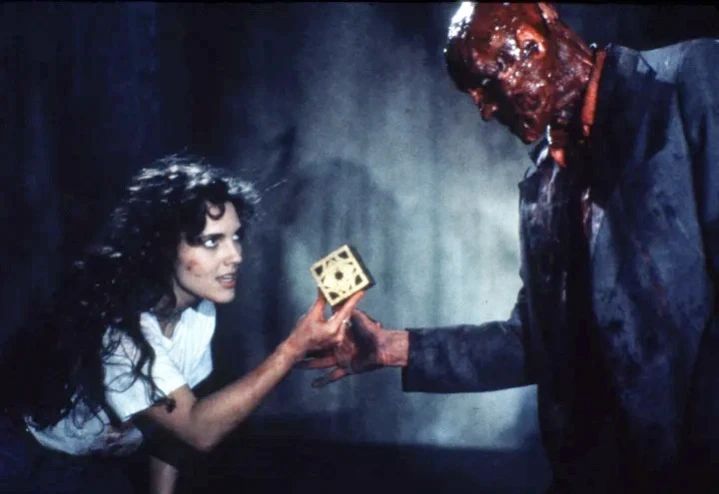
One particular change in adaptation I have to give Barker points for -
The decision to change Kirsty from just a friend to Larry's daughter.
It's an extra detail that adds to Frank's creepiness by giving his 
advances an overtly incestuous overtone 
(no doubt intentional given how Sean Chapman
leans into the delivery on "Come to Daddy.")


Over the course of the film, these are the two we see as monsters - Julia picking up random men she can then kill and feed to Frank (though many are seen as alive when Frank starts to feed, adding to the brutality as they plead for mercy.) All are seen as expendable in their pursuit of pleasures, culminating in their decision to murder Larry - ending in a final ‘insult to injury’ as Frank wears his skin as a disguise to fool Larry’s daughter, Kirsty.

By comparison, the Cenobites are, despite their ethos of pain mixed with pleasure, strictly business - they come when the box summons them. They bring whoever summons them to Hell to be subjected to torments for all eternity. They are beings that could be described as horrifically principled. The only time we see them even slightly waver on their rules is a result of Kirsty accidentally summoning them, then bartering to avoid damnation. Even that flex is, ultimately, still within their jurisdiction - the box summons them and they can’t return empty handed. In order to give them someone in her place, Kirsty offers them a more tempting target - one who has broken their rules and that they would, otherwise, be unable to deal with unless he summoned them himself.

It goes back to an aspect of horror that I’ve resonated with more and more over the years - so many of the monsters mankind has dreamed are presented as beings with set rules. There are ways to deal with them, ways to avoid them, ways to summon them, and in some cases ways to defeat them. It’s not universal, of course, but often there is a sense of guidelines that are seen as irrefutable, or if refuted, the storyteller is called to task on.

As a result, they are often presented as more principled, reasonable, and, for lack of a better term, honor bound than human beings. Just as often as horror presents creatures with set rules of engagement, it presents stories about how the most disturbing aspects of human beings is how they will frequently skirt the bounds of what is acceptable or the social contract in pursuit of their own personal drives.

Love is...
Helping your skinless partner by bringing home people
he can drain the life force from.


In this case, that means the beings who live and thrive in an alternate world where pain and pleasure are horrifically intertwined, despite a lifestyle built around sensation, are still framed to us as the creatures of (for lack of a better term) law and order, compared to the movie’s fugitive couple. Despite their menacing appearances and brutal means of dealing with those who are damned, they are ultimately seen as fair against the self-serving, ruthless counter of Frank and Julia, whose love is even secondary to self preservation.

While I don’t imagine marketing did it this way on purpose, the misdirect makes the movie into a great inversion of expectations that allows it to stand the test of time arguably far better than many of the movies that came after where our leather-bound sadomasochists take the center stage.

That, however, is a topic for later this month. For now, the time comes to put the box back on the shelf.

It won’t have long to gather dust, however. Keep an eye out, for soon we’ll be back here to discuss the fascinating, fantastical sequel that literally takes us to Hell in Hellbound: Hellraiser II.

Till then.

Tuesday, October 29, 2019

Prince of Darkness (1987) - Evil Not Void If Seal Is Broken


Hello and welcome back. You may have noticed the previously mandatory blood tests are no longer in effect. That's because The Week of Things ™ has come to an end, and in this final week, we resume our journey through the Apocalypse Trilogy proper.

The good news, now that we're done in the world of Outpost 31 (and some offshoots), things are going to start getting a bit warmer. The bad news, isolation is still on the menu, this time in the form of the abandoned church that houses Carpenter's Prince of Darkness.


Of the three movies in the trilogy, this could arguably be considered something of the black sheep nowadays. Not as a statement of its quality as much as the fact that, compared to The Thing's modern classic status and the recent resurgence over the past decade for In the Mouth of Madness, Prince of Darkness is more at the level of a cult favorite – still generally well regarded by Carpenter fans, but not quite as well known as the other two in general.

Which isn't entirely hard to understand – of the three, all of which are pretty bold on the concept front, this is the movie that is arguably the most ambitious with what it's trying to do, presenting a story taking place in a curious nexus of science fiction and the occult.

Case in point - this movie's version of Satan.

Those crossroads make an interesting playground for Carpenter to work in – starting from the already promising horror hook of a secretive religious order known as the Brotherhood of Sleep tasked with keeping Satan imprisoned under lock and key. From that jumping off point, the movie expands to include the idea of evil as a great cosmic force, messages that travel across time as dreams, and a small team of university students trapped in a building poised to become ground zero for the ultimate evil being unleashed upon the world.

Speaking of that ground zero, one aspect of this movie I find myself appreciating this time around that I never fully considered before – the earlier mentioned isolation. Despite the church much of this movie takes place in being in the middle of an urban area, Carpenter still finds a way to create a situation of isolation from the world at large – without nature at play, the ill-fated team find themselves much more literally trapped, as the building falls under siege by an army of derelicts acting under the influence of the evil within. After the first act, those who venture out are few, and those who make it back in alive, even fewer. Paired with the growing influence of Satan inside, the growing sense of claustrophobia within the movie becomes an effective strength.

I don't care what the internet says - Todd Phillips's Pee-Wee's Big Adventure was a mistake.

As those trapped within are concerned, the movie's cast are an interesting spread. They don't hit the same highs as the earlier The Thing, but there is still some good interplay between them. As a nice bonus, there are also several John Carpenter regulars among the players. Of these Donald Pleasance makes a welcome familiar face as an unnamed priest in a theological tailspin after discovering the secrets of the Brotherhood have completely upended everything he's believed of good and evil. Besides Pleasance, other returning faces include Victor Wong and Dennis Dun, both fresh off Big Trouble in Little China and getting a chance to each try a different sort of role, the former trading mysticism for science, the latter making for a fairly entertaining comic relief character.

Of the new faces to this cast, two in particular stand out in supporting roles. The first of these bring rock star Alice Cooper in a nonspeaking role among the army of derelicts. Doubtless, the fact it's Cooper is likely part of why he is one of two derelicts to be given significant screentime, but even with that acknowledged, he brings a malevolent presence that helps the part stand out. The other being Jessie Lawrence Ferguson, whose transformation from one of the more levelheaded, good-natured members of the team to a leering, giggling agent of evil is an especially effective dash of creepiness in the movie's final acts.
 

Seriously - the other possessed don't get as much chance to stand
out, but Ferguson not only stands out, he is genuinely unsettling
when he turns.

Said creepiness, admittedly, comes in stops and starts compared to the earlier efforts of The Thing. There's a sense of dread, to be certain, but it doesn't have the same level of paranoia to benefit from, instead playing to the altogether alien nature of the evil force at the center of this movie. To its credit, despite that overall uneven feel, the movie has some strong individual sequences and images that help to stand out – the recurring nightmare warning is a main example, teasing hints of the danger to come in the form of a scratchy video recording that helps make the sequence, and its eventual evolution, even more memorable.

Lined up alongside its predecessor and successor, I have to admit, I don't have quite the same affection for this movie that I have for the other two parts of the series. I want to clarify – this doesn't mean that I think this is a bad movie, because I don't. Taken on its own, I still find this an overall enjoyable offering from Carpenter's overall filmography, and even if it doesn't quite hit the same highs as the other two, it still has a number of strong visuals and sequences on its own that are worth the the experience. What it does with traditional Satan horror is something that feels like a sci-fi take on something from Lucio Fulci's Gates of Hell trilogy, and that's something I never would have thought I'd want to see until I saw this try it.
And honestly, this sequence alone helps secure it a spot in my good graces where Carpenter is concerned.

With this, we're now one entry away.

Carpenter has brought humanity to the brink twice now, each time taking it a little closer, and now it all comes down on Halloween night. Join me for concluding this run, and the trilogy, with Carpenter's tribute to H.P. Lovecraft, In the Mouth of Madness.

Till then.