Showing posts with label comedy. Show all posts

Thursday, September 30, 2021

Fast Times at Ridgemont High (1982)

Welcome back. Class is still in session here at the Criterion Challenge, albeit not for much longer.

Now that we got class elections out of the way (give or take a disgraced educator), it seemed fitting to find a movie that would cover the rest of the school year.

Okay, not my sharpest transition, but deal with it, we're here to talk about Amy Heckerling's seminal high school comedy Fast Times at Ridgemont High.


This was a first for me - I knew the angle I wanted to dig into as soon as the movie was done, but it took a while to figure out how to put it.

Which is even more fitting because I wanted to focus on the movie's surprisingly sharp sense of awkwardness.

Yes, this is a good thing.

It's something I'd been kind of aware of before, but this is the first time that I really appreciated how much this movie is willing to let its teenage characters be, well, teenagers.

I'm impressed with how it's willing to have that awkwardness while also never quite feeling like a cringe comedy (and I'm a sucker for a good cringe comedy, so don't take that as a dig.) The movie is able to have an arc like Sean Penn's surfer burnout Jeff Spicoli and at the same time Jennifer Jason Leigh's Stacy Hamilton navigating dating and the significance of losing one's virginity, and the shifts never feel jarring.

Part of what helps is that it never leans too heavily to either side of that line. To use them as examples again: as goofy as Spicoli is, the wildest his stunts get is having a pizza ordered into school or having to bluff out of getting a car wrecked. Stacy, meanwhile, has moments like her less than romantic first time - in a baseball dugout (a great detail being her being distracted by the obscene graffiti on the ceiling above her) and for as weird as it gets, it never feels like the movie is trying to heap abuse on her for it.


The movie is more than Stacy and Jeff, of course. We also have the similarly young and inexperienced Mark (Brian Backer), the increasingly unlucky Brad (Judge Reinhold) and the older, presumably wiser Linda and Mike (Phoebe Cates and Robert Romanus respectively.)

If there's a word that sums up the larger arc of all of these characters, it's 'unromantic.' Not in the sense of relationships, though there is some of that as shown by scenes like the above-mentioned dugout. In this case, unromantic being with regards to the idea of a rose-tinted high school experience. It's surprising to remember two years after this would see the rise of John Hughes's teen comedies ,given how differently Heckerling tackles things by comparison.

There's something that feels more, for lack of a better term, human in the way Heckerling presents her teens. They can be messy. They can make mistakes with consequences that aren't simply written off the very next day. As cool and experienced as an older kid may be, they may not have all the answers they want you to believe they do (as the movie shows from both Linda and Mike.) They are flawed, but ultimately likable individuals in a way that it feels like many later mainstream high school comedies are reluctant to show.

To bring this full circle, the culmination of Stacy's story is one that feels strange to see in a modern mainstream high school film - after an awkward hook-up with Mike, she finds herself pregnant and in need of an abortion (that alone being a risky prospect.) The resolution of the arc isn't a big dramatic beat, but a few smaller ones - an attempt to get a ride from her older brother (Brad) which he figures out, but ultimately still supports without asking too many questions, and an act of revenge by Linda in the form of graffiti. Despite being smaller beats, they still feel like a satisfying resolution narratively and thematically.

Also, it's not part of my main point, but I do feel like
I need to give a shout out to the late, great Ray Walston
as the put-upon Mr. Hand. Another great showcasing
of that crotchety snark that he could play so very, very well.


I don't want to say 'they couldn't make this movie anymore', because that is a phrase that feels like it's been misused too often for misguided commentary on culture. At the same time, this is a movie it's hard to picture being made now because of how frank, if funny, it is about the messier sides of teenage life. I wouldn't say it can't be made, but it would definitely not be on the level of a studio release quite like this one.

Which makes me appreciate that this happened at the level it did even more.

I could take this as a moment to add my vote to the larger sentiment that we as a society never really gave Heckerling her due as a director, but that would be a whole other topic, and the fact is, I'm running out of September.

October is right around the corner, and, as I promised, I'll be doing another franchise this time out.

And at the risk of laying it on too thick, this one's gonna be a real monster.

Till then

Tuesday, August 31, 2021

Local Hero (1983)

Ahh, the dog days of summer.

Enjoying the last of the wind down before September, then it's back to the grind.

I suppose The Criterion Challenge counts as part of that, huh?

Well, I've still got one more day of vacation left. So after Hausu, I decided the best way to end this month was Bill Forsyth's funny, charming 1983 comedy, Local Hero.
 
 
This time last month, I wouldn't have thought I'd spend this much time comparing this movie and Hausu. As I tried to explore this as a vacation movie, however, it was hard not to.

It's not as though these are especially similar in terms of set-up or style. In fact, even as experiences, they're vastly different - where Hausu is like a funhouse ride, Local Hero is more like a warm bath or a comfortable sweater. Despite that, much of what I find appealing in this is similar to what appealed to me last time.

Like Hausu, I'm hard pressed to think of many other movies I'd say quite hit me the way Local Hero does. There's movies that get parts of it right, but something about the way it all comes together makes this one unique for me.


I know I've said it before, but over the past year, my view of movies has shifted from 'this could have been better with' and more to 'this could have gone *, and I'm glad it didn't.'

I can see a lot of the ways a more generic take on this could have played out - how Peter Riegert's Mac could have been the cocky big city fast talker (with shades of his earlier role in Animal House). How Burt Lancaster's Happer could have been the cold-blooded dollars and cents boss. How Denis Lawson's Gordon could have been the more 'pure' country figure to counter Mac and refuse to sell out his home town.

All familiar tropes. None of which Forsyth settles for.

Instead, Riegert is a man out of his element, able to local down a deal easily by telex, but much less certain having to close the deal in person. Happer is working to advance his company, but his heart is more in his dreams of the stars. Gordon is very willing to cash out, as are most of the other locals, and they are happy to welcome Mac to help close the deal. That Mac is then charmed by their small town happens inadvertently as a result of their efforts to help sweeten the deal.

I also can't not give a shout out to a young Peter Capaldi
as well. For someone who first encountered the man as
the surly, foul-mouthed Malcolm Tucker on
The Thick of It,
his turn in this was an awkwardly pleasant surprise.


On paper, Local Hero has a lot of familiar elements of the 'city v country' fish out of water comedy. It plays a few straight, but for every one of those, there are one or more it subverts or takes for a fresh spin. There is no heavy dramatic baggage, no overtly villainous presence, or moments of severe stakes. It's a very relaxed, funny movie where the big mystery is how everything will play out while still seeing everyone's desires fulfilled. We come to like these people and, despite their clashing goals, want to see everything work out for all involved.

This really is the perfect movie to close out the summer with. It's light, but involving, warm, funny, visually striking for the local scenery. Even the final scene, with Mac back in the states feeling a sort of melancholy for the Scottish village that became home for him is a feeling that seems appropriate as one unwinds from their vacation and prepares to return to daily life.

Even if you're reading this in early September, I'd recommend giving this one a watch as the temperatures start to cool and the leaves change. After how hectic this month has been, it's a downright therapeutic 110 minutes.

Of course, with September around the corner, the challenge rolls on and it's time for this writer to get ready for something he hasn't had to do in quite some time - go back to school.

Come back next month for a few trips into cinematic academia as we ramp up for October.

And oooh, that's gonna be a doozy.

Till then.

Sunday, August 22, 2021

Hausu (1977)

 Hello and welcome back to another round of the Criterion Challenge.

And let me start by saying - oof.

It's been a rough summer here. Technical issues. The heat. The weirdly dark turn last month's entries took.

Oh, and just about the entirety of the world at large right now. But, that's a talk for another time.

As we come into the dog days of summer, I decided there was only one way to end this summer - vacations! So, for the next couple of entries, we'll be looking at films about packing up and getting away from it all.

So what better place to start this trip than one of the most batshit haunted houses in cinema?


This isn't my first time seeing, or writing about, Nobuhiko Obayashi's cult classic Hausu (officially House, but the other pronunciation has been adopted to help avoid confusion with the 1986 haunted house movie with the same name.) At first, I wasn't sure what would be a good new perspective here.

Then it hit me - lean in to the vacation. Yes, this is a movie about a group of schoolgirls who take a fateful trip to a friend's aunt's haunted house. But it's also a movie that is its own miniature ninety-minute vacation.

This is a refreshing movie to watch for how weird it is, and how unapologetic it is about that, from start to finish.  This is a movie where, among other things - someone is eaten by a piano, people are turned into produce on multiple occasions, and someone is killed by being attacked by futons.


No, I don't feel bad about telling you this up front, because reading it is one thing, seeing it is something else.

For Hausu, it's all in seeing the weirdness unfold. It sounds pretentious to say, but this really is an experience. There's a lot of great haunted house movies out there (I can't recommend the likes of The Innocents and The Changeling enough come October) but I'd be hard pressed to think of another quite like Hausu.

A large part of this is thanks to Obayashi's direction. From the start, this was going to be a wild, imaginative movie, thanks to his decision to make his creative partner his young daughter Chigumi. That helped give the movie a lot of its more imaginative touches (Obayashi has been quoted as saying he felt like adult thoughts would cause the film to stay "on a boring, human level.")

From there, Obayashi's direction adds to the stylish strangeness. Between the animated tangents, the stop-motion style of some scenes, and the musical numbers (did I forget to mention this movie is also kind of a musical?) Obayashi keeps the movie lively. Even at the one serious beat, exploring protagonist Gorgeous's aunt's tragic backstory, is presented in a visually striking way that keeps it from snapping the tone in a way it can't recover from.

Seriously. Did I forget to mention the musical thing?
Cause it sort of goes there. This little dance number also
involves a cat.


I admit I haven't seen much of Obayashi's other work (though having seen his earlier short, Emotion, I can definitely see that his bold directorial streak wasn't an isolated aspect) but this has me wanting to see more. There's a lot of great haunted house movies out there, but not many (if any) others like this - it's a movie that captures the feel of being a kid on a well made haunted house ride. Once you're on, it's a blast from start to finish.

To pivot on this theme - it's a movie about a vacation that also doubles as a short trip all on its own.

Ahhh. I needed this.

One more trip to come this month before it's time to be moving on with fall, and coming into the big project for year one.

But that can come later. For now, still on vacation and enjoying it.

Till next time.

Sunday, June 27, 2021

La Cage Aux Folles (1978)

 Welcome back to the Criterion Challenge.

As I said last time, we're doing something a little bit different today. Along with this writeup on the 1978 French-Italian comedy, La Cage Aux Folles, I'm taking part in a crossover discussion with a friend, offering a second perspective on the movie. In particular, discussing how it compares to its 1996 American remake, The Birdcage.

That discussion will be available to read here: https://theguyinthe3rdrow.blogspot.com/2021/06/la-cage-aux-folles-1978-discussion.html

There's no intended reading order here - whichever appeals to you to read first, by all means, do so.
With the majority of the comparisons in that discussion, I'm looking to focus on just the merits of La Cage on its own, but I apologize in advance if I retread ground. I say this because, honestly, the thing I keep coming back to with this movie is how relatively well it has aged.

Ordinarily, doing a movie with this subject matter, especially as a comedy, is a really iffy prospect. As Drew McWeeny arguably put it best, comedy ages faster than almost any other type of film. So much so that, on paper, the idea of a late 1970s comedy about a homosexual couple automatically sounds like a representational minefield.

To be fair, there are some aspects that haven't held up well - the racial dynamics of the movie, care of the houseboy, Jacob, come to mind  - but as far as its central couple is concerned, this holds up surprisingly well.

To clarify - Jacob is the ONLY non-white character in this
movie.
Yeeeeeeeeeeah...

A big part of where this comes from is Ugo Tognazzi and Michel Serrault as the film's central couple. I will admit there are some cliched and stereotypical aspects to the performances, most notably in Serrault's Albin, who fits a lot of the effete gay man tropes. Several of those work in the context of the film, both as a farce and as far as Albin's character as an aging drag performer.

Even with the broader cliches and comedic elements, however, the movie works because of the chemistry between the two. From their first scene together, playing as a bickering couple, to moments like the genuinely touching scene at Albin's cemetery, when Tognazzi's Renato tells him of his desire for them to share a plot together, the movie maintains the love between its two leads.

For not being explicitly presented as a romantic movie, that love is the central piece that the entire story hangs on. It's the complication that Renato's son's marriage hinges on, it's the relationship that they try to fool the conservative in-laws about, and at the end, it's the genuine love between Renato and Albin that winds up bringing the film to its entertaining conclusion.

With that as the lynchpin, this movie could have aged like milk if it hadn't been done well. Instead, it's one of the strongest parts of the movie and part of why, comparisons to its remake aside, it's still a very entertaining farce with a lot of heart at its own center.
Two down, one to go.

Catch you for the end of Pride Month next time.


Till then

Tuesday, April 20, 2021

Polyester (1981)

 French provincial
They do their best
To stay neutral
Expressionless, ah-hah,
Come on upstairs
Meet your polyester queen

What can I say? That song gets in your head and sets up shop.

Welcome back to another round of the Criterion backlog challenge.

As discussed last time, this month we're focusing in on one director – the weird, the wild, the proudly filthy John Waters. Kicking this off, we're starting with his first foray into the (relative) mainstream, Polyester.


Up top, two general notices:

First, I want to tip my hat to one of my old college film professors. I enrolled in Professor Noletti's course on film genre the year he taught melodrama. It was thanks to that course and its deep dive into Douglas Sirk that I got that much more of what Waters was going for here. So thank you, sir, wherever you may be. This may not have been the influence you intended, but damn if I'm not grateful for helping me appreciate the joke of this film more.

And for the record, I'd say Sirk's work is worth seeking out, but that's for another time.

Next, a general preface regarding the film's star, Divine. Yes, in real life, Divine was a man, and as far as all reports show, was not transgender. Having said that, I am still opting to use the her pronoun, as Divine is treated as a persona independent from Glenn Milstead. Just getting that out there now.


Or, as Waters himself has put it best:

"Divine didn't want to be a woman,

Divine wanted to be Godzilla!"

Okay. We all good? Everyone got their Odorama cards ready? Great. Let's dive on in!

Parody in film is, and always has been, a hard type of comedy to get right. For every Blazing Saddles or Airplane!, there's any number of misfires (see, just about anything else the Zuckers worked on, save for the Hot Shots! films.)

Which, ultimately, became what I wound up hinging this write-up on. Why is Polyester one of the spoofs that works where so many others don't?

I can think of a number of reasons, but two in particular stand out and go hand in hand.

The first of these, cliché as it may sound, is love. It's not a necessary requirement, but there is something to be said for riffing a genre you love for a full feature vs just trying to make a film out of something you are uninterested in or actively dislike. The latter isn't impossible, but it is more difficult, as you are less invested, and less likely to find those extra angles to play with compared to a filmmaker whose mockery is affectionate.


In Polyester's case, Waters has made a movie that is a classic Sirkian melodrama at heart – a housewife's life is beset by tragedies and finds new love. It's not any one film, but it's written in the vein of them. That classic story is then run through the filter of Waters's signature cinematic batshit. As outlandish and absurd as it gets, at no point does Waters feel like he's disdaining the trappings of the genre, or acting like he's smarter than them. At its core, this movie still looks to them as a map. Most of the silliness comes from him simply turning up the drama up to the proverbial 11.

The other reason this succeeds is Divine's performance as the film's put upon heroine, Francine Fishpaw. It's a change for Divine compared to her earlier work. When one mentions her with Waters, the first roles that come to mind tend to be the wonderfully brash, over the top characters like Babs Johnson or Dawn Davenport. Compared to those, Francine is a 180 degree shift – she brings her share of the over the top moments, but compared to everyone else, she is the grounded one. In her own words, she's a good Christian woman (and for a time, alcoholic) maneuvering a world populated with gleeful sleaze mongers, coked up old ladies, foot-stomping maniacs, and former teen heartthrob Tab Hunter as a love interest with a wild dark side.


and credit where it's due - Hunter is clearly

having a field day playing the increasingly unhinged

Todd Tomorrow.

I could keep going with outlining all the movie's delightful absurdity (all I will say besides the above - “I never wanted to use macrame to kill!”) but it all comes down to one thing – Divine's performance is a grounding force for the film. If Francine was as outlandish and crazy as everyone else, the movie would lose its plot and run completely off the rails. It could still be entertaining, but it would be untethered and likely collapse before crossing the finish line. Instead, we get a funny, bizarre movie that Divine does a titan's job of keeping together on her good Christian shoulders.

In closing, I will note (as I should have at the start) John Waters is not a filmmaker for everyone. I feel like recommending, say, Pink Flamingos to someone sight unseen MIGHT be an act of abuse.

Having said that, if you have any interest in seeing any of his films, Polyester is a great way to test the waters. A lot of his signature craziness, but also with more of the structure than his earlier Dreamland productions.

So if this sounds like it could be fun, by all means, seek it out.

And don't worry, you don't HAVE to use the Odorama card.

That's it for now. Waters month continues as next time we probe the immortal question – who wants to die for art?

Till then

Saturday, October 31, 2020

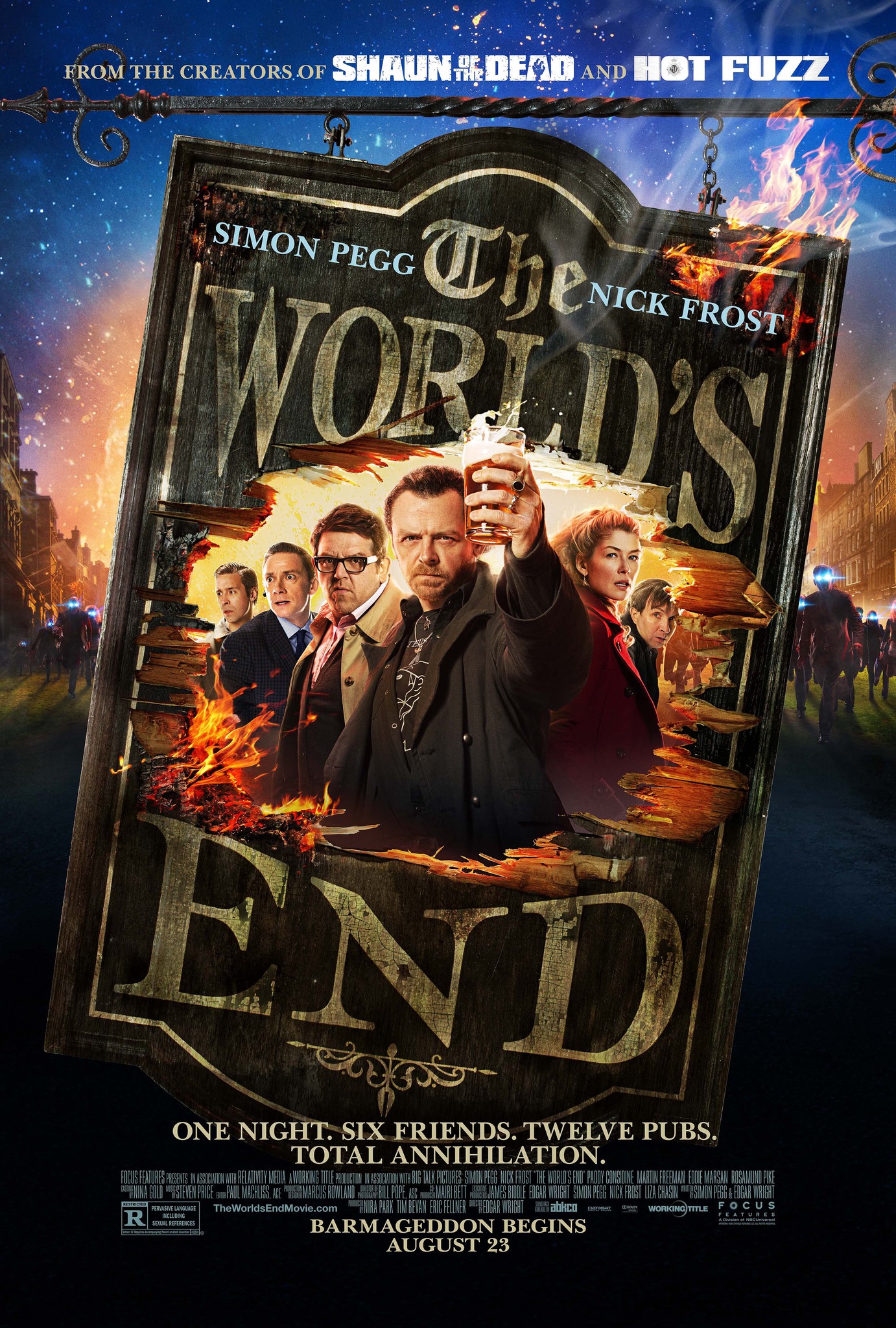
The World's End (2013) – BONUS ROUND

 Okay. I admit it. The Invasion was an altogether lackluster entry to close out this series on. Not even in a fun cathartic way. Just a disappointing affair all around.

I was bracing for this and had planned a bonus entry for the end of this month. Sort of a palate cleanser and an extension of the old saying about not going to bed angry.

At the start, I was going to use this spot to give a shout-out to the recent movie Little Joe.  A shout out I will still give as preamble here anyway – it isn't quite a Body Snatchers-style movie, but it is one very genuinely inspired by the series.

Why am I not making the whole write-up about this, then?

Because damn – as I waded through the nihilism-heavy back end of The Invasion, I kept finding myself thinking of Edgar Wright's The World's End (a movie that Wright himself openly compared to Body Snatchers and similar movies of the 'comfy catastrophe' genre), and how, without explicitly going for it, it nailed the general thematic aspects of the Body Snatchers story much more effectively compared to the official remake.


...and, because, like most adults living in the year 2020,

I can't help but feel the best solution to disappointment is drinking.

In comparing to the other entries in the series, The World's End is – to me anyway – the Gallant to The Invasion's Goofus. Where the latter makes its changes to formula for reasons that ultimately don't feel like they're achieving anything, Wright's own pod equivalent – the robotic Blanks – thread in well with the two main themes Wright is addressing in the film.

Which is the other area where The World's End excels in this race. Not only does it make them work well with the story - in general, it feels like it has a much better grasp on the themes it's trying to convey.

First, we have a continuation of one of the themes from Wright's earlier Hot Fuzz – the continued criticism of gentrification. As our movie's heroes return to their old home town to find all the pubs redesigned with a downright eerie uniformity – to the point where even the beer descriptions read like a set script – one can see the obvious critique of modern mass marketing at play. It's even more overt when you read up on the behind the scenes – in some interviews, Wright's description of the Network (the intelligence behind the Blanks) describes them as a sort of intergalactic Starbucks. Not necessarily malicious, simply just propagating its brand, much like the pods - simply existing and doing what comes naturally to it.

The final act of the movie, in turn, plays like a sort of oddly comic riff on many of the earlier movies' debates between human and pod – humanity isn't championed in the eyes of the stoic higher intelligence by love or hope or art. Instead, humanity's champion is Gary King (Simon Pegg, in probably one of his best performances to date) a problem alcoholic who has spent much of the night prior to that confrontation coming to terms with the fact he has lived as a complete and utter human trainwreck since high school ended. His argument is brash, irrational, unapologetically profane, and, to that end, incredibly human.


Humanity's hero, everyone.

It's also part of where the other interesting variation on a theme comes from – the allure, and danger, of nostalgia. The entire reason Gary and his former friends wind up returning to their old stomping grounds is itself born out of Gary's desire to try to complete the famous pub crawl they all attempted and failed in their youth. For him, this is all an attempt at reliving a childhood that the rest of the group has since left behind (and, as he learns, ultimately never really existed.)

Enter the Blanks, which quite literally offer that past fantasy – not just to Gary, but the entire group. That promise of youth, old romances, and reliving past high school glories plays as a different take on the 'perfection' offered by the alien intelligence. That it offers it as a choice (albeit with a very stacked deck) does make the Network a bit more nuanced an antagonist than most iterations of the Pods, but at its core it is still much in the same vein.

It's an interesting two-step that would be right at home with the story's tendency to address the issues and concerns of the age it's taking place in – there is definitely more of a feeling of relevance to be had in Wright's shared themes of a sanitized corporate buyout or the lengths people go to pursue an idealized past that never was (personal or not) that has helped the film age to far more success than the muddled nihilism that the most recent mainline Body Snatchers brought to the table.


and on a lighter note, this just makes a great

callback to the iconic pod shriek.


It's a brother from another mother (father, technically), but damned if it doesn't feel right at home with the best this particular series has had to offer.

There. That's a note I can close this month out feeling a bit more satisfied with.

With that said, I hope you're all staying safe and sane this year (we're all gonna need it soon) and to you all I wish a Happy Halloween.

...I mean...


SHRIEEEEEEEEEEEEEEEEEEKKKK