Showing posts with label divine. Show all posts

Wednesday, March 18, 2026

52 Pick-Up # 11 – Multiple Maniacs (1970)

“I think Divine made drag queens hipper because they were really square before he came along. Van and I wanted Divine’s look to scare hippies, because those are the people who went to see underground movies. If you watch that documentary The Queen, all of those drag queens wanted to be Miss America. They were all trying to dress like their mothers back then, but Divine didn’t wanna be a woman—he wanted to be Godzilla!” – John Waters

Okay, so normally I don't start these with a quote, but given this movie and this quote, this one demanded it.

With that, welcome back for the 11th go of 52 Pick-Up, a year long dive into my cinematic to do list. After promising this two weeks ago (and again, sorry about that) we're back on track this week. Coming on the heels of last week's excellent but bleak political thriller, it's time to go back into Uncharted Waters and continue to explore the remaining parts of John Waters's filmography. For this month, that involves his 1970 sophomore effort Multiple Maniacs.

Last time I did a John Waters movie here, I had reflected that, if I came into it early into my journey into his filmography, I might have liked it more. I bring this up because, the more I think of it, I feel like Multiple Maniacs is the reverse of this idea for me. Coming into this near the end of the run through John Waters's movies enhances the appreciation of it for me as a milestone in his career. A milestone that led to me almost subtitling this entry 'Dawn of the Divine.'

I feel like if this had been one of my first encounters with Waters as a filmmaker, it might not have landed as much for me. I don't think I would have hated it, but the looser narrative and the flow of events might have just not landed as much. Watched now, especially seeing the films that came immediately after (including Female Trouble, which at the time of this writing is still my favorite Waters movie) I don't see as much the kind of less formed parts, but the pieces that would become more concentrated in the movies that followed.

On the other side of this in the timeline, this was the movie Waters made following this debut, Mondo Trasho. In the larger arc of Waters lore, Trasho is a movie that mainly holds value for the circumstances around it rather than the movie itself – i.e. it's his first movie, and one that will likely stay out of print due to the music rights issues. It's a movie I would really only recommend to someone who's going for Waters completism, because the movie as it is mostly just feels a very rough, unpolished movie that has occasional glimmers of the Waters we all know and love, not in such a capacity that it's worth the run time for much beyond saying you've seen it.

Coming on the heels of that, Multiple Maniacs feels like a big step up. There's a confidence and a clearer sense of style and the kinds of things Waters wants to do on screen here that makes for a much more enjoyable watch by comparison. Right at the center of that is – you guessed it – the elevation of Divine from a support in Trasho to the center stage in Maniacs. We get other notable names in the Waters canon as well – Mink Stole, Cookie Mueller, and David Lochary all have great appearances among others. In particular, shout-out for the late Lochary who kicks the movie off in a memorable fashion in full carnival barker more for 'Lady Divine's cavalcade of perversions' – a wild sales pitch intro I would happily try to crib for an audition in the future if I though I could get away with it.


I never would have imagined I'd see
a John Waters rendition of the Stations of
the Cross before, but it's there
and it is absolutely insane in all the right ways.


But again, Divine is what makes this movie shine. This first variation has parts of what we would see Waters later adapt into Babs Johnson and Dawn Davenport in later movies, and as the prototype, Divine (as Divine) is in full chaotic force of nature mode, going from a life of crime, to a foray into religion, to a rampaging finale that may be the closest thing John Waters will ever make to a kaiju movie. Even beyond just her role in Dreamland history, she is a lot of fun in this movie and gives it a pulse that the earlier movie doesn't quite have.

So I feel like I'm rating this movie on two levels. On its own, it's a very watchable, if genuinely weird, piece of the more gonzo early years of John Waters with some truly bonkers set pieces that need to be seen to be believed. Taken as part of the larger Waters canon, I really enjoy this as that first really clear statement of Waters as a filmmaker. So much of what comes after can be seen in its early stages here. Multiple Maniacs walked so Pink Flamingos could tear down the streets in a psychotic Weapons-style sprint.

Believe it or not, this isn't the part where the movie
goes full kaiju.
It STARTS here, but this isn't it yet.


As you can imagine, this was also a great mood lifter after last time (though again, DO seek out Z.)

Alas, with this, I have completed the journey into the early days of Dreamland and sometime next month it's time to journey into the late 90s and beyond for Waters.

But before we do that, March has one more movie in the queue and it's one I have been circling for years. In closing out March, 52 Pick Up discovers what it means to be young as the month closes out with the Walter Hill cult classic Streets of Fire.

Till then.

Thursday, April 29, 2021

Female Trouble (1974)

 Welcome back for another round of the Criterion Backlog Challenge (still trying to find a better name.)

As with last entry, we're continuing to play in the delightfully filthy world of John Waters. Following up on Polyester, we're going back to the earlier years of the Dreamland players with his 1974 black comedy Female Trouble.

Once again, I repeat the disclaimer regarding Divine - Yes, in real life, Divine was a man, and as far as all reports show, was not transgender. Having said that, I am still opting to use the her pronoun, as Divine is still treated as a persona different from Glenn Milstead. Just getting that out there now.

To start - I'm still a relative neophyte where Waters is concerned. I've seen several of his movies, but not all of them. With that said, I think Female Trouble might be my favorite of those I've seen.

Rewatching this with what I know of Waters's early output and on the heels of Polyester gives interesting perspective. In many ways, this feels like a conceptual earlier link in the evolution to Polyester as a more 'mainstream' Waters movie. It has much of the weirdo, anarchic spirit of earlier films like Mondo Trasho and Pink Flamingos, but also more of a structure and thematic throughline.

Much like on Polyester, this is one where Waters' love of film really shines. This time, however, he isn't so much paying tribute to one particular director/style as he is several different genres. Over the cinematic life of Dawn Davenport (Divine, again proving there's a reason she was a regular muse to Waters), her story is told in a series of vignettes that play from high school delinquent stories to melodramas to 'women in prison' exploitation. Equally impressive is that Waters is able to make the beats serve the story/character admirably without any of the pivots feeling misplaced.

This isn't related to the particular image, but I do need
to point out - again, like last time, this movie's title theme
song is catchy as Hell.


Coming from the other side of the equation, this is a top notch showing for many of the Dreamland Players. This was far from their last appearance (in fact, many later appeared in Polyester) but it's worth pointing out because they are in top form here and I would be remiss not to give them their due. Divine, for example, is a full blown force of nature in this. I spoke last time about her ability to play the cinematic straight role (such as it is) in a movie where everyone else was playing up the weird. Here, she becomes the nucleus of crazy that many of her co-stars orbit around.

This isn't to say they're diminished by her, either. Several of the other Dreamland regulars shine in this, many in how they play off of Divine. In particular I have to give a shout-outs to Mink Stole as Dawn's daughter, Taffy - conspicuously older than written, albeit that's part of the joke.


Stole's Taffy Davenport MIGHT be the closest thing to

a 'sane' character in this movie.

Which, as you can see, is still only going just so far.

With that general praise, there is one aspect in particular I want to focus on – by now this is sort of becoming the mechanic for these entries after all. For Female Trouble, the stand aspect out for me, both that first time and now, is how the film addresses celebrity, and why it still feels eerily resonant nearly fifty years later.

Heads up, we're getting into some spoilers ahead. You've been warned.

Last chance to either turn back or jump to the ending.

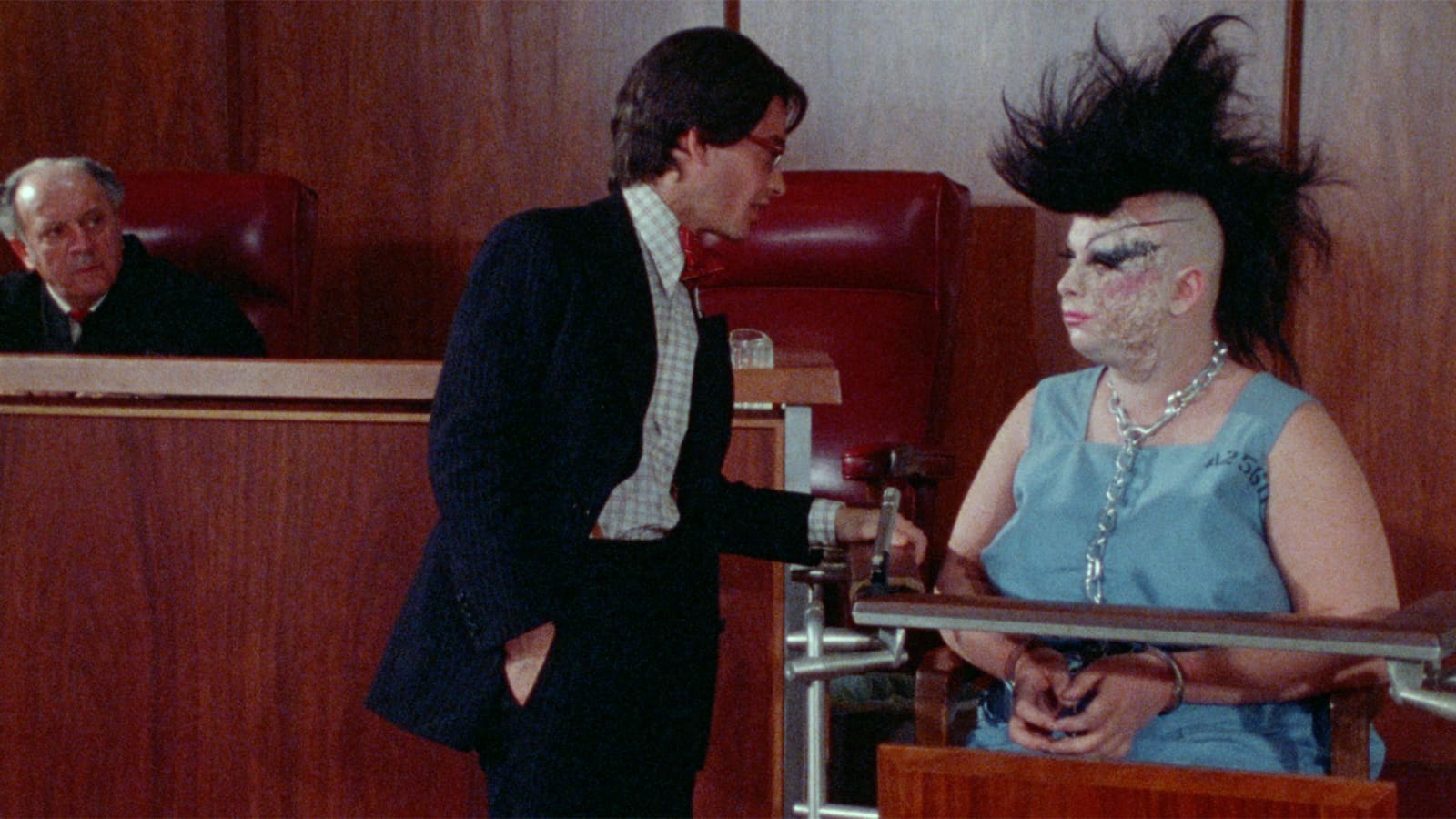
As a protagonist, Dawn is, in her own paraphrased words 'a thief, a shitkicker, and she'd like to be famous.' She gets that wish in a way that plays to the theft and shitkicking care of Donald and Donna Dasher, (David Lochary and Mary Vivian Pearce, both playing batshit pretentious perfectly.) The Dashers are a preening couple who believe crime is art and see their latest muse in Dawn. The trio get on like gasoline and a blowtorch as Dawn's criminal antics gain her a following that dances between admiration and freakshow appeal. The line becomes especially blurred after Dawn is attacked and burned with acid – a cavalcade of fans are led by the Dashers into her hospital room to watch the removal of her bandages, the burns met with a wild admiration.

Dawn's fame is seemingly untouchable, as every act of violence draws more of a crowd. Even near the end of the movie when she strangles her own daughter to death, the act is met with wild applause. The crowds love all her artistic absurdity and cruelty, the illusion only breaking when she asks her infamous question “Who wants to die for art?, a question that gets enthusiastic volunteers until she opens fire. Once the audience realizes they can be effected, they quickly turn. Even the Dashers, Dawn's top enablers, are all too willing to throw her under the bus once the police arrive, getting away scot free as she's sent to the electric chair.


Again, there's something striking about watching this fifty years out and how familiar it still feels. It's not like this was unheard of at the time - the movie's opening titles include a dedication to Manson family member Charles 'Tex' Watson, after all (a choice Waters has since admitted he's not proud of). Watched in the cold light of 2021, however, after years of seeing people who have either built or attempted to build reputations for celebrity on anything from just pure shock value all the way up to involvement in criminal activities (I'm not gonna name names because we could be here for hours) it's hard not to be shocked, impressed, and even a little bit disturbed how well this holds up.

It's still a very entertaining and funny dark comedy, but damn if time hasn't made those laughs THAT much darker.

On that note, I'd say that's as good a spot as any to wrap up here.

I had hoped to get one more trip into Dreamland in before the end of the month (keep an eye out, that may be a wild card in the future!)

Time, however, marches on, and I'll be back here soon for a theme I will explain when the time comes involving not one, but two directors.


Till then!

Tuesday, April 20, 2021

Polyester (1981)

 French provincial
They do their best
To stay neutral
Expressionless, ah-hah,
Come on upstairs
Meet your polyester queen

What can I say? That song gets in your head and sets up shop.

Welcome back to another round of the Criterion backlog challenge.

As discussed last time, this month we're focusing in on one director – the weird, the wild, the proudly filthy John Waters. Kicking this off, we're starting with his first foray into the (relative) mainstream, Polyester.


Up top, two general notices:

First, I want to tip my hat to one of my old college film professors. I enrolled in Professor Noletti's course on film genre the year he taught melodrama. It was thanks to that course and its deep dive into Douglas Sirk that I got that much more of what Waters was going for here. So thank you, sir, wherever you may be. This may not have been the influence you intended, but damn if I'm not grateful for helping me appreciate the joke of this film more.

And for the record, I'd say Sirk's work is worth seeking out, but that's for another time.

Next, a general preface regarding the film's star, Divine. Yes, in real life, Divine was a man, and as far as all reports show, was not transgender. Having said that, I am still opting to use the her pronoun, as Divine is treated as a persona independent from Glenn Milstead. Just getting that out there now.


Or, as Waters himself has put it best:

"Divine didn't want to be a woman,

Divine wanted to be Godzilla!"

Okay. We all good? Everyone got their Odorama cards ready? Great. Let's dive on in!

Parody in film is, and always has been, a hard type of comedy to get right. For every Blazing Saddles or Airplane!, there's any number of misfires (see, just about anything else the Zuckers worked on, save for the Hot Shots! films.)

Which, ultimately, became what I wound up hinging this write-up on. Why is Polyester one of the spoofs that works where so many others don't?

I can think of a number of reasons, but two in particular stand out and go hand in hand.

The first of these, cliché as it may sound, is love. It's not a necessary requirement, but there is something to be said for riffing a genre you love for a full feature vs just trying to make a film out of something you are uninterested in or actively dislike. The latter isn't impossible, but it is more difficult, as you are less invested, and less likely to find those extra angles to play with compared to a filmmaker whose mockery is affectionate.


In Polyester's case, Waters has made a movie that is a classic Sirkian melodrama at heart – a housewife's life is beset by tragedies and finds new love. It's not any one film, but it's written in the vein of them. That classic story is then run through the filter of Waters's signature cinematic batshit. As outlandish and absurd as it gets, at no point does Waters feel like he's disdaining the trappings of the genre, or acting like he's smarter than them. At its core, this movie still looks to them as a map. Most of the silliness comes from him simply turning up the drama up to the proverbial 11.

The other reason this succeeds is Divine's performance as the film's put upon heroine, Francine Fishpaw. It's a change for Divine compared to her earlier work. When one mentions her with Waters, the first roles that come to mind tend to be the wonderfully brash, over the top characters like Babs Johnson or Dawn Davenport. Compared to those, Francine is a 180 degree shift – she brings her share of the over the top moments, but compared to everyone else, she is the grounded one. In her own words, she's a good Christian woman (and for a time, alcoholic) maneuvering a world populated with gleeful sleaze mongers, coked up old ladies, foot-stomping maniacs, and former teen heartthrob Tab Hunter as a love interest with a wild dark side.


and credit where it's due - Hunter is clearly

having a field day playing the increasingly unhinged

Todd Tomorrow.

I could keep going with outlining all the movie's delightful absurdity (all I will say besides the above - “I never wanted to use macrame to kill!”) but it all comes down to one thing – Divine's performance is a grounding force for the film. If Francine was as outlandish and crazy as everyone else, the movie would lose its plot and run completely off the rails. It could still be entertaining, but it would be untethered and likely collapse before crossing the finish line. Instead, we get a funny, bizarre movie that Divine does a titan's job of keeping together on her good Christian shoulders.

In closing, I will note (as I should have at the start) John Waters is not a filmmaker for everyone. I feel like recommending, say, Pink Flamingos to someone sight unseen MIGHT be an act of abuse.

Having said that, if you have any interest in seeing any of his films, Polyester is a great way to test the waters. A lot of his signature craziness, but also with more of the structure than his earlier Dreamland productions.

So if this sounds like it could be fun, by all means, seek it out.

And don't worry, you don't HAVE to use the Odorama card.

That's it for now. Waters month continues as next time we probe the immortal question – who wants to die for art?

Till then