Friday, February 26, 2021

Black Girl (1966)

 
Welcome back for another round in the Criterion Collection Backlog Challenge (we're still shopping names around.)

This marks a small, but special road marker for me on this project – this marks the first movie on this list that I had not seen before. With that said, Black Girl made a very strong first impression on me.

First off, just reading up on the backstory of this movie is worth it. I don't mean in the sense you get often now of a larger in-film lore, rather the life of the movie's director, Ousmane Sembène, and the role this film has in the larger history of African cinema. In the case of the former, Sembène had already lived a pretty storied life even before he took up film, making a prominent mark as a writer and activist before deciding on film as the best medium to reach people. This movie, meanwhile came in part as a result of changes following Senegal's independence from France (stick a pin in this, we'll be coming back to it.) The Senegalese, largely blocked from making film by law before that point, were finally given an opportunity to make their mark on film history.

Black Girl is largely considered to be, perhaps not the first in general, but certainly the first movie of this movement to really make an international impression. A well earned distinction, given how hard Sembène had to fight to get it made in the first place (I'd highly recommend reading the essay for the film on the Criterion website for this, rather than have me unload all of that here.)

Like the films that led this project last month, this movie is by no means diminished by the history around it. Quite the opposite, for clocking in at only a little shy of an hour, Black Girl leaves one Hell of an impact, one that's even stronger when you know the larger context it was made in.

This is the first, and certainly won't be the last film
on this project where it's gonna be tricky for me to get

cheeky with the captions.

So in the meantime, the link to the above-mentioned essay:
https://www.criterion.com/current/posts/4402-black-girl-self-possessed

Part of why this film proved such an uphill battle (I promised myself I wouldn't just rehash, but I'm going somewhere with this) is because Sembène did NOT want to make a happy film out of his country's independence. He was certainly glad to not be under French rule, but he also recognized that they were still not completely free of France's influence.

In that regard, the movie is a perfect microcosm of that sentiment – the titular girl, Diouana (Mbissine Thérèse Diop, giving this movie's emotional core a lot of its resonance) agrees to a job with a white family in France. Initially excited by the offer, she soon realizes the situation is far from what was promised, finding herself effectively a prisoner in the apartment she works in, treated in equal parts with disdain, disinterest, and fascination as an oddity. The last is captured in especially uncomfortable nature in a dinner party where Diouana serves the guests, while treated to all manner of commentary about her from them along the way.

As you can likely tell, this falls under
'fascination' in a genuinely unsettling way.

Throughout the film, we're treated to flashbacks of Diouana's life back in Dakar, first from the day she got the job offer and expanding beyond that from there. The contrast, not surprisingly, is stark - the open, welcome life she has at home compared to the close confines (in every sense) of her life in France. The only shared symbol between the two worlds for Diouana is a mask she buys from a local boy to give to her new employer, where that piece of her culture is rendered purely decoration with no meaning behind it.

I know I did this last week, but once again, if anyone wants to avoid spoilers, I'm gonna ask you to skip ahead to the end (to make this easier, do a CTRL-F to 'SPOILER END'), cause this is another film where I want to discuss the ending in terms of impact.

Okay?

Moving on.

There's a lot to recommend in this film, and a lot of things that will stick with you. One of the biggest examples of this is the film's final scenes. Diouana, having come to terms with the fact she was lied to repeatedly by her employers as they tried to control aspects of her life tries to fight back, ultimately in vain. Realizing she is in a no-win situation with them, she concludes the only way out is to commit suicide.

The act isn't played for high drama. In fact, the reveal is fairly stoic, paired with a news clipping that doesn't even mention her by name. The heavy hit, instead, comes in the aftermath of the suicide, when the man who hired her (Robert Fontaine) returns to Dakar to give Diouana's family her possessions and try to offer the money she was promised to her family. They decline, and as he leaves, he finds himself followed by a young boy, wearing the mask and watching him every step of the way to the boat.


The end result is considerably more resonant than a full

hour of "Screw you!"s could have been.
Albeit that would still be pretty damn cathartic.

It's a powerful message in the larger post-colonial context of the movie. Of the two employers, the man is presented as the 'lesser evil' (one would be hard pressed to call him good, but compared to the crueler demeanor of his wife, he is far more passive and indifferent toward Diouana). Despite his not being overtly antagonistic, he nevertheless stands by and watches everything happen, doing nothing to stop it. When he attempts to make it 'right' by offering money, he is justifiably rebuked. Simply watching oppression might be argued as being better than actively oppressing, but it still can't be taken as good, and one can't pretend their hands are clean for the act either.

SPOILER END.

If I had to describe Black Girl in a single word, it's probably 'angry.' Not in the sense of full-throated rage or hyperbole. Rather, the anger in the film is quiet and intense. It doesn't scream its message at you, but Sembène still makes what he's saying incredibly clear in a controlled, effective manner. He doesn't wish for the days of French rule back, but doesn't think they've magically vanished into thin air either.

As a first impression, both as a movie, and as a director, this landed for me. So much so that, earlier this week, a Criterion flash sale led me to put in an order for Sembène's later Mandabi. I'm looking forward to seeing more of the man's work and, even independent of this project, reading up on his life and career in general.

That makes for a strong note to end our second month on. Next time we're shifting gears again for March with Women's History Month. As you can imagine, that will mean exploring some films directed by women, starting off with a name that's been a cinematic blind spot for me for a while. A blind spot I look forward to correcting.


Till then.

Thursday, February 18, 2021

Do The Right Thing (1989) – The More Things Change...

Well, the first theme month has officially come and gone.

To that end, as we established last time, we're now moving into a look at black filmmakers in the Criterion Collection for Black History Month.

Before we get into this first entry, a small disclaimer – this was gonna be a lean month. I knew that going in one part because of our own selection, and also because, independent of what's on hand, Criterion has had something of a blind spot where POC filmmakers have been concerned. This has been brought up before, and last year they did respond saying more of an effort will be made to focus on this in the future, so we'll see what comes of it.

Just wanted to get that disclaimer out there up front was all, because this was enough of a discussion to get them to sound off was all.

So, with that said, let's start this theme with Spike Lee's classic Do the Right Thing.

In terms of what struck me about this, two things come to mind, both of which can be summed up as being about how well this movie has aged. This is, as some of you may be guessing, both a good thing and a bad thing.

First, the good – this was and still is, an incredibly well made film on several levels. Lee does a great job of setting up all of his players and their disparate plot lines throughout the day and slowly drawing them all together for the film's explosive finale. Further, Lee's script, as well as his cast, present a cross section of people with an impressive level of nuance. No one is presented as a complete saint or a two-dimensional villain, and as the heat rises on the day, no one manages to stay completely above the rising tension.

That nuance being a key part of what makes the tension in the movie work. Race is certainly not a new topic in film and not unique to this one movie, but this is a movie that gets a good handle on how to present it, with everyone presented as having both their humanizing moments as well as their biases and bigotries, presented in a fashion that doesn't feel forced.


Samuel L Jackson's Mr. Senor Love Daddy is probably the
closest to being
above the growing tension and chaos,
and even that is largely a
result of his job keeping him
separated from everything unfolding on the streets -
a voice trying to keep the peace to increasingly diminished effect.

I realize I'm painting in broad strokes. Admittedly, that's because every time I start to focus on a particular player or storyline, I feel like it will have to lead into going into at least four or five others as well. The movie's cohesive nature is both a blessing and a curse in that regard here, and has me honestly wanting to come back to this independent of this project and try to give it a more in depth going over.

...suffice it to say, I am wholeheartedly recommending this.

So what is the bad side of this?

As I said, this movie has aged incredibly well. Unfortunately, this isn't just a reflection on how the craft of the movie still holds up well over thirty years later. The other side of this is, thematically, much of this movie feels uncomfortably all too familiar.

Okay, I WILL concede the relaxed attitude of the police
early on feels a bit dated now. That said, not exactly scoring

a point for things in the 2020s by acknowledging that.


I'm gonna say now, if you haven't seen this, this is probably the best time to step out (or go to the bottom of the page for the next installment teaser image) cause to really go into this, I will need to drop a spoiler.

Okay? All clear?

Good. Moving on.

On this rewatch, there was already that sense of familiarity in how some of the racial tensions were still there. That wasn't too shocking on its own. The part that really hit home with this regard was in the movie's finale, most notably the death of Bill Nunn's character, Radio Raheem, put into a lethal choke hold by the police.

Raheem's death in the film isn't meant to be read as simply a fictional hypothetical by Lee. In fact, even within the confines of the film, parallels to what happens to Raheem are drawn by other characters using real life examples of other black people killed as a result of police brutality.

This was before Rodney King. Before Tamir Rice. Before Eric Garner. Before George Floyd. Before Breonna Taylor. Those are just off the top of my head. Again, if I tried to comprehensively list every incident since this movie's release, we'd be here a while. The fact that that is only scratching the surface says a lot right there.

Further adding to the 'then and now' factor on this -
Watching and remembering discussing this in film school,

wherein the professor pointed out how some audiences at the time

completely missed the point of this ending and questioned the property

damage.

...Yeah, watching this in 2021 is a LOT.


It's a grim feeling, and one that honestly calls to mind the ending of Lee's later film BlackKklansman – as much as it may be comforting in other films to act as though this sort of thing is in the past and over with, it hasn't gone away. If anything, it's gotten worse with time, to the point where reminding one's self this movie was made in '89 does little to dispel how contemporary much of what one sees in this feels.

...Okay. Those of you who walked out for spoilers, it's okay to come back in. Once again, standing by the recommendation on this one.

Hopefully if you've not seen this one, that will change soon.

In the meantime, back next week with the next entry for this month's theme.


Till then.

Sunday, January 31, 2021

Cronos (1993) - No. Really. Who the Hell wants to live forever?

Welcome back for another round with the Criterion backlog!

This marks our second, and for this month, final entry for January's theme of famous firsts. Following our kick-off with the Coen Bros' Blood Simple, this time we're looking at the feature debut of Guillermo del Toro – Cronos.

Like our previous entry, besides being the director's debut, this also marks the beginning of several creative relationships that will continue through del Toro's later career. First off, lead Federico Luppi will return to work with del Toro again on The Devil's Backbone and Pan's Labyrinth (both of which we'll touch on later.) Next, his director of photography, Guillermo Navarro, will work with del Toro on many of his subsequent features – and given the strong visual style of much of his work, it's a creative relationship worth highlighting. Finally, it marks the beginning of a number of collaborations (as well as a general good friendship) with actor Ron Perlman.

In terms of impressions from this watch in particular, I'll start by saying, it had been a long time since I previously watched this. Several years of long time. The result, overall, has proven a welcome revisit for a movie I was long overdue to rewatch. Taken alongside his larger body of work, I was pleased to see how much of what defines Del Toro's later filmography is on display here – the fascinating world-building he sets up around the titular Cronos device, his take on vampirism that presents it an even-handed and fairly human light, and a strong visual style, again aided by his long-term collaboration with Navarro as DP. There are several directors whose work I admire where I will admit, their first features are rough as they try to find their footing. In that regard, like the Coens before, Del Toro is one of those who found his voice early on and does a great job of making it heard here and keeping it up in his later movies.


Yeah, you won't die, so you don't have to worry
about unsanitary floors.
But again - at what cost?

Of those aspects mentioned above, the one that made the strongest impression for me this time out was the thematic handling of vampirism. The idea of a nuanced, humanizing look at the undead wasn't a particularly new one on its own at the time that this came out, so I can't say it's blazing trails there, but all the same, Del Toro's particular sentiments on the matter shine, thanks in part to how the mythology around the Cronos device lets him sidestep several of the more traditional trappings of the genre as it's generally known here. Vampirism as presented in the world of Cronos isn't sexy, or even all that sexual. It isn't about gaining new special powers, or becoming superhuman. In fact, for protagonist Jesus Gris (Luppi, showing a range from grandfatherly warmth and tenderness to energetic revitalization to exhaustion on a physical and mental level all over the space of 90 minutes) the only benefits he really notices are a bit of a fresh spark of vitality and youth, and even that is gradual rather than drastic. As the movie establishes with its opening narration, the primary driver behind the creation of the device and its appeal is purely immortality, and that at a cost.

That idea – the immortality for a price – is the central piece the movie hangs on, presenting its two sides in the afflicted Jesus and his counter in the sickly, aging Dieter (Claudio Brook), who simply desires immortality for immortality's sake, knowing what it will entail and not being deterred by that. The movie makes that more stark as we go on and see the extent of what the immortality does to Jesus, going from simply gaining new energy to (painfully) surviving several brushes with death, his human flesh literally sloughing away, revealing a 'new' Jesus, pale and ever thirsting for human blood.

I couldn't quite work it into the larger writeup in a way
I was satisfied with, but I do need to give some mention here -

I forgot how much the movie also plays into the addiction

subtext through the use of the Cronos device as its means
of conveyance.

That conflict isn't presented in a major way until the second half of the movie, but Del Toro lays the foundations for it very well in the first half. We see Jesus in his life with his wife and granddaughter, a man who has experienced losses, but ultimately still has much to love in his life and people he cares for that enrich his life. Conversely, Dieter lives in a cold, sterile room where his only family is his nephew Angel (Perlman), who he treats more as a strongarm and errand boy than family, with a sense of disdain that is more than mutual. Those relationships underpin the ideological conflict between the two old men perfectly – Jesus has those he loves in his life and the idea of becoming a vampire terrifies him for driving them away from him and his being tempted to feed on them, Dieter has no particular attachment to his nephew (or anyone) and so the idea of that rift from other humans doesn't phase him when weighed against the idea of never having to fear death.

Again, these sorts of retakes are part of why I'm looking forward to this project. Many of the films here I've not seen in some time, and I'm looking forward to looking at them with this relatively fresh perspective and having the chance to really dig into those ideas more.

There's not much more I can add in closing here except to say the fact that this isn't brought up quite as readily in terms of vampire cinema still surprises me. It's not that it's disliked (Hell, the fact it's been released by Criterion in two different editions speaks to that), it's more strange to me that it seems so readily overlooked in the general discussion of the greats of the genre is all.

Suffice it to say, if you haven't watched it, I would wholeheartedly encourage seeking it out. It's a Hell of a start to what has been a great career for Del Toro since.

That brings January to a close. Come back next month where, in recognition of Black History Month, we'll be focusing on some entries in the Criterion Collection by black filmmakers.


Till then.

Friday, January 29, 2021

Blood Simple (1984) - Breaking Up Is Hard Enough To Do Without the Psychopathic Hitman

Welcome back. Again, I'm surprised to be back here this early, but it's a good surprised.

As discussed last time, this marks the official kick-off on the Criterion backlog project (I'll need to come up with a snappier name for this in the future.)

Also, as promised, we're kicking things off with Famous Firsts, and fittingly, this pick is actually a movie of several famous firsts.

Blood Simple is, first and foremost, remembered as the directorial debut for Joel and Ethan Coen (though Joel is the only one of the two credited). Besides that, the film is also the acting debut of Frances McDormand – marking several collaborations and an eventual marriage to Joel - and the first feature film cinematography for Barry Sonnenfeld (if we're being technical, he worked on a documentary called In Our Water before this.)

With all that praise built up in its wake, one would almost worry the movie itself can't live up to what followed (and let's be clear, there has been some genuinely great work to come from these people since.) Fortunately, even watched with that legacy in mind, Blood Simple still holds up quite well, both as a first feature as well as just a general part of the larger Coen filmography.

As has become a pattern for me (and will continue with these) I'll start with an aspect of this hadn't really caught on to before (at least where rewatches are concerned.) In this case, the surprisingly lean nature of the film is something I'd never really properly take in before. A handful of principle players, a few key locales – three in particular – and a fairly grim, darkly comic tale of an affair and the Hell unleashed when the husband finds out. Granted, this is a neo-noir, so there are twists in store, but even those twists feel like logical extensions of the way the best laid plans of the movie's players all slowly go awry, rather than feeling like an arbitrary twist to keep the movie rolling.


There's still something darkly funny to me about the fact
that future couple Frances McDormand and Joel Coen first worked
together on a movie that starts from an affair then ends in a body count.

With that, I do have to give a shout-out to the players as they run through the movie's blood-soaked comedy of errors (I'll stand by this description, dammit.) Again, this was feature debut for Frances McDormand, and even before considering her later career (hello, future Oscar winner) she hits the ground running, carrying a role that could have been largely forgettable in less capable hands. As the two men making up the other sides of this movie's deadly love triangle, John Getz and Dan Hedaya likewise both shine, with Hedaya in particular straddling the line with a short fuse that can go from comic to dangerous as the scene calls for it.


As the supporting cast goes, I made it a point watching to give a shout-out to Samm-Art Williams. Besides having a great introductory scene (semi-related, this movie has left “It's the Same Old Song” stuck in my head for the past week), he takes on the relatively thankless role of being the movie's voice of reason and makes him a genuinely sympathetic, at times exasperated figure watching this drama play out from the sidelines.


Finally, yes, he needs his own paragraph, we have M. Emmet Walsh, the first in a long line of characters I have take to referring to as the Coen Brothers Nightmare Squad (without giving a full roster, I will say off the bat John Goodman in Barton Fink is part of the starting line.) Like McDormand, Walsh has a role that can fly or fall easily based on how it's played. In this case, Walsh plays the villainous Lorren with a sort of sick glee. He's definitely not going to turn down being paid for his services, but there is also a sense he is genuinely enjoying what he does even without the financial incentive. He goes from spy to assassin for Hedaya without even skipping a beat – it's a sick game to him and he is having the most fun out of anyone playing it.


One will protect you

One will stop at nothing to end your life

By the time you figure out which is which, it's already too late.


Part of why I had to give Visser his own paragraph, besides the fact that it's a Hell of a performance, is that the character is a big part of why Blood Simple stands out for me. The three leads are all well written and likable – even if I'll always first and foremost associate Getz with his later role in The Fly – but it's the dash of chaos and horror that is added by Visser that really ratchets the movie up, both from the obvious fact he is the devil on Hedaya's shoulder, as well as from the 'all bets are off' feeling that sinks in as he clearly starts running his own plans counter to those around him. That feeling marks the first of many times in the Coens' career where their filmography has flirted with horror without going full tilt into it.

With that said, I have to give a shout-out to another first here – this marks the first of a long list of collaborations composer Carter Burwell has had with the brothers, and while it's not his first movie period, his score is a great fit for the movie's slow shift into increasingly more chilling territory. While not as much of a earworm as the film's use of The Four Tops, I'd be lying if I said the piano score in this has not also stuck with me.

Honestly, the more I let this sink in, the more this really felt like the perfect pick to start this project off. It's a genuinely well made film that launched several careers, and even just within its own confines, goes well with evolving from a noir about infidelity before taking a violent turn care of a human devil in a cowboy hat.

That's as far as I can safely put it without spoiling anything, but I feel satisfied with it.

With a few days left in January, we've got another notable directorial debut on the docket for this weekend.


See you then!

Saturday, January 23, 2021

2021 – New Year, New Project

I know, I'm surprised to be awake right now too.

Jokes aside, like many people, I had some time to do a lot of thinking last year while we were all stuck in various levels of quarantine. One of the things I came away from that realizing was, for all the ups and downs, I do miss working on this site on something of a semi-regular basis. The Halloween projects have been fun, but in the lead-up/follow through, I come away wondering why I don't do more.

Then, sometime late last year, an idea hit, inspired by two other events of 2020 (no, not those events.)

The first was of these was being invited by a friend to participate in a backlog challenge. This challenge, initially with regards to anime and manga, was a personal challenge to work through things in our backlogs that we hadn't gotten around to finishing previously and had on the back burner.

Still taking part in that as well, but I won't be documenting that one here, save for maybe if I find a particular title I really feel needs the extra shout out.

The other, and this was a biggie, was officially moving in with my significant other. In this case, it led to the inevitable meshing of our collected media.

In doing so, I came to the realization we have amassed as a sizable number of Criterion Collection movies between us. Not necessarily a superfan-sized collection, but enough that at a title a week, this would still take a couple of years go to through.

Subsequently, I mulled over the best way to go about this. I briefly considered doing brackets, either with voting or random draw, but after a point, it just felt like overthinking.

Then it hit me – just keep doing what I had done every October, but on a year-round basis.

So, with each month, I'll be picking a few titles (two minimum) for a theme run to work my way through the collection with.

And just to say up front (and slightly tip my hand) yes, this year this will also effect October's line-up, but this should be a fun one, so there's that.

I will also be doing what I can to work other projects in besides these, but this felt like a good way to work back into something with more regularity.

With that said, I'll be starting this off with two titles this week for January. The theme, in keeping with the kickoff, is Famous Firsts – noted directorial debuts.

Keep your eyes out for that first entry by Tuesday at latest.

Till then!

...ah, what the Hell?
I'll drop a hint for the first up.
Who knows, this might become a feature of these now.


Saturday, October 31, 2020

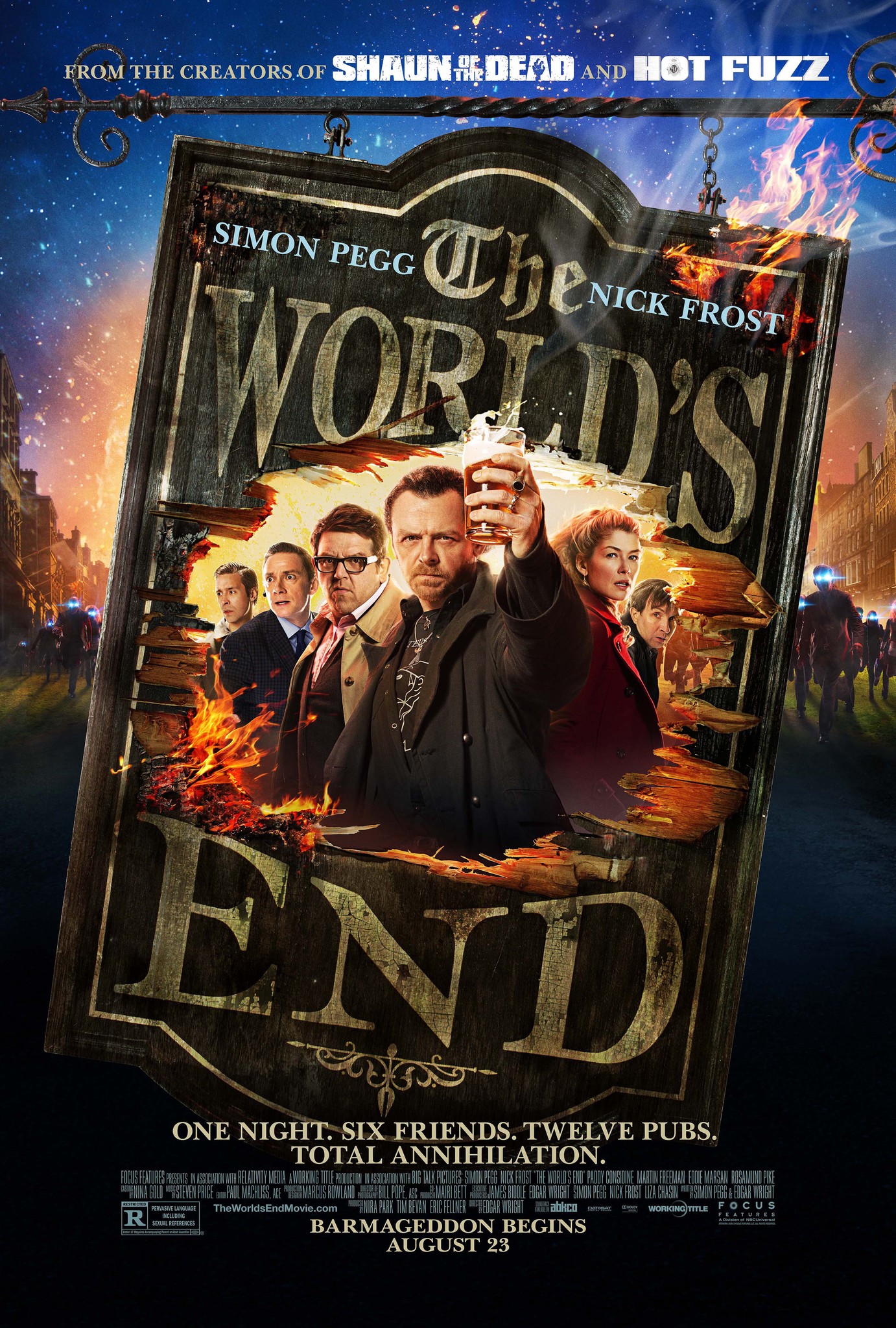
The World's End (2013) – BONUS ROUND

 Okay. I admit it. The Invasion was an altogether lackluster entry to close out this series on. Not even in a fun cathartic way. Just a disappointing affair all around.

I was bracing for this and had planned a bonus entry for the end of this month. Sort of a palate cleanser and an extension of the old saying about not going to bed angry.

At the start, I was going to use this spot to give a shout-out to the recent movie Little Joe.  A shout out I will still give as preamble here anyway – it isn't quite a Body Snatchers-style movie, but it is one very genuinely inspired by the series.

Why am I not making the whole write-up about this, then?

Because damn – as I waded through the nihilism-heavy back end of The Invasion, I kept finding myself thinking of Edgar Wright's The World's End (a movie that Wright himself openly compared to Body Snatchers and similar movies of the 'comfy catastrophe' genre), and how, without explicitly going for it, it nailed the general thematic aspects of the Body Snatchers story much more effectively compared to the official remake.


...and, because, like most adults living in the year 2020,

I can't help but feel the best solution to disappointment is drinking.

In comparing to the other entries in the series, The World's End is – to me anyway – the Gallant to The Invasion's Goofus. Where the latter makes its changes to formula for reasons that ultimately don't feel like they're achieving anything, Wright's own pod equivalent – the robotic Blanks – thread in well with the two main themes Wright is addressing in the film.

Which is the other area where The World's End excels in this race. Not only does it make them work well with the story - in general, it feels like it has a much better grasp on the themes it's trying to convey.

First, we have a continuation of one of the themes from Wright's earlier Hot Fuzz – the continued criticism of gentrification. As our movie's heroes return to their old home town to find all the pubs redesigned with a downright eerie uniformity – to the point where even the beer descriptions read like a set script – one can see the obvious critique of modern mass marketing at play. It's even more overt when you read up on the behind the scenes – in some interviews, Wright's description of the Network (the intelligence behind the Blanks) describes them as a sort of intergalactic Starbucks. Not necessarily malicious, simply just propagating its brand, much like the pods - simply existing and doing what comes naturally to it.

The final act of the movie, in turn, plays like a sort of oddly comic riff on many of the earlier movies' debates between human and pod – humanity isn't championed in the eyes of the stoic higher intelligence by love or hope or art. Instead, humanity's champion is Gary King (Simon Pegg, in probably one of his best performances to date) a problem alcoholic who has spent much of the night prior to that confrontation coming to terms with the fact he has lived as a complete and utter human trainwreck since high school ended. His argument is brash, irrational, unapologetically profane, and, to that end, incredibly human.


Humanity's hero, everyone.

It's also part of where the other interesting variation on a theme comes from – the allure, and danger, of nostalgia. The entire reason Gary and his former friends wind up returning to their old stomping grounds is itself born out of Gary's desire to try to complete the famous pub crawl they all attempted and failed in their youth. For him, this is all an attempt at reliving a childhood that the rest of the group has since left behind (and, as he learns, ultimately never really existed.)

Enter the Blanks, which quite literally offer that past fantasy – not just to Gary, but the entire group. That promise of youth, old romances, and reliving past high school glories plays as a different take on the 'perfection' offered by the alien intelligence. That it offers it as a choice (albeit with a very stacked deck) does make the Network a bit more nuanced an antagonist than most iterations of the Pods, but at its core it is still much in the same vein.

It's an interesting two-step that would be right at home with the story's tendency to address the issues and concerns of the age it's taking place in – there is definitely more of a feeling of relevance to be had in Wright's shared themes of a sanitized corporate buyout or the lengths people go to pursue an idealized past that never was (personal or not) that has helped the film age to far more success than the muddled nihilism that the most recent mainline Body Snatchers brought to the table.


and on a lighter note, this just makes a great

callback to the iconic pod shriek.


It's a brother from another mother (father, technically), but damned if it doesn't feel right at home with the best this particular series has had to offer.

There. That's a note I can close this month out feeling a bit more satisfied with.

With that said, I hope you're all staying safe and sane this year (we're all gonna need it soon) and to you all I wish a Happy Halloween.

...I mean...


SHRIEEEEEEEEEEEEEEEEEEKKKK

Friday, October 30, 2020

The Invasion (2007) – A Good Streak Has to End Some Time

A few more days here, another sixteen years there, and we come to the next installment in this run through the evolution of the Body Snatchers series.

As I've gotten older, I've come to realize I don't get the same zeal in a bad movie takedown I once did. There's definitely a catharsis to it, but it's not something I find myself going out of my way for the way I used to.

I'm saying that up front for a reason – I didn't go into this one expecting a cinematic drag. With that in mind, I'm still willing to admit The Invasion is probably the most disappointing watch I have had tied to this project since switching to the franchise format.


Besides the fact this just makes the whole thing look

incredibly vague and uninteresting, the knowledge that

Daniel Craig's career just gets THAT much better

after this just makes his being squandered here hurt that much more.


Yes, I say this even after having watched 2011's The Thing and Omen IV: The Awakening. The Thing, while misfired, seemed to have its heart in the right place, and Omen IV at least managed to get an honest to God laugh out of me (albeit not by design.) That still puts them both ahead of The Invasion for me in the final estimate.

Again, I want to make this very clear – I went into this trying to find good in it. I won't pretend I wasn't skeptical, but I still gave it the benefit of the doubt. Hell, I was even getting curious to see how it'd play in the aftermath of the first three in relatively short succession.

Turns out, sadly, not very well. From the jump, this surpasses Ferrara in terms of taking departures from the source. Granted, on its own, departure can be a good thing, but there's still a limit. In this version, much of the old premise is gone – of the original pod concept, the only thing that they seemed to maintain was an alien lifeform (the pod is now a spore) that needs you to sleep to take over. Granted, even the reasoning there has been altered – the spore doesn't so much grow a new you as it infects you and rewrites you, with sleep as a catalyst (and the infection now spread by people vomiting on their targets. No, you read that right.)


Pictured - a still from a setpiece that literally involves

dodging vomit on the subway.

Go look it up. I'm not making this up.

I'll wait.

With that tenuous a connection, it was hard not to suspect, while watching, that this movie started as something else and then in the process got retooled into a Body Snatchers movie – certainly common enough in the realm of horror sequels and remakes. Surprisingly, this is one time where the process was reversed – the project was meant to be a more straightforward adaptation, then the writer diverged wildly in an attempt to modernize it, leading to what we got back in 2007.

Again, difference in and of itself isn't a bad thing. If this were a better movie, I'd likely be commending it for its taking the chance. As it is though, the changes don't really feel like they add much to the movie, save for someone deciding this series had a criminal lack of people spitting/puking on each other.

I'm trying not to harp too much on the changes, lest this simply read as purist rage. The problem is, unlike with earlier changes in content, I'm not entirely clear as to the why of many of the changes beyond 'it's modern.'

For a series that I have earlier lauded for its ability to adapt its themes to the concerns of the time, The Invasion is particularly frustrating. I've given it some time since watching trying to parse out a singular theme it's trying to explore to the extent the previous versions did (even if by accident in 56) and it all just keeps coming back to the immortal words of David Byrne: “You're talking a lot, but you're not saying anything.”


and while I'm comparing this to films which felt like

they had a clearer idea what they wanted to convey -

spending a large chunk of this in a supermarket just

left me wanting to watch
The Mist.


For a movie made in 2007, it does feel like it's trying to make some commentary with its changes. The new method of transmission, for example, could read as addressing the growing concern with flu outbreaks – albeit that theme then makes a strange read of the movie's use of inoculations, which in the current environment, can manage to read first as anti, then pro vaccination.

I'd be inclined to give more of the benefit of the doubt that they weren't quite intending a theme there, but for the fact that the changes were in the interest of a more modern take to begin with, to say nothing for the fact that, by the fourth go around, the idea that a Body Snatchers movie is saying something is sort of expected by now unless the people making it say otherwise.

Which leads to probably one of the biggest issues with what this movie is saying – when it addresses the idea of humanity and emotion. It's a concept that's been at the core of every iteration of the series, even in its more (relatively) apolitical early incarnation. In truth, the series started to drift from this with Ferrara, but it's such a stark departure here as to become jarring.

In earlier iterations, the idea of the negative side of human emotions is simply framed as part of the pods' argument – they offer humanity a freedom from fear, hate, etc, albeit at the cost of the positive emotions such as joy and love that other versions offer as a counter point. In this, the emphasis feels almost exclusively fixed on the negative emotions, with human characters dwelling on it even before the aliens start taking them over. Even when the movie ends with humanity surviving the titular invasion, it is presented with a dour counterpoint as Jeffrey Wright only dwells on all those more negative traits of humanity surviving.


Also adding to the 'Where were you going with this?' factor:

This version has people who just have inherent

immunity to the spore. For seemingly no other reason

than to justify the 'happy' ending.

Just wanted to observe that is all.

On one hand, I get it – it was 2007 (and this project actually started in 2004), people weren't in a particularly happy headspace at the time. But even with that context in mind, it's hard to really look at this and feel like it's really saying anything specific to the time beyond 'Boy, humanity sucks, am I right?'

Which, again, raises the question of why go to all the trouble of so completely remaking it if you're really not going to have a clear vision of where you want to go with it. As it is, this movie has threads that could have made for interesting exploration, but never really feels like it does much more than chew them over for a little while and never really come a single conclusion about them.

I would be more likely to forgive a lot of this if the movie still worked as a thriller. Sadly, it's in that sort of nexus of a movie that manages to be both underwhelming and technically overproduced (at the same time, so I don't even have that to take solace in here.

There has been talk since about offering another take on the series – and honestly, I stand by what I said in earlier writeups, there is still pretty fertile ground for this concept to take root in (no pun intended.)

This time it just didn't take is all.

Well, we'll see what happens if that new one comes.

Until then.