Showing posts with label dark comedy. Show all posts

Wednesday, September 22, 2021

Election (1999)

Ahhh, fall. Possibly my favorite time of year.

The days are getting cooler, the leaves are turning, and Halloween is right around the corner.

But first, it's September, and for many, including the Criterion Challenge, that means back to school.

To kick things off, we're going back to the far off (oh God, I'm old) year of 1999 with Alexander Payne's black comedy Election. A movie that touches on all the high school experiences - finding yourself, running for student government and...let me check this note again...torpedoing your career when you take out your newfound midlife crisis on the overachieving student in your class.


I'm sure that was a high school experience for some. Thankfully I dodged that bullet.

As a rule, I try not to go into these with a direct focus picked out. A broad direction sometimes, but I feel if I zero in too much, I could miss something, so I'm reluctant to pre-plan too much.

I did break that rule a bit this time. It was hard not to with the debate this movie has sparked with regards to how we're meant to see the above-mentioned overachieving Tracy Flick.

If it helps, that became a jumping off point rather than the sole topic (hence 'a bit'.) As that question kicked around, I found myself instead focusing on a throughline of the movie that I hadn't put too much thought into before - misplaced blame.

Election is a movie that is spurred forward often by grievance. It's the entire reason Jim McAllister feels the need to try and put a stop to Tracy's presidential ambitions. It's what pushes Tracy to nurse a venomous degree of hate for opponents who don't share her enmity. Finally, it's what leads to Tammy Metzler's 'burn it all down' bid for class presidency that throws even McAllister's plans into disarray.


In the interests of some semblance of order, let's start from the bottom of that list and work our way to the top.

Of the three lashing out in this movie, I feel like Tammy is the one who comes out the best, both in terms of recognizing her misplaced anger and how to address that. Yes, her grudge with Paul and Tracy is largely a consequence of her much more justified anger with her former friend/spurned romantic interest Lisa, but that also allows her to step back from it, rather than let it consume her. By the end, even though she's expelled, she is ultimately happy at her new school with the bad blood left in the past.

Tracy's issues with blame are what really got me on this path in the first place. First and foremost in this movie, Tracy Flick is a victim. This is presented to us on multiple levels - first and most abhorrent being her sexual relationship with disgraced teacher Dave Novotny. Behind him, we have her mother, Judith, who is presented as channeling her own frustrations with unfulfilled ambitions into her daughter (I let out an audible 'oof' this time around when her mother's reaction to Tracy's losing is simply "maybe you needed more posters.") Bringing up the rear, of course, is Jim McAllister, Novotny's friend who ultimately makes Tracy the target of his own anger born out of his blossoming midlife crisis (we'll get back to that.)


I mulled over numerous ways to compare the dynamic
between Tracy and Paul to Frank Grimes and Homer Simpson.
I couldn't quite make it stick, but I maintain there is
a case to be made.


Despite how clearly toxic these adults are, Tracy bears them no ill will in her narrations. She commends her mother's drive, she speaks of Novotny sympathetically and recalls their relationship fondly, and even after McAllister's efforts to sabotage her election, she looks on him with pity more than anything else. By comparison, her attitude towards Paul and Tammy is one of complete and utter scorn. She views them as unworthy of the presidency and beneath her, even though neither has done anything to slight her personally.

This watch was the first time I ever really processed how much those toxic adults have affected Tracy. Her narrations give the impression of someone still unwilling to admit they were a victim, and rather than fire back at those who did mistreat her, she takes out her anger on those she sees as beneath her instead. It's part of why, while working on this writeup, I was pleasantly surprised by the reports of Tom Perotta looking to write a follow up to the original novel where Tracy coming to terms with what happened to her is a factor.

I can't really say I see her as a hero or villain as some would contest, but I have to admit, she is a fascinating, complicated character the more I look at her.

If there's anyone I WOULD say is a hero in this movie,
it's the janitor who undoes McAllister's plan because he's
had enough of his shit.


Finally, we have Jim McAllister. Like Tracy, I was struck by how differently he read to me on this viewing. If anyone in this film could be read as a villain (besides Novotny), it's McAllister. A big part of that is just how far he slides over the course of the film. At the start, the depiction of McAllister is, decidedly, positive (taken with a grain of salt, of course - the movie is rife with unreliable narrators). He is a respected teacher, well liked by his students, and when Novotny confides in his affair, his response is one of shock and disapproval. When Novotny's subsequent disgrace is recounted, McAllister isn't immediately hostile to Tracy. It starts to creep its way in as the first signs of what the movie ultimately plays out as a mid-life crisis, not unlike the one that destroyed his former colleague. Perhaps because of that point of reference, rather than recognize what he's going through and trying to sort himself out, he instead focuses himself on Tracy and destroying her ambitions.

Unlike Tammy or Tracy, McAllister's behavior is much harder to forgive, especially because of how he's introduced. He is presented to us as a man who, for all intents and purposes, should know better - he has a good life, is well respected, and at first has a recognition of how reckless and stupid his friend is being. When it happens to him, however, he ignores that, and ultimately abuses the trusts of his students, his friends, and his wife.

The movie's epilogue further adds to why it's harder to forgive him. As everything settles, we see each of the students finding their way in life - Paul and Tammy each happy with the paths they choose, Tracy continuing to aspire higher and still begrudging those around her. McAllister, we find out, lands himself a museum job and seemingly gets his life back on track. He does see Tracy one more time, this time in the cadre of a noted politician. At first, the movie gives you the impression he's let go and moved on, until he dwells on it more, and we find out he still has some unresolved blame for her and her ambitions proceeding while his are stymied. It's a feeling that then carries into the last scene, as he once again finds himself haunted by an overeager student, reluctant to acknowledge her.

Adding a bit of a darker note -
Remembering that this was a movie made in 99, following
the Clinton scandals, this scene very clearly implies
Tracy is again being taken advantage of by someone
abusing their authority.
Which, sadly, ties well with her never quite reckoning
with what happened to her.


Whew. This was a lot.

What can I say? After taking the summer easy, this one gave me a lot to turn over, and I'm glad to be back in the swing of things.

We have one more entry left before October (where, as I promised, we're still doing a franchise dive, and oh what a dive it will be!)

Stick around for one more class next week and then we'll be on our way!

Till then

Wednesday, July 28, 2021

Lost in America (1985)

 Hello and welcome back for the back end of another month for the Criterion Challenge.

As I'd said last time, this month kind of went with a bit of a broader theme. I'd toyed with a few ideas before I decided to try and do a spin on the 4th of July (my first planned theme was moved to next month.)

I toyed with a few angles before settling on two movies that play to the idea of the American Dream, with an emphasis on the 'dream' part.

Albert Brooks's Lost in America was an immediate lock from there. The wonderfully sarcastic comedy, with its story of Brooks and Julie Hagerty as David and Linda Howard, a well off couple who decide to pitch their life of comfort to get away from it all has been hailed by many as one of the ultimate cinematic critiques of the Baby Boomer generation.
 
 
Watching it in 2021, I find myself both agreeing and feeling like that doesn't quite go far enough. In the context of the movie, the comedy of errors is definitely a riff on David and Linda's boomer sensibilities - they base their entire new life plan around the movie Easy Rider, then invest in a fancy RV, for example. 

That Easy Rider point especially sticks out to me now - the idea that these two uproot themselves and ultimately financially hobble themselves in the pursuit of a lifestyle they saw in a movie feels like an idea that has aged perhaps too well. 

This isn't to say that the movie isn't funny anymore. In fact, there are still several parts of this that get a solid laugh from me. Rather, the idea of seeing people commit themselves, often to their detriment, to actions born of an idea that never actually existed has become a much darker joke in the cold light of 2021.


I do have to say as far as the humor goes.
As famous as the Gary Marshall scene is,
the roulette table might be one of the funniest
scenes Julie Hagerty has done to date.
And yes, I say this as a fan of Airplane!

I do feel a bit like I'm underselling it here, because again, this is a very funny, biting satire. Rather, like Do the Right Thing earlier this year, it's a movie that has, through no fault of its own, gained a darker shadow from the fact that we learned nothing from it.

If anything, more people could probably stand to learn from David and Linda and recognize when it's time to hang the fantasy up, even if it means you have to eat some shit.

(Not literally - I already reviewed Salo once. Once was enough.)

Okay, tasteless joke aside, that about wraps it up for this entry.

Sorry this one was a bit shorter. Mix of technical issues this month and several attempts to flesh this angle out getting exceedingly pessimistic.

We have one more for this month coming up.

I'd say we're going to be less dark next time, but, well, I'd be lying.


Till then.


Virus-free. www.avast.com

Thursday, April 29, 2021

Female Trouble (1974)

 Welcome back for another round of the Criterion Backlog Challenge (still trying to find a better name.)

As with last entry, we're continuing to play in the delightfully filthy world of John Waters. Following up on Polyester, we're going back to the earlier years of the Dreamland players with his 1974 black comedy Female Trouble.

Once again, I repeat the disclaimer regarding Divine - Yes, in real life, Divine was a man, and as far as all reports show, was not transgender. Having said that, I am still opting to use the her pronoun, as Divine is still treated as a persona different from Glenn Milstead. Just getting that out there now.

To start - I'm still a relative neophyte where Waters is concerned. I've seen several of his movies, but not all of them. With that said, I think Female Trouble might be my favorite of those I've seen.

Rewatching this with what I know of Waters's early output and on the heels of Polyester gives interesting perspective. In many ways, this feels like a conceptual earlier link in the evolution to Polyester as a more 'mainstream' Waters movie. It has much of the weirdo, anarchic spirit of earlier films like Mondo Trasho and Pink Flamingos, but also more of a structure and thematic throughline.

Much like on Polyester, this is one where Waters' love of film really shines. This time, however, he isn't so much paying tribute to one particular director/style as he is several different genres. Over the cinematic life of Dawn Davenport (Divine, again proving there's a reason she was a regular muse to Waters), her story is told in a series of vignettes that play from high school delinquent stories to melodramas to 'women in prison' exploitation. Equally impressive is that Waters is able to make the beats serve the story/character admirably without any of the pivots feeling misplaced.

This isn't related to the particular image, but I do need
to point out - again, like last time, this movie's title theme
song is catchy as Hell.


Coming from the other side of the equation, this is a top notch showing for many of the Dreamland Players. This was far from their last appearance (in fact, many later appeared in Polyester) but it's worth pointing out because they are in top form here and I would be remiss not to give them their due. Divine, for example, is a full blown force of nature in this. I spoke last time about her ability to play the cinematic straight role (such as it is) in a movie where everyone else was playing up the weird. Here, she becomes the nucleus of crazy that many of her co-stars orbit around.

This isn't to say they're diminished by her, either. Several of the other Dreamland regulars shine in this, many in how they play off of Divine. In particular I have to give a shout-outs to Mink Stole as Dawn's daughter, Taffy - conspicuously older than written, albeit that's part of the joke.


Stole's Taffy Davenport MIGHT be the closest thing to

a 'sane' character in this movie.

Which, as you can see, is still only going just so far.

With that general praise, there is one aspect in particular I want to focus on – by now this is sort of becoming the mechanic for these entries after all. For Female Trouble, the stand aspect out for me, both that first time and now, is how the film addresses celebrity, and why it still feels eerily resonant nearly fifty years later.

Heads up, we're getting into some spoilers ahead. You've been warned.

Last chance to either turn back or jump to the ending.

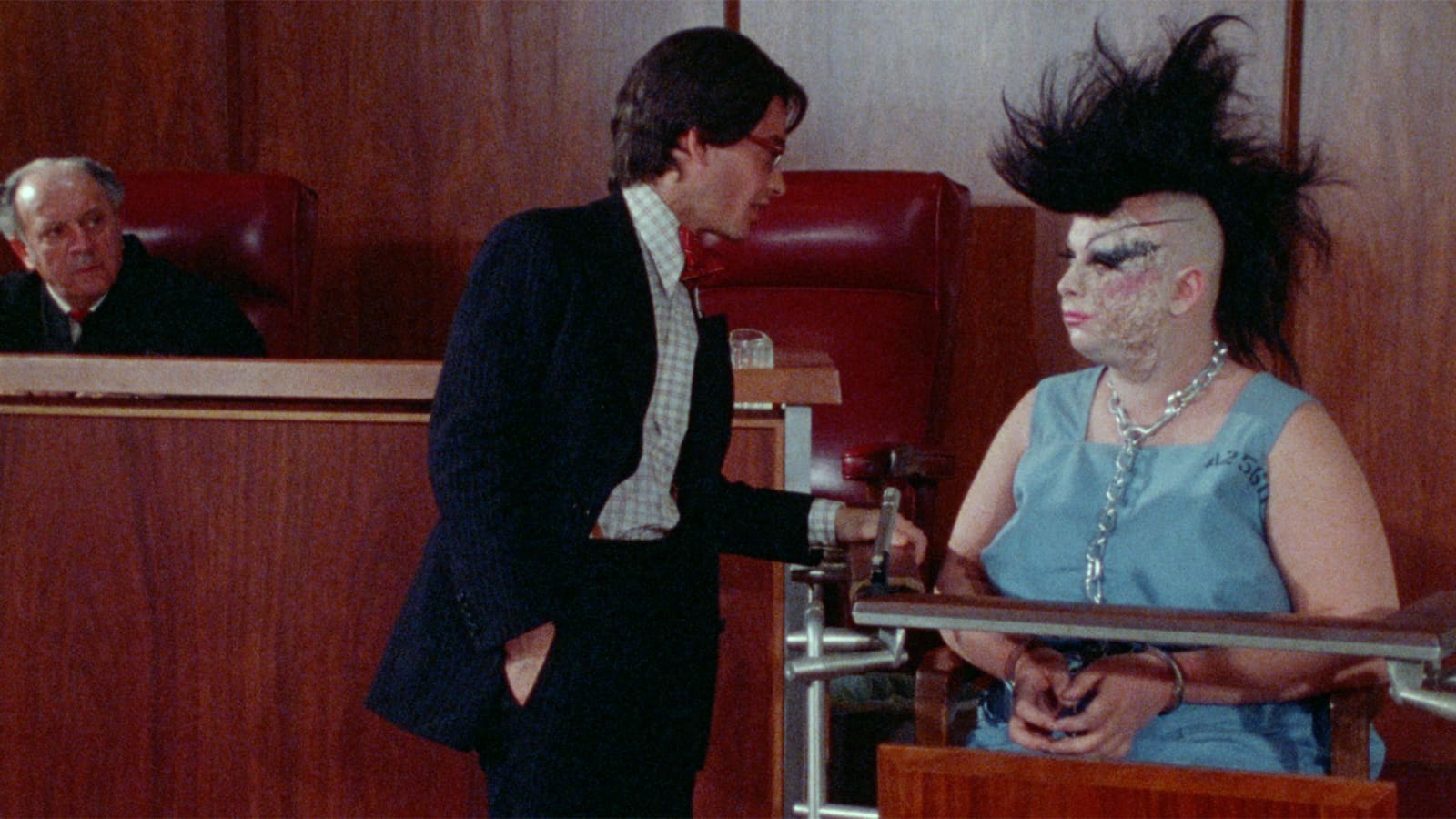
As a protagonist, Dawn is, in her own paraphrased words 'a thief, a shitkicker, and she'd like to be famous.' She gets that wish in a way that plays to the theft and shitkicking care of Donald and Donna Dasher, (David Lochary and Mary Vivian Pearce, both playing batshit pretentious perfectly.) The Dashers are a preening couple who believe crime is art and see their latest muse in Dawn. The trio get on like gasoline and a blowtorch as Dawn's criminal antics gain her a following that dances between admiration and freakshow appeal. The line becomes especially blurred after Dawn is attacked and burned with acid – a cavalcade of fans are led by the Dashers into her hospital room to watch the removal of her bandages, the burns met with a wild admiration.

Dawn's fame is seemingly untouchable, as every act of violence draws more of a crowd. Even near the end of the movie when she strangles her own daughter to death, the act is met with wild applause. The crowds love all her artistic absurdity and cruelty, the illusion only breaking when she asks her infamous question “Who wants to die for art?, a question that gets enthusiastic volunteers until she opens fire. Once the audience realizes they can be effected, they quickly turn. Even the Dashers, Dawn's top enablers, are all too willing to throw her under the bus once the police arrive, getting away scot free as she's sent to the electric chair.


Again, there's something striking about watching this fifty years out and how familiar it still feels. It's not like this was unheard of at the time - the movie's opening titles include a dedication to Manson family member Charles 'Tex' Watson, after all (a choice Waters has since admitted he's not proud of). Watched in the cold light of 2021, however, after years of seeing people who have either built or attempted to build reputations for celebrity on anything from just pure shock value all the way up to involvement in criminal activities (I'm not gonna name names because we could be here for hours) it's hard not to be shocked, impressed, and even a little bit disturbed how well this holds up.

It's still a very entertaining and funny dark comedy, but damn if time hasn't made those laughs THAT much darker.

On that note, I'd say that's as good a spot as any to wrap up here.

I had hoped to get one more trip into Dreamland in before the end of the month (keep an eye out, that may be a wild card in the future!)

Time, however, marches on, and I'll be back here soon for a theme I will explain when the time comes involving not one, but two directors.


Till then!

Friday, January 29, 2021

Blood Simple (1984) - Breaking Up Is Hard Enough To Do Without the Psychopathic Hitman

Welcome back. Again, I'm surprised to be back here this early, but it's a good surprised.

As discussed last time, this marks the official kick-off on the Criterion backlog project (I'll need to come up with a snappier name for this in the future.)

Also, as promised, we're kicking things off with Famous Firsts, and fittingly, this pick is actually a movie of several famous firsts.

Blood Simple is, first and foremost, remembered as the directorial debut for Joel and Ethan Coen (though Joel is the only one of the two credited). Besides that, the film is also the acting debut of Frances McDormand – marking several collaborations and an eventual marriage to Joel - and the first feature film cinematography for Barry Sonnenfeld (if we're being technical, he worked on a documentary called In Our Water before this.)

With all that praise built up in its wake, one would almost worry the movie itself can't live up to what followed (and let's be clear, there has been some genuinely great work to come from these people since.) Fortunately, even watched with that legacy in mind, Blood Simple still holds up quite well, both as a first feature as well as just a general part of the larger Coen filmography.

As has become a pattern for me (and will continue with these) I'll start with an aspect of this hadn't really caught on to before (at least where rewatches are concerned.) In this case, the surprisingly lean nature of the film is something I'd never really properly take in before. A handful of principle players, a few key locales – three in particular – and a fairly grim, darkly comic tale of an affair and the Hell unleashed when the husband finds out. Granted, this is a neo-noir, so there are twists in store, but even those twists feel like logical extensions of the way the best laid plans of the movie's players all slowly go awry, rather than feeling like an arbitrary twist to keep the movie rolling.


There's still something darkly funny to me about the fact
that future couple Frances McDormand and Joel Coen first worked
together on a movie that starts from an affair then ends in a body count.

With that, I do have to give a shout-out to the players as they run through the movie's blood-soaked comedy of errors (I'll stand by this description, dammit.) Again, this was feature debut for Frances McDormand, and even before considering her later career (hello, future Oscar winner) she hits the ground running, carrying a role that could have been largely forgettable in less capable hands. As the two men making up the other sides of this movie's deadly love triangle, John Getz and Dan Hedaya likewise both shine, with Hedaya in particular straddling the line with a short fuse that can go from comic to dangerous as the scene calls for it.


As the supporting cast goes, I made it a point watching to give a shout-out to Samm-Art Williams. Besides having a great introductory scene (semi-related, this movie has left “It's the Same Old Song” stuck in my head for the past week), he takes on the relatively thankless role of being the movie's voice of reason and makes him a genuinely sympathetic, at times exasperated figure watching this drama play out from the sidelines.


Finally, yes, he needs his own paragraph, we have M. Emmet Walsh, the first in a long line of characters I have take to referring to as the Coen Brothers Nightmare Squad (without giving a full roster, I will say off the bat John Goodman in Barton Fink is part of the starting line.) Like McDormand, Walsh has a role that can fly or fall easily based on how it's played. In this case, Walsh plays the villainous Lorren with a sort of sick glee. He's definitely not going to turn down being paid for his services, but there is also a sense he is genuinely enjoying what he does even without the financial incentive. He goes from spy to assassin for Hedaya without even skipping a beat – it's a sick game to him and he is having the most fun out of anyone playing it.


One will protect you

One will stop at nothing to end your life

By the time you figure out which is which, it's already too late.


Part of why I had to give Visser his own paragraph, besides the fact that it's a Hell of a performance, is that the character is a big part of why Blood Simple stands out for me. The three leads are all well written and likable – even if I'll always first and foremost associate Getz with his later role in The Fly – but it's the dash of chaos and horror that is added by Visser that really ratchets the movie up, both from the obvious fact he is the devil on Hedaya's shoulder, as well as from the 'all bets are off' feeling that sinks in as he clearly starts running his own plans counter to those around him. That feeling marks the first of many times in the Coens' career where their filmography has flirted with horror without going full tilt into it.

With that said, I have to give a shout-out to another first here – this marks the first of a long list of collaborations composer Carter Burwell has had with the brothers, and while it's not his first movie period, his score is a great fit for the movie's slow shift into increasingly more chilling territory. While not as much of a earworm as the film's use of The Four Tops, I'd be lying if I said the piano score in this has not also stuck with me.

Honestly, the more I let this sink in, the more this really felt like the perfect pick to start this project off. It's a genuinely well made film that launched several careers, and even just within its own confines, goes well with evolving from a noir about infidelity before taking a violent turn care of a human devil in a cowboy hat.

That's as far as I can safely put it without spoiling anything, but I feel satisfied with it.

With a few days left in January, we've got another notable directorial debut on the docket for this weekend.


See you then!