Showing posts with label mink stole. Show all posts

Thursday, May 7, 2026

52 Pick-Up # 18 – Desperate Living (1977)

 This MIGHT have the most quoted line in all of John Waters' filmography, even if not everyone knows they're quoting it.

With that as the opener, welcome to 52 Pick-Up, my ongoing year-long experiment in cutting down my cinematic to do list and keeping myself consistent with writing.

The last couple of weeks were a little erratic – that was on me due to a mix of life in general and a busy rehearsal schedule, but things will be getting back on track for the foreseeable future.

Now that the housekeeping notice is out of the way, let's get into this week's movie. As April turns to May, the chance shuffling of titles means I'll be staying in Uncharted Waters for just a little bit longer. Going from last week's correspondence from the front lines of the Cinema Wars, I'm taking things a bit further back into John Waters's filmography, this time closing out his Trash Trilogy with 1977's Desperate Living.


I'm trying not to make this a theme, but this is the third time in a row I've had a John Waters movie that I find myself looking at particularly in light of when it came out. In this case, like Multiple Maniacs, this is going into where this falls specifically in Waters's own body of work. Alongside being the final chapter in the Trash Trilogy (the previous two parts being Pink Flamingos and Female Trouble), this also feels like a turning point in Waters's movies in general. While his subsequent movies maintain a lot of his gleefully subversive elements, such as following this up with his gleefully warped take on melodramas in Polyester, this marks him taking a step back from the more overtly shocking. As though to signal this, we start seeing the cast of some of his movies shifting as well: David Lochary is not present due to issues he had been having with drugs (and his subsequent death meant Female Trouble would be his final Waters appearance), while Divine would return, a prior commitment meant she had to reluctantly bow out from this, and this would be the second to last appearance by Edith Massey. I can't quite call it a full 'end of an era' picture, as many of Waters's regulars did continue with him from here, but looking at where his work went after the 70s, this movie definitely feels like something of a turning point.

So how did Waters close out that wilder era of the 70s? Starting in a vision of archetypal American suburbia, we're introduced to Peggy Gravel (Mink Stole, opening this movie in top form) a, to put it mildly, high strung housewife coming off of a nervous breakdown. After a crash out involving yelling at the neighborhood children, she gets into an altercation that leaves her with a dead husband. Wasting no time, she finds herself on the lam with her maid, Grizelda (Jean Hill.) Eventually, the two make their way to the shantytown of Mortville, an ostensibly lawless burg ruled over by the iron-fisted Queen Carlotta (Edith Massey.) From there, they become caught up in the lives of many of Mortville's regulars, such as wrestler Mole McHenry (Susan Lowe), her lover Muffy (Liz Renay) and Carlotta's daughter, Princess Coo-Coo (Mary Vivian Pearce.)

Told ya. Easily one of his most quoted lines.


There's something fitting about the fact Divine had to back out of her commitment to this due to being involved in the play Women Behind Bars. While it's not expressly giving off the same vibe, the very woman-focused (and yes, very gay) nature of the characters in Desperate Living evokes feelings of the exploitative prison genre that the play is similarly poking fun at. In particular, some of the character dynamics and the power structure, right down to Queen Carlotta serving as the archetypal corrupt warden figure all feel a hop, skip, and a popper-fueled jump from the more traditional tropes of the genre.

Having said that, I do feel a little bit torn on this movie. It has its charms, and when it's funny, it can be very funny. In fact, like I said above, the opening to this may be one of the most quoted moments in Waters's cinematic body of work, and it is a genuinely hilarious sequence in its own right as well as one of the career highs for Mink Stole. Unfortunately, it also sets a high note that the rest of the movie never quite manages to match. There are still elements of what follows that are fun (Massey is clearly having fun with the over the top villainy of Carlotta, and Lowe is a scene stealer as Mole for two big examples) but the movie feels like once it gets to Mortville it goes from the bonkers charge it starts with to a more meandering pace that causes the movie to feel like it loses some steam. I'm also not sure how to feel about the fact the movie seems to pivot its focus with the arrival of Mole and Muffy. Like I said before, Susan Lowe is a lot of fun in the role, and she is an enjoyable character to follow, but it also makes it feel like the movie lays on a heavy dash of Peggy and then she gets sidelined out of what is initially framed as her story.


This MIGHT be my favorite Edith Massey performance.


All in all, I still enjoyed this even with those flaws factored in. Yes, it makes it feel uneven, but the highs are still enjoyable and more than balance out the lows (which aren't even as much lows as just not quite landing as strong as they could.) As to its role in the concluding the Trash Trilogy? Maybe my opinion will change with time, but as it is now, it feels like it's probably the one I'd put at the bottom in ranking the three, though that is also just a matter of the fact the other two movies are Pink Flamingos and Female Trouble. What can I say? They set a high bar. Beyond the quality, like I said above, it also feels fitting as the final offering from the younger, more overtly shocking era of Waters as he transitioned into a different brand of subversive.

Two titles left to go before the final rankings. Not gonna lie, I'm pretty intrigued to see where the last of his filmography goes.

But, that is for another month. In the meantime, the rest of May has been rolled and next week marks a shift to another notable filmmaker (or filmmakers) whose body of work I have gaps to fill. So, next week I mark the first of a few gaps in the work of the Coen Brothers that have been on the to do list with Hail, Caesar!

Till then.


Thursday, April 29, 2021

Female Trouble (1974)

 Welcome back for another round of the Criterion Backlog Challenge (still trying to find a better name.)

As with last entry, we're continuing to play in the delightfully filthy world of John Waters. Following up on Polyester, we're going back to the earlier years of the Dreamland players with his 1974 black comedy Female Trouble.

Once again, I repeat the disclaimer regarding Divine - Yes, in real life, Divine was a man, and as far as all reports show, was not transgender. Having said that, I am still opting to use the her pronoun, as Divine is still treated as a persona different from Glenn Milstead. Just getting that out there now.

To start - I'm still a relative neophyte where Waters is concerned. I've seen several of his movies, but not all of them. With that said, I think Female Trouble might be my favorite of those I've seen.

Rewatching this with what I know of Waters's early output and on the heels of Polyester gives interesting perspective. In many ways, this feels like a conceptual earlier link in the evolution to Polyester as a more 'mainstream' Waters movie. It has much of the weirdo, anarchic spirit of earlier films like Mondo Trasho and Pink Flamingos, but also more of a structure and thematic throughline.

Much like on Polyester, this is one where Waters' love of film really shines. This time, however, he isn't so much paying tribute to one particular director/style as he is several different genres. Over the cinematic life of Dawn Davenport (Divine, again proving there's a reason she was a regular muse to Waters), her story is told in a series of vignettes that play from high school delinquent stories to melodramas to 'women in prison' exploitation. Equally impressive is that Waters is able to make the beats serve the story/character admirably without any of the pivots feeling misplaced.

This isn't related to the particular image, but I do need
to point out - again, like last time, this movie's title theme
song is catchy as Hell.


Coming from the other side of the equation, this is a top notch showing for many of the Dreamland Players. This was far from their last appearance (in fact, many later appeared in Polyester) but it's worth pointing out because they are in top form here and I would be remiss not to give them their due. Divine, for example, is a full blown force of nature in this. I spoke last time about her ability to play the cinematic straight role (such as it is) in a movie where everyone else was playing up the weird. Here, she becomes the nucleus of crazy that many of her co-stars orbit around.

This isn't to say they're diminished by her, either. Several of the other Dreamland regulars shine in this, many in how they play off of Divine. In particular I have to give a shout-outs to Mink Stole as Dawn's daughter, Taffy - conspicuously older than written, albeit that's part of the joke.


Stole's Taffy Davenport MIGHT be the closest thing to

a 'sane' character in this movie.

Which, as you can see, is still only going just so far.

With that general praise, there is one aspect in particular I want to focus on – by now this is sort of becoming the mechanic for these entries after all. For Female Trouble, the stand aspect out for me, both that first time and now, is how the film addresses celebrity, and why it still feels eerily resonant nearly fifty years later.

Heads up, we're getting into some spoilers ahead. You've been warned.

Last chance to either turn back or jump to the ending.

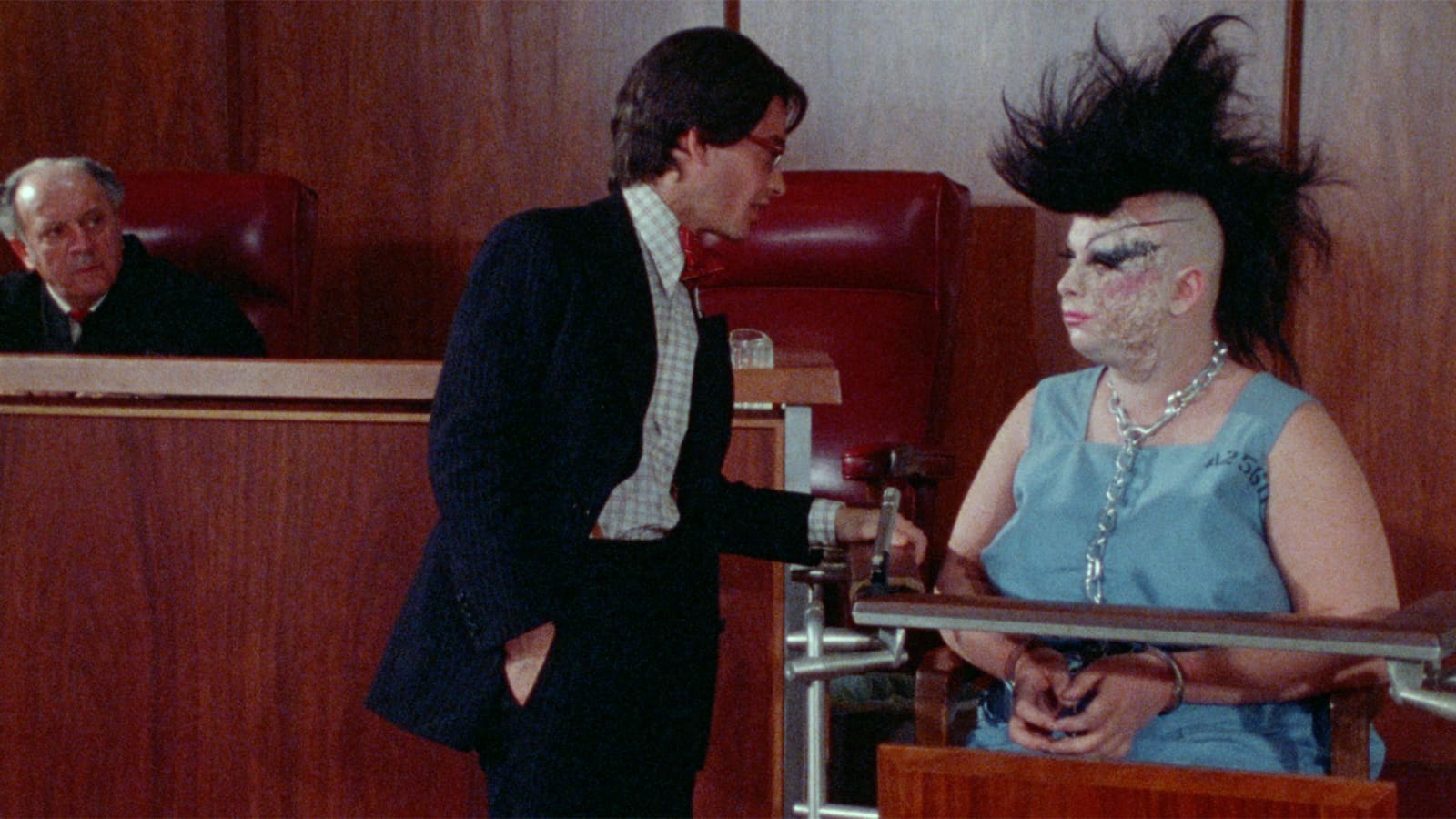
As a protagonist, Dawn is, in her own paraphrased words 'a thief, a shitkicker, and she'd like to be famous.' She gets that wish in a way that plays to the theft and shitkicking care of Donald and Donna Dasher, (David Lochary and Mary Vivian Pearce, both playing batshit pretentious perfectly.) The Dashers are a preening couple who believe crime is art and see their latest muse in Dawn. The trio get on like gasoline and a blowtorch as Dawn's criminal antics gain her a following that dances between admiration and freakshow appeal. The line becomes especially blurred after Dawn is attacked and burned with acid – a cavalcade of fans are led by the Dashers into her hospital room to watch the removal of her bandages, the burns met with a wild admiration.

Dawn's fame is seemingly untouchable, as every act of violence draws more of a crowd. Even near the end of the movie when she strangles her own daughter to death, the act is met with wild applause. The crowds love all her artistic absurdity and cruelty, the illusion only breaking when she asks her infamous question “Who wants to die for art?, a question that gets enthusiastic volunteers until she opens fire. Once the audience realizes they can be effected, they quickly turn. Even the Dashers, Dawn's top enablers, are all too willing to throw her under the bus once the police arrive, getting away scot free as she's sent to the electric chair.


Again, there's something striking about watching this fifty years out and how familiar it still feels. It's not like this was unheard of at the time - the movie's opening titles include a dedication to Manson family member Charles 'Tex' Watson, after all (a choice Waters has since admitted he's not proud of). Watched in the cold light of 2021, however, after years of seeing people who have either built or attempted to build reputations for celebrity on anything from just pure shock value all the way up to involvement in criminal activities (I'm not gonna name names because we could be here for hours) it's hard not to be shocked, impressed, and even a little bit disturbed how well this holds up.

It's still a very entertaining and funny dark comedy, but damn if time hasn't made those laughs THAT much darker.

On that note, I'd say that's as good a spot as any to wrap up here.

I had hoped to get one more trip into Dreamland in before the end of the month (keep an eye out, that may be a wild card in the future!)

Time, however, marches on, and I'll be back here soon for a theme I will explain when the time comes involving not one, but two directors.


Till then!